
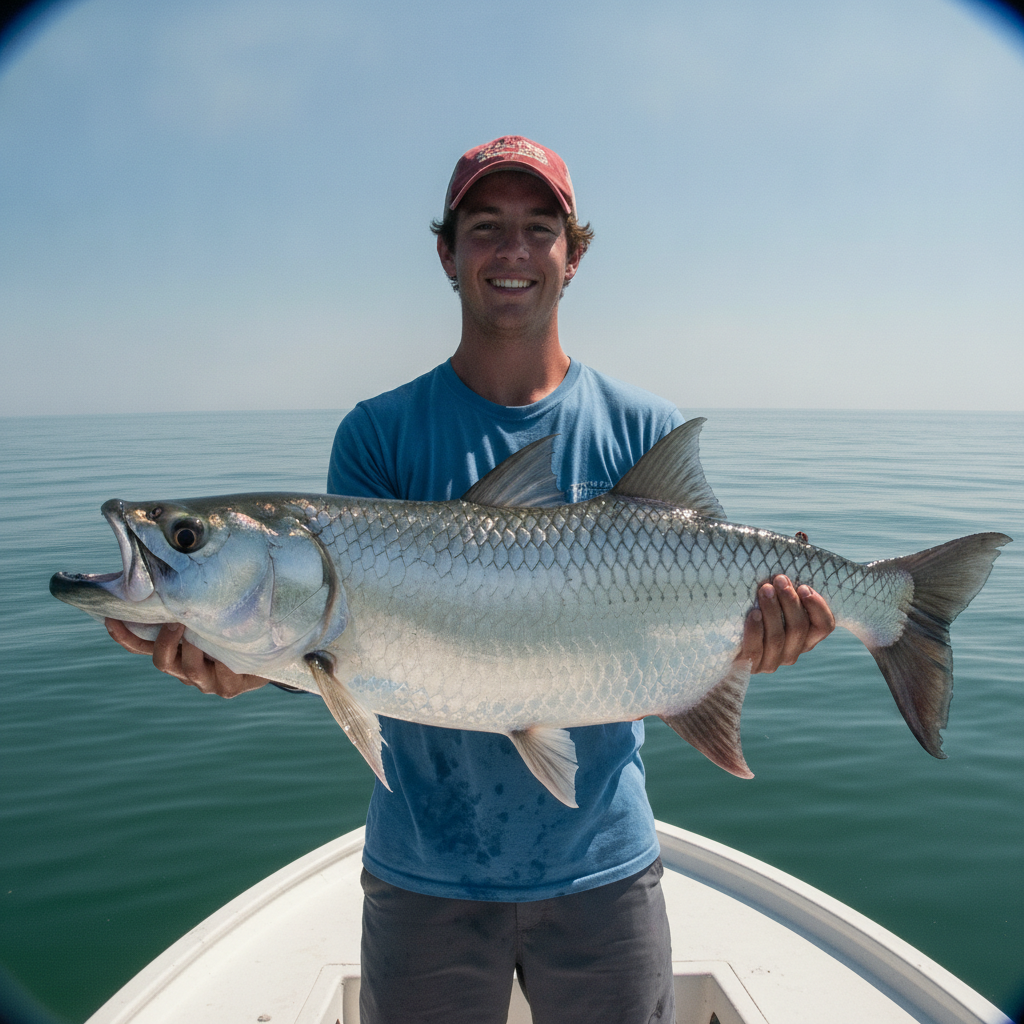
Most of what’s written about tarpon fishing focuses on the catch. Sixty-pound test, twelve-weight rod, the four-minute fight that feels like forty, the photograph in the boat. That stuff is real. But it’s downstream of the real skill, which is being in the right place on the right tide when the fish are actually there.
I’ve fished the Florida tarpon migration for going on three decades — most of it from Palm City out to the inlets, the Indian River Lagoon, and the Keys. The single biggest difference between anglers who consistently catch migrating tarpon and those who don’t is that the consistent ones understand the fish are MOVING. They’re not residents. They’re a parade. Your job is not to find a school. Your job is to be on the route, at the right hour, when the parade walks past your window.
Here’s what I’ve learned about how to do that.
Two migrations, one species
In Florida, “tarpon season” is really two overlapping patterns:
The northbound spring migration (March through June) is the famous one. Adult tarpon — 80 to 200+ pounds — work their way up the southwest Florida coast, around the tip of the peninsula, and up the Atlantic side, staging at passes and inlets along the way. Boca Grande, Homosassa, the Keys bridges, the southeast Florida beaches, the St. Lucie Inlet area — these are all migration choke points where fish stack up before or after a leg of the trip.
The summer-into-fall pattern (July through October) is more dispersed but no less productive. Fish are scattered along beaches and in deeper passes, feeding on bait that’s stacked up after the spring spawn. Big schools of mullet trigger blitzes. Some of my biggest fish have come from the September mullet run at Sebastian Inlet.
These two patterns require different tactics and different reads. The spring fish are TRANSIENT and moody — they’re traveling, they’re spawning, they’re not always feeding. The fall fish are feeding heavily, more aggressive, more willing to commit. Plan your trips with this in mind.
Reading the migration
The single most useful skill for tarpon fishing is learning to READ the migration in real time. Fish move with conditions, not the calendar. A cold front in early May can stall the migration for two weeks. A warm push can put fish on Stuart’s beaches three weeks early.
What to watch:
Water temperature. Tarpon are tropical fish. They want 72-82°F. When water on a beach climbs through the high 60s into the low 70s, the fish move in. When it drops back below 70 from a front, they leave. NOAA buoys 41008 (Grays Reef), 41009 (Canaveral 20NM), and 42036 (West Tampa) all publish real-time SST. Check these daily during the migration window.
Bait migrations. Tarpon follow bait. Schools of menhaden, mullet, threadfin herring, and pilchards moving up the coast pull the tarpon with them. Local bait shops know — sometimes before anyone else — when the mullet are pushing through. Spring threadfin runs around Stuart-Sebastian frequently arrive with tarpon attached.
Reports from your network. Charter captains share intel constantly. If you have ANY captain contacts, get on their text thread. The Boca Grande captains know two days before the spring fish hit Stuart. The Stuart captains know two days before the fish hit Jupiter. This is the single most valuable form of intel for tarpon fishing.
Reports from your eyes. Drive the beaches at dawn during the spring window. You can sometimes SEE the migration — strings of fish rolling on the surface, half a mile offshore, working north. If you’ve never seen it, you don’t forget it.
Where to fish — the choke points
Migrating tarpon don’t move in random patterns. They funnel through specific geographic features, year after year. The productive fishing positions, in order:
Inlets and passes. Where ocean meets bay, tarpon stack up. The current carries bait into the channel; the fish stage in the deeper holes just inside or outside the inlet. St. Lucie Inlet, Sebastian Inlet, Jupiter Inlet, Boca Grande Pass, Big Marco Pass — every famous tarpon fishery is built around an inlet or pass.
Beach guts and troughs. Tarpon traveling up the beach hold in the deeper trough between the first and second sandbars, working north or south depending on the leg of migration. From a boat 80-150 yards off the beach, in 10-15 feet of water, you’re sitting in the migration corridor.
Bridges with current. Where bridges cross deeper channels (the Florida Keys, Sebastian Inlet’s bridges, the IRL crossings), tarpon stage on the down-current sides to ambush bait being flushed through. The Bahia Honda bridge, the Long Key Channel bridge — these are legendary spots for a reason.
Channel intersections. Where a main channel meets a flat or a side cut, tarpon stage on the deep edge. Less famous than the bridges and inlets, but consistently productive once you find them.
What is NOT a tarpon migration spot, despite what people think: long flat sections of beach with no structure, the back of dead-end residential canals, anywhere the bottom is uniform sand with no relief. Migrating fish don’t stop in those places. They pass through.
Timing — when to be there
For migration fishing specifically:
Dawn and dusk are the best windows. Fish are rolling, feeding, visible. By 10 AM in late spring, the bigger fish often go deep and sulk.
Moving water is everything. Slack tide is dead tide for inlet and pass fishing. Plan to be on the water during the second hour of an outgoing or incoming tide for the strongest bite. If you can fish only one tide, the OUTGOING is usually slightly more productive at inlets — bait flushes out, fish stage to ambush.
Two days after a cold front is often the magic window in spring. Water clears, fish settle, the bite turns on hard for 36-48 hours before the next front pushes through.
Full and new moon spring tides push more bait through inlets. Strong current can shut down the bite mid-tide but the periods right around the strongest current are exceptional.
The three ways to catch them
I’ll skip the dozens of variations and give you the three approaches that actually catch migrating tarpon consistently. Different anglers will rank them differently, but all three work.
1. Live bait at the beach or pass
The volume approach. Anchor or drift along a beach or pass with live bait — mullet, crabs, threadfin, pinfish, depending on what’s running. A single hook through the lips on a 7/0-9/0 circle hook, leader of 60-100 lb fluorocarbon, free-lined with no weight or with a small egg sinker if current demands.
This is how most tournament tarpon are caught. It works because you’re presenting a real, struggling, scent-emitting baitfish in the path of fish that have been moving for hours and are looking for an easy meal.
Key tactics:
- Live bait must be LIVELY. A half-dead bait gets ignored. Fresh, well-aerated, swimming hard.
- Lip-hook through the upper jaw for surface baits; through the back near the dorsal for sinkers.
- Circle hooks REQUIRED in Florida for tarpon (since 2013). Non-negotiable. The fish will hook itself in the corner of the jaw on the pull — you don’t strike, you LIFT and reel.
- 20-30 lb mainline braid with the heavy fluoro shock leader. Heavier line is overkill and reduces casting distance.
2. Sight casting with crabs
The technical approach, my favorite. When fish are visible — rolling, daisy-chaining, cruising in clear water — pitch a small live crab (silver dollar size, hooked through the corner of the shell) on a 7-foot leader straight ahead of the lead fish. Let it sink slowly.
Crabs are tarpon candy. A tarpon that has been swimming north for three weeks and seen 600 live pinfish will commit to a crab in front of him because crabs in the surf zone mean the spring spawn is happening, which means the fish are programmed to eat them.
The challenge: you have to see the fish. You have to make a quiet presentation (no big plops). You have to pick the right fish in the school (usually the lead, NOT the school behind, because the lead fish hasn’t fed and the back-of-pack fish are following the leader). And you have to set the hook from a fish that often eats so subtly that you barely feel the pickup.
When it works, it’s the most rewarding way to catch a tarpon. When it doesn’t work, it’s frustrating in the way only sight fishing can be.
3. Flies, plugs, and artificials
The hardest, most patient approach. Migrating tarpon will eat flies and lures, but with much greater selectivity than they’ll eat live bait. The fish needs to be in a feeding window AND the presentation needs to mimic exactly what they’re tracking.
The fly fishing approach: 11 or 12-weight rod, floating or intermediate line, 60-80 lb fluoro leader with a 16 lb class tippet (or whatever current IGFA spec is — verify before tournament fishing). Tarpon Toad, Black Death, Cockroach patterns. Cast 3-4 feet in front of a moving fish. Strip the fly to imitate fleeing bait. Strike with the rod LOW and to the side (NEVER lift the rod tip on the strike — this is the most common mistake and pulls the fly out of the fish’s mouth).
The plug approach: a Yo-Zuri Crystal Minnow or a swim plug like the DOA Bait Buster, fished in the same retrieve as you’d work a striper plug. Around bridges and at inlets when fish are blitzing.
The fly and lure approaches are how the most committed tarpon anglers catch fish. They take more skill and more failed presentations to result in fewer fish — but the fish you catch this way mean more.
The fight
I’m not going to write a whole section on fighting tarpon — there’s volumes of material elsewhere. But three things you must know:
Bow to the tarpon when it jumps. A jumping tarpon is the iconic moment. The tarpon will throw the hook half the time it jumps if you don’t drop the rod tip and create slack as the fish becomes airborne. Watch your line; when the fish is committed to going up, lower the rod tip to the water and reel hard to maintain just enough tension to keep the hook seated.
Apply pressure, don’t be passive. Tarpon can be fought to exhaustion, but the fight needs to be active. Keep the rod loaded. Walk the boat around the fish. Don’t let the fish rest at any depth — that’s when it figures out what you’re doing.
Release the fish properly. Florida law requires tarpon over 40 inches to be released in the water — you cannot bring them in the boat. Take the photo with the fish in the water. Revive the fish by holding it boatside, head into the current, and let the water flow through its gills until the fish kicks free. This can take five to fifteen minutes for a big fish that fought hard. Don’t rush it. A drowned tarpon defeats the whole conservation ethic of the sport.
The conservation note
The Florida tarpon population is one of the great quiet success stories in saltwater fisheries management. In 1989, Florida banned the harvest of tarpon. Since then, the population has rebuilt. The fish you catch on the migration this spring is the descendant of fish that survived the harvest era. Some of them are 50-80 years old. Treat them accordingly.
The unspoken rules among committed tarpon anglers:
- Release every fish, every time.
- Don’t drag fish over 40 inches into the boat for any reason.
- Use circle hooks with bait.
- Revive every fish to a strong release.
- Don’t crowd other anglers on schools of fish (especially the daisy-chaining schools in the Keys).
- Don’t fish a school relentlessly — move on after a few shots so the school stays calm.
The fishery exists because of these ethics. Pass them on.
What a great day looks like
A great migration tarpon day for me means three or four fish hooked, one or two landed and released. NOT a 10-fish day. The fish are big, the fights are long, and the goal is to engage with the migration, not to crush a number.
The best single day I ever had on migrating tarpon was a third week of May at Stuart’s beaches, 2014. Water clean, light north wind, fish rolling 200 yards off the bar. We poled the boat into a school, hooked a fish on the second cast — a 130-pounder that jumped seven times. Released it after 35 minutes. Saw the school again. Hooked another at 150 pounds — released after 50 minutes. By 9 AM the wind had built and the fish dropped. Two fish landed, four hooked, both released strong. Drove home grinning the whole way.
That’s the standard. The migration is generous when you read it right. But it requires you to be there at the right hour, in the right water, with the right offering — and to respect the fish enough to put them back stronger than you found them.
Dennis Suler is a career outdoors writer and lifelong angler. He spent six years on the editorial staff of The Fisherman magazine as a field editor and managing editor — first editing the New Jersey reports section, then managing editor of the Mid-Atlantic edition. He also served as managing editor of Boater’s Digest magazine. He’s a member of the Outdoor Writers Association of America and writes for fishing.digital — covering 40+ U.S. fishing destinations with weekly reports, location guides, and feature articles.
This article is part of fishing.digital’s Florida Atlantic regional coverage. For weekly reports across Stuart, the Florida Keys, Palm Beach, Boca Grande, and the rest of the Florida tarpon migration, visit fishing.digital/newsletter and subscribe to fishing.digital Florida Atlantic Weekly.
Planning a trip to Florida Keys?
This report tells you what happened. ReelAI tells you what to do about it — a briefing for your date, your target species and how you're fishing, built from our reports plus live NOAA and USGS data.
Powered by ReelAI — fishing.digital's intelligence layer. Answers are generated from fishing.digital reports and public NOAA, NWS and USGS data, and may be incomplete or out of date. Regulations and marine safety information are summaries only; always confirm with the responsible authority before you fish.