
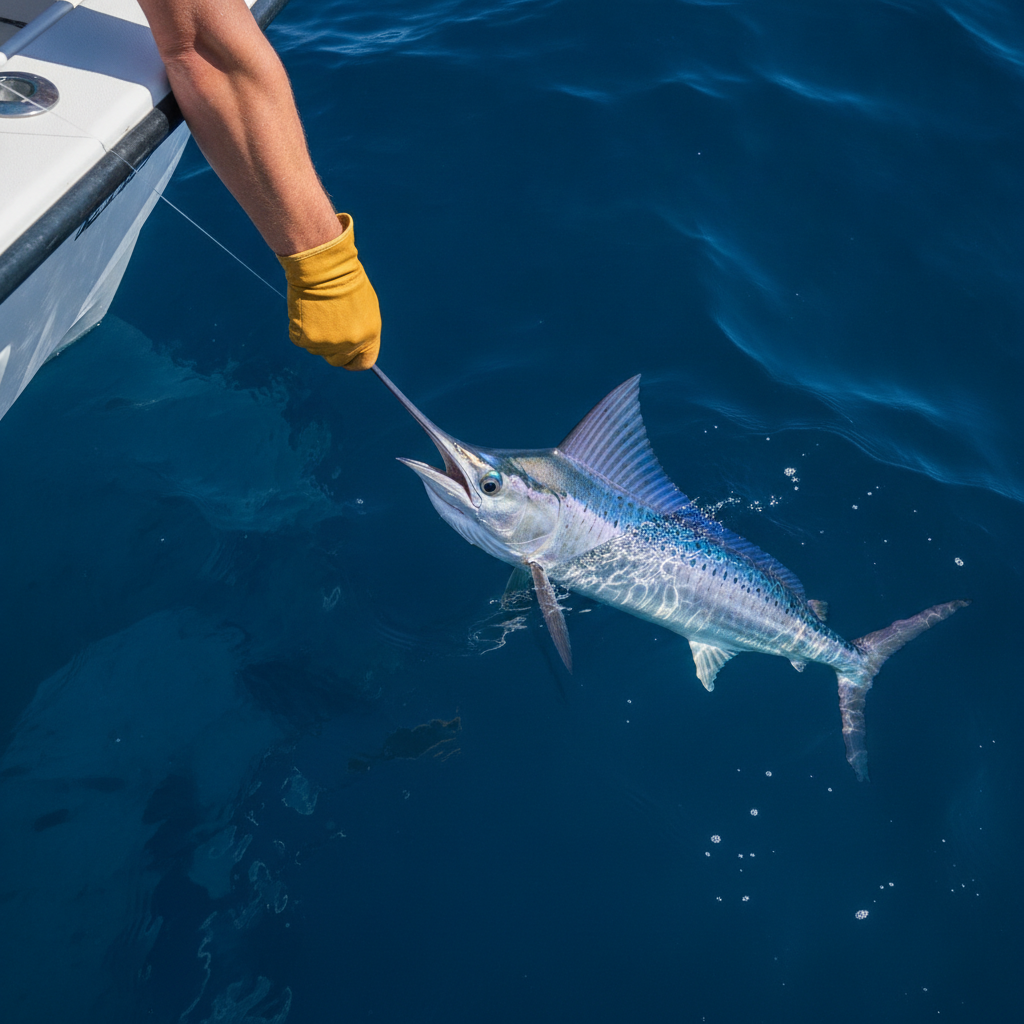
White marlin (Kajikia albida) are the signature offshore billfish of the Mid-Atlantic — smaller than blue marlin, far more abundant, and pound for pound the most acrobatic fish that swims off the East Coast. A 60-pound white will tail-walk fifty yards across a flat-calm canyon edge and throw a bait three times before a crew gets a hand on the leader. They are the billfish Mid-Atlantic crews actually expect to see, and the species the region’s entire offshore tournament culture is built around.
Where white marlin live
White marlin range across the tropical and subtropical Atlantic, but the fishery that matters to most American anglers runs along the Gulf Stream from Cape Hatteras to southern New England between July and September.
The productive ground is the canyon system along the edge of the continental shelf:
- Hudson Canyon — the New York and New Jersey fleet’s home water
- Wilmington and Baltimore Canyons — the core of the Ocean City and Delaware fishery
- Washington and Norfolk Canyons — Virginia and lower Delmarva
- Poor Man’s and Spencer Canyons — shorter runs that fish well in the right conditions
They also show off Florida, through the Gulf, and across the Caribbean, but nowhere in U.S. waters concentrates them like the Mid-Atlantic canyons in late summer.
Reading the water
Finding white marlin is mostly a water-quality problem. Look for:
- 72–82°F surface temperature, with the sweet spot usually in the mid-to-high 70s
- Temperature breaks and color changes — the harder the edge, the better
- Warm Gulf Stream eddies pressing up against the canyon rim, which stack bait against structure
- Bait and life — flying fish, squid, working birds, scattered weed lines. Marlin follow bait; clean blue water with nothing in it is just pretty.
Most crews leave the dock with satellite temperature and chlorophyll imagery already studied. The run is long and fuel is expensive; the boats that catch consistently are the ones that decide where they are going before they leave the inlet.
Tackle
White marlin are caught on lighter gear than any other Atlantic billfish, and the fishery rewards it.
| Component | Standard setup |
|---|---|
| Class | 20–30 lb conventional; 30 lb is the tournament standard |
| Rod | 6’6”–7’ conventional trolling rod, 30 lb class |
| Reel | Two-speed lever-drag in the 30-class — Shimano TLD 30, Talica 25, Penn International |
| Line | 30 lb monofilament, or 50 lb braid with a mono top shot |
| Leader | 60–80 lb fluorocarbon, 15–20 feet |
| Hook | 7/0–8/0 non-offset circle hook with natural bait |
Monofilament — not braid — is what most crews run straight through on the flat lines. The stretch matters when a fish eats close to the transom and the drag is light.
How the bite actually works
This is the part that separates crews that raise fish from crews that catch them.
A white marlin usually does not simply eat a trolled bait. It appears behind the spread, lights up — the fish flushes electric blue as it excites — and starts hitting the bait with its bill rather than swallowing it. Crews call this “whacking.” The fish may knock a ballyhoo three or four times before committing, and an angler who strikes on the first tap pulls the bait away from a fish that was about to eat.
The circle hook changes everything about this moment. With a J-hook, the angler set the hook. With a circle hook, the angler must not. The technique is:
- Drop back. When the fish knocks the bait, put the reel in free spool and let the bait fall back naturally, thumbing the spool just enough to prevent a backlash.
- Wait. Give the fish time to turn and swallow. Count it out — several seconds feels like a long time and usually is not long enough.
- Push the drag up and wind. No strike, no jerk. Come tight steadily and let the hook slide to the corner of the jaw and rotate home.
Done properly, circle hooks produce a corner-of-the-mouth hookup on the great majority of fish, which is why they are both a conservation win and a higher-percentage way to fish.
Techniques
Dredge and teaser fishing
The single biggest change in white marlin fishing over the last two decades. A dredge is a multi-armed array — rigged mullet, ballyhoo, or artificial shads and squid — pulled well below the surface off a heavy rod or an electric reel. It imitates a tight ball of bait rather than a single target, and it raises fish that never would have come up to a flat line.
Behind the dredge, run hookless surface teasers — squid chains, bowling-pin teasers, dredge birds. When a fish comes up on a teaser, the mate teases it toward the boat, pulls the teaser away, and the angler pitches a bait into the hole where it was. This is the highest-percentage way to catch a white marlin, and it is why good mates are worth what they are paid.
The trolling spread
Six to eight lines at 6–8 knots: naked and skirted ballyhoo on the flat lines and short riggers, sea witches or Ilanders on the long riggers, dredge and teasers underneath and behind. Vary bait size — dink ballyhoo often outproduce medium baits when fish are picky.
Pitch baits
Keep two rods rigged and ready at all times: one with a rigged ballyhoo, one with a live bait if you have them. When a fish shows on a teaser or in the spread, the pitch has to happen in seconds. Crews that fumble this lose most of the fish they raise.
Kite fishing
More common off Florida than in the canyons, but effective anywhere fish are concentrated. A live bait suspended from a kite stays on the surface, thrashing, with no leader visible in the water.
Baits and lures
- Rigged ballyhoo — the backbone of the fishery. Swimming or skipping, naked or under a small skirt.
- Sea witches and Ilanders — small, in blue/white, pink/white, and green/yellow, pulled ahead of a ballyhoo
- Artificial dredge baits — durable mullet and shad imitations that hold up all day
- Live bait — where available, a live tinker mackerel or small blue runner is hard to beat as a pitch bait
Seasonal pattern
| Period | What happens |
|---|---|
| June | First fish push into the southern canyons; numbers building |
| July–September | Peak. Best numbers Mid-Atlantic; tournament season |
| October | Fish move south and offshore as water cools; quality can stay high |
| Winter | Fishery shifts to the tropics and the southern Caribbean |
Regulations
Atlantic billfish are federally managed and the rules are strict. Current NOAA Fisheries requirements:
- Minimum size: white marlin 66 inches lower jaw fork length. Blue marlin 99”, roundscale spearfish 66”, sailfish 63”.
- Permit: a valid HMS Angling or HMS Charterboat/Headboat permit is required to fish for Atlantic billfish.
- Circle hooks: non-offset circle hooks are required when fishing with natural baits in HMS-permitted billfish tournaments.
- Reporting: landed Atlantic billfish must be reported to NOAA Fisheries.
- Sale is prohibited. Recreationally caught Atlantic billfish may not be sold.
Rules change. Confirm the current numbers in the NOAA HMS Recreational Compliance Guide before you fish, and note that roundscale spearfish are easily mistaken for white marlin — the two are managed at the same minimum size for that reason.
Release ethic
The overwhelming majority of white marlin caught in the United States are released, and the fishery’s culture strongly favors it. A fish that will not clear 66 inches — which is most of them — is released regardless. Circle hooks, short fight times on appropriate tackle, and leaving the fish in the water for the release all improve survival.
Frequently asked questions
How big is a typical white marlin?
Most are 40 to 80 pounds. A fish that clears the 66-inch minimum is a good one, and a 100-pounder is exceptional — the White Marlin Open’s winning fish are usually in the 70s and 80s.
Why circle hooks instead of J-hooks?
They hook fish in the corner of the jaw rather than the gut, which dramatically improves survival on release, and they are required with natural bait in permitted billfish tournaments. They also hook a higher percentage of fish, provided the angler resists the urge to strike.
What is a dredge and do I need one?
A dredge is a subsurface array of baits imitating a bait ball. It is the most effective fish-raising tool in the fishery. You can catch white marlin without one, but every serious canyon boat runs them.
How far offshore is the run?
From Ocean City or Cape May, typically 50 to 80 miles to the canyon edge. This is a serious offshore trip requiring a capable boat, proper safety equipment, and a real weather window.
When is the best time to go?
Late July through early September in the Mid-Atlantic. That is also when the tournaments run, which is not a coincidence.
More from fishing.digital
- White Marlin Open 2026 — results, dates and prize money
- How to Catch Blue Marlin — bluewater trolling and tackle
- How to Catch Yellowfin Tuna
- Ocean City, MD fishing reports
- Fishing Knots Guide — 15 knots every angler should know
Planning a trip to White Marlin?
This report tells you what happened. ReelAI tells you what to do about it — a briefing for your date, your target species and how you're fishing, built from our reports plus live NOAA and USGS data.
Powered by ReelAI — fishing.digital's intelligence layer. Answers are generated from fishing.digital reports and public NOAA, NWS and USGS data, and may be incomplete or out of date. Regulations and marine safety information are summaries only; always confirm with the responsible authority before you fish.
[…] our complete How to Catch White Marlin guide for full tackle, rigging, and technique […]