
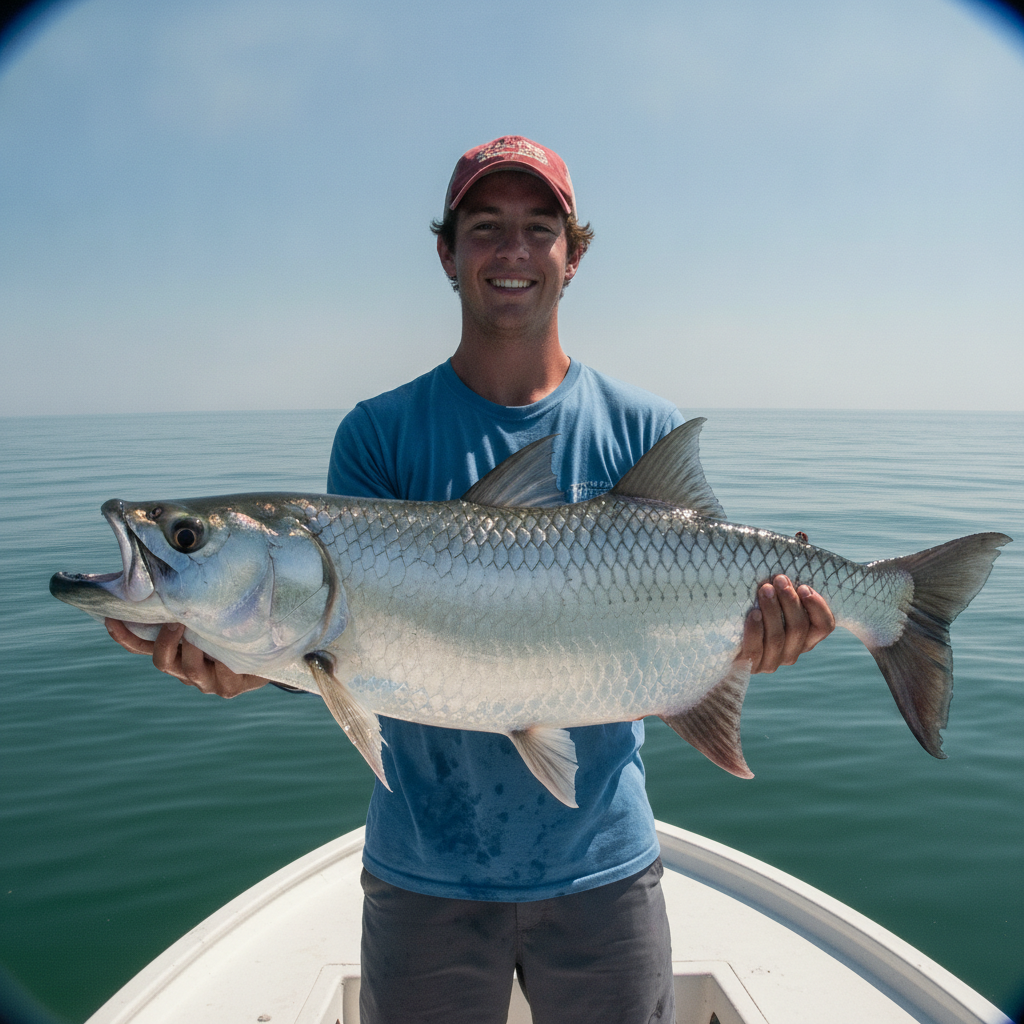
Tarpon (Megalops atlanticus) — the Silver King — is the ultimate inshore gamefish. Reaching lengths over 8 feet and weights exceeding 280 lbs, tarpon are famous for their explosive, gill-rattling jumps that can send a fly or lure airborne and dump line from the reel faster than almost any other inshore species. Catching a tarpon — particularly a large one — is a bucket-list achievement that draws anglers to Florida, the Keys, and beyond every spring.
Where to Find Tarpon: Range & Habitat
Tarpon range from Virginia to Brazil along the Atlantic coast, with the largest populations concentrated in Florida, the Gulf Coast, and Central America. In Florida, tarpon are found year-round in the warm south but are primarily migratory further north, arriving in numbers from April through July as water temps climb above 74°F. They inhabit coastal bays, tidal rivers, mangrove edges, Gulf beaches, and inlets — and are remarkably tolerant of low-oxygen, low-salinity water due to their ability to breathe air directly.
Best Tackle for Tarpon
Conventional Tackle (Boat Fishing)
Rod: 7–7’6″ heavy or extra-heavy conventional or spinning rod rated 30–80 lb. Penn Carnage, Ugly Stik Tiger, or similar heavy-duty sticks.
Reel: High-capacity spinning (5000–8000 size) or conventional reel with 300+ yards of 50–65 lb braid. Penn Spinfisher VI, Shimano Saragosa, or Daiwa Saltist.
Leader: 60–100 lb fluorocarbon, 4–6 feet. Tarpon have a hard, bony mouth — heavy leader is essential for abrasion resistance during a long fight.
Fly Tackle
12-weight fly rod, large-arbor saltwater reel with 250+ yards of 30 lb backing, weight-forward floating or intermediate line. 60–80 lb shock tippet is standard in the Keys.
Top Techniques for Catching Tarpon
Live Bait Fishing (Anchored or Drifting): The most productive method for large tarpon in rivers and bays. Free-line a live mullet, threadfin herring, or crab in the current near rolling fish. No weight or minimal weight — natural presentation is key. Use circle hooks for best hookup ratios and to reduce deep hooking.
Sight-Fishing (Flats/Beaches): Poling quietly over shallow flats in a skiff, spotting rolling or tailing tarpon and making a precise cast ahead of the fish. A lead of 6–10 feet is typical — cast to where the fish is going, not where it is. This is the quintessential Keys tarpon experience.
Inlet and Pass Fishing: During the migration, tarpon stack up in inlets and coastal passes. Position in the current and present baits directly to rolling fish or work the edges of the channel on a drift.
Bridge Fishing at Night: Large tarpon feed aggressively at bridge shadow lines after dark. Present a live crab or mullet on the up-current side and let it drift naturally through the shadow. This method produces some of the largest tarpon caught from shore in Florida.
Best Baits & Lures for Tarpon
- Live Mullet: The top tarpon live bait everywhere they occur. Hook through the back behind the dorsal fin. Scale matches bait to fish size — smaller mullet for juvenile tarpon, larger for adults.
- Live Crabs (blue, pass, swimming): The preferred bait in the Florida Keys and for night fishing under bridges. Florida blue crabs are widely available at Keys bait shops.
- Live Threadfin Herring/Pilchards: Excellent in open water situations. Rig on a 7/0–9/0 circle hook free-lined near rolling fish.
- Tarpon Flies (Cockroach, Black Death, Palolo Worm): Classic Keys flies on 3/0–5/0 saltwater hooks. The Palolo worm hatch (May–June, Keys) triggers an epic surface fly bite.
- Soft Plastic Swimbaits (Hogy, DOA Baitbuster): Effective for juvenile tarpon and when live bait isn’t available. Work slowly near surface-rolling fish.
- Topwater Plugs: 6–8″ pencil poppers and walking plugs can trigger explosive surface strikes from tarpon in shallow passes and rivers.
Seasonal Patterns: When to Fish for Tarpon
Spring (March–May): The tarpon migration begins. Fish arrive first in South Florida (February–March in the Keys), progressing north through April and May. April is peak month in the Stuart/Treasure Coast area.
Summer (June–July): Peak tarpon season throughout Florida. The Keys have the most concentrated sight-fishing. Tidal rivers along both coasts are loaded with fish.
Fall/Winter: Tarpon are present year-round in South Florida and the Keys. The fish in the tidal rivers and backcountry provide good fishing through winter.
Pro Tips for Tarpon
- Bow to the king: When a tarpon jumps, drop your rod tip toward the fish (“bowing”) to create slack and prevent the hook from tearing free. This is the single most important tarpon technique.
- Use circle hooks: For live bait fishing, circle hooks dramatically improve hookup rates and hook fish in the corner of the mouth for easy release.
- Keep the fish in the water: Tarpon are catch-and-release only in Florida (permit required to kill one). Revive the fish thoroughly before release — hold horizontally in the water, moving it forward and back until it swims away strongly.
- Position ahead of the school: Rolling tarpon are moving with purpose. Study the direction of travel and position your boat 100+ yards ahead of the school.
- Heavy drag from the start: Set your drag at 25–30% of line strength. Tarpon will use the initial run and jumps to throw the hook — maintaining pressure throughout is essential.
Regulations
Tarpon must be released in Florida unless you have a tarpon tag (required to keep any tarpon over 24 inches). Minimum 24 inches to even possess one. Handle with care — this fish is worth far more alive.
Looking for current tarpon fishing conditions near you? Browse our weekly fishing reports — updated every Thursday for 18 top fishing destinations.
Looking for current tarpon fishing conditions near you? Browse our weekly fishing reports — updated every Thursday. Browse all species how-to guides.
Best Tarpon Fishing Tackle
Affiliate disclosure: fishing.digital earns a small commission on qualifying purchases at no extra cost to you. We only recommend gear we’d use ourselves.
1. Penn Spinfisher VI 6500 Spinning Reel
High-capacity reel with 400+ yards of 50 lb braid capacity. The standard tarpon spinning reel. → Check price on Amazon
2. Ugly Stik Tiger Elite Spinning Rod 7ft Heavy
Heavy-duty rod rated for 30-80 lb. Handles the power runs and head-shaking jumps of large tarpon. → Check price on Amazon
3. Sufix 832 Braid 50 lb
Strong, round braid with excellent castability for tarpon fishing. → Check price on Amazon
4. Seaguar Blue Label 80 lb Fluorocarbon
Heavy fluoro leader for tarpon — their gill plates are abrasive. Never go lighter than 60 lb. → Check price on Amazon
5. Gamakatsu Octopus Circle Hook 7/0
Circle hooks dramatically improve hookup rates on live bait tarpon and reduce deep hooking. → Check price on Amazon
6. Hogy Harness Eel 9 inch
Effective artificial when live bait isn’t available. Slow, swimming retrieve near rolling fish. → Check price on Amazon
👉 Browse all fishing tackle on Amazon →
Planning a trip to Tarpon?
This report tells you what happened. ReelAI tells you what to do about it — a briefing for your date, your target species and how you're fishing, built from our reports plus live NOAA and USGS data.
Powered by ReelAI — fishing.digital's intelligence layer. Answers are generated from fishing.digital reports and public NOAA, NWS and USGS data, and may be incomplete or out of date. Regulations and marine safety information are summaries only; always confirm with the responsible authority before you fish.