
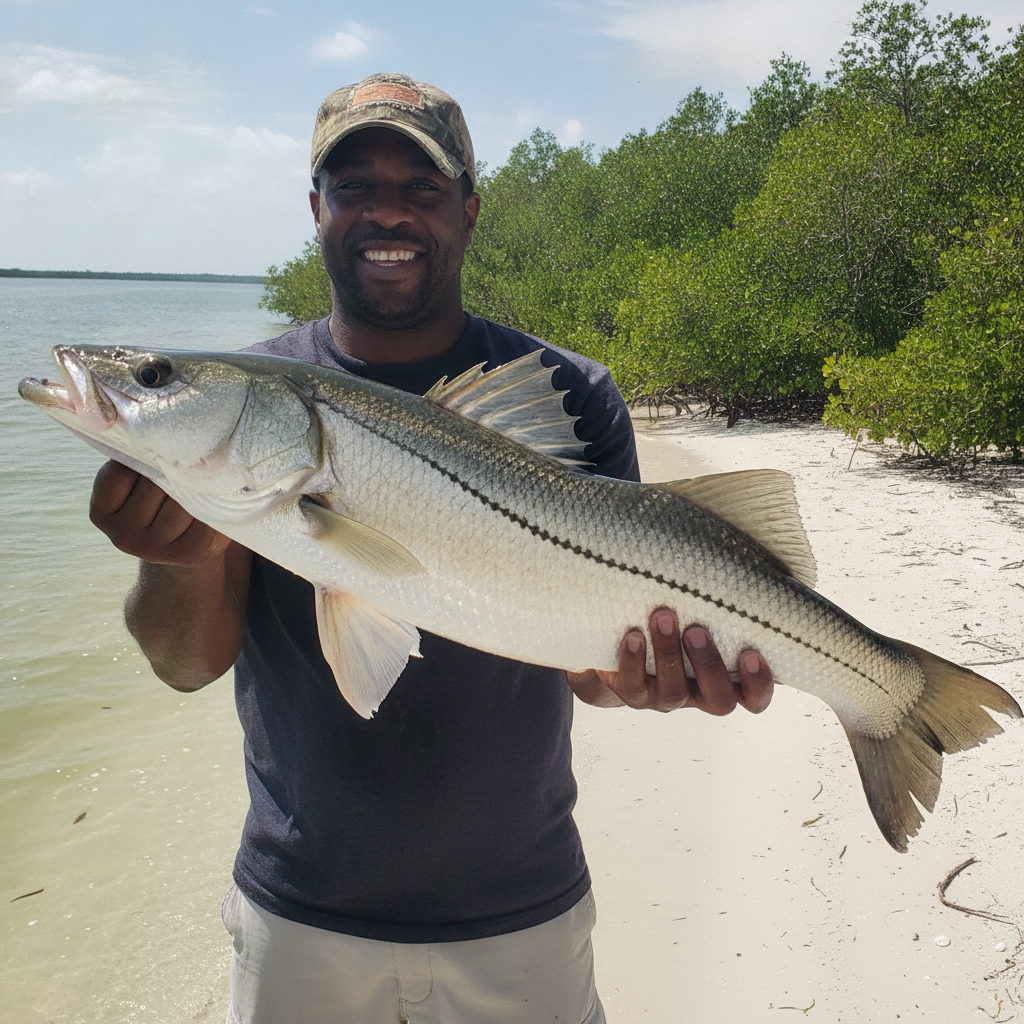
Snook (Centropomus undecimalis) are the fish that organize the fishing year in south Florida. They live where the water is complicated — against seawalls, under bridges, in the shadow line of a dock light, in the wash of a beach trough, up tannic creeks miles from salt — and they are built to use that complication against you. A snook eats, turns, and is in the pilings before you have finished registering the strike.
They are also readable. Snook are one of the most predictable inshore gamefish in North America once you understand three things: the temperature range they tolerate, the way they orient to current, and how their year is organized around the summer spawn. This guide covers all three, along with the tackle and presentations that convert on them.
Where snook live
Snook range along both Florida coasts — roughly from the Cape Canaveral area south on the Atlantic side and through the Gulf coast, with populations continuing into Mexico, Central America, and South America. The northern boundary is set by cold, not by geography: snook go lethargic below about 60°F and begin to die in the low 50s. A hard winter pushes the northern edge of the population south, and a run of mild years pushes it back north.
They are euryhaline, meaning they move freely between salt, brackish, and fresh water. That is why you find them in coastal canals, in retention lakes connected to tidal creeks, and well up river systems. On the St. Lucie watershed where I fish, snook hold in the South Fork and up in Bessey’s Creek and the Halpatiokee marsh — water that looks like bass water and holds fish that will break your rod on a piling.
The four structures that hold snook
- Shadow lines. Bridge lights and dock lights create a hard edge between lit water and dark water. Snook sit in the dark side, facing up-current, and eat things that get swept across the line. The fish are almost never in the light — they are in the dark just outside it.
- Current seams. Anywhere moving water meets slower water — a point, a bridge piling, the mouth of a creek dumping into a river — snook stage on the slow side of the seam and take bait that tumbles past.
- Mangrove and seawall edges. The productive spot is the corner where the vertical structure meets the bottom. A cast that lands a foot off the wall is usually a cast that does not get eaten.
- Beach troughs and inlet mouths. In summer, snook stack in the first trough along the beach and in the moving water at inlet mouths. These are sight-fishing situations in the morning and blind-casting situations after the sun gets up.
Tackle for snook
| Situation | Rod | Reel | Braid | Leader |
|---|---|---|---|---|
| General inshore / seawalls | 7’–7’6″ medium-heavy, fast | 3000–4000 spinning | 15–20 lb | 30 lb fluorocarbon |
| Docks and heavy structure | 7′ medium-heavy, fast | 4000 spinning or baitcast | 20–30 lb | 40–50 lb fluorocarbon |
| Beach and clear water | 7’6″ medium, fast | 3000 spinning | 10–15 lb | 20–25 lb fluorocarbon |
| Inlets and passes | 7’6″ heavy, fast | 5000 spinning | 30–50 lb | 50–60 lb fluorocarbon |
A 4000-class spinning reel on a 7-foot medium-heavy rod is the workhorse combination and covers most of what you will do. Our guide to choosing an inshore saltwater spinning reel covers the sizing and sealing decisions in detail.
Baitcasting gear earns its place in one specific situation: pitching under low docks and mangrove overhangs where a sidearm cast has to skip flat across the surface and stop on a dime. If that is most of your fishing, a 7-foot medium-heavy casting rod with 30-pound braid is the better tool.
Leader is not a place to economize
Snook have raspy gill plates and a mouth full of abrasive surfaces, and everything they live in — barnacled pilings, oyster bars, mangrove roots — is designed to cut line. Thirty-pound fluorocarbon is the practical minimum around structure and forty is better. Run 18 to 30 inches of it, connected with an FG knot or a double uni; both are covered in our fishing knots guide. On the beach and on bright, calm flats, drop to 20 or 25 pounds — the fish get noticeably leader-shy in clear water — and accept that you will lose a few.
Baits and lures
Live bait
- Mullet, 4 to 8 inches. The definitive snook bait. Free-lined or fished on the lightest weight that will hold, near structure. Match the size to what the fish are eating; during the fall mullet run, bigger is better.
- Pilchards and threadfins. The best bait for beaches and inlets, and the only one that lets you chum and fish at the same time. A few handfuls of live chum will bring snook out of a shadow line and into the open.
- Pinfish and croakers. Tough, active, and hard to kill in current — the right choice for bridges and deep dock fishing where a soft bait will not survive the drift.
- Live shrimp. Underrated. In winter, when snook are sulking in a deep river hole, a live shrimp on a light jighead worked slowly along the bottom will get eaten when nothing else will.
Artificials
- Paddle-tail swimbaits, 3 to 5 inches, on a 1/8 to 1/2 ounce jighead. The most versatile snook lure there is. White, chartreuse, and natural mullet patterns cover almost everything. Work them slowly along seawalls and let them fall on the up-current side of a shadow line.
- Suspending twitch baits. The MirrOlure MirrOdine is the pattern of record here — a small, flashy suspending bait that can be twitched and paused in the strike zone longer than any moving lure. Deadly along mangrove edges and in dock shadows where the fish want something that hangs.
- Walking topwater plugs. A walk-the-dog bait at first light or during the mullet run produces the most violent strikes in inshore fishing. Bone and white are the colors that matter.
- Weedless soft-plastic shrimp. Rigged weedless, these can be worked into mangrove roots that would eat any treble-hooked lure. The right tool for tight backcountry.
- Jig and soft-plastic combinations. A simple leadhead jig with a shad or shrimp body is the universal inshore lure — it catches snook, redfish, and seatrout on the same retrieve.
The presentations that work
Dock lights and bridge lights at night
This is the highest-percentage snook fishing there is, and it is almost entirely about the shadow line. Position up-current, well off the light — a boat that drifts into the lit water ends the spot. Cast past the edge of the light and bring the bait back across the line, or better, let it drift across naturally with the current. The eat usually comes within a foot of the boundary. If the fish refuse, go smaller and lighter before you go bigger.
We have covered this pattern in detail in snook fishing at night under dock lights.
Seawalls and residential shorelines
Work parallel to the wall, not perpendicular to it. Cast down the seawall so the lure tracks the corner where the concrete meets the bottom for as long as possible. Snook use these walls as ambush lanes, and a lure that spends five feet in the zone gets three times the looks of one that crosses it in one foot.
Inlets and passes
Inlets concentrate everything. Snook face into the moving water at the jetty tips, along the rock edges, and in the current seams behind bridge pilings. Outgoing water is generally more productive at Florida inlets because it flushes bait out of the back country, but the last of the incoming can be excellent on a clean tide. Stuart Inlet at the mouth of the St. Lucie is the piece of water I know best; the same reading applies at Sebastian, Jupiter, and every other cut on the coast. See reading the inlet at the Stuart crossroads for the tidal logic.
Beaches
Summer beach fishing is the closest thing to sight-fishing snook available to a shore angler. Walk the wash at first light with polarized glasses on and look into the trough for dark shapes moving against the sand. Cast ahead of a fish, never at it, and lead it by ten feet. Small white swimbaits, live pilchards, and topwater plugs all work. Wade quietly — beach snook feel footsteps.
Backwater in winter
When a front drops water temperatures, snook leave the open river and stack into whatever holds heat: power plant discharges, deep bends in tannic creeks, dark-bottomed canals. The fishing gets slow and precise. Small baits, slow retrieves, and repeated casts to the same spot. It is not exciting fishing, but it is reliable, and it is one of the few times of year you can put a big fish in a small space.
The snook year
Spring (March–May). Water climbs through the 70s and snook move out of winter refuges toward the coast, feeding hard to build condition for the spawn. Seawalls, bridges, and creek mouths all turn on. This is one of the two best stretches of the year.
Summer (June–August). Peak spawning season. Fish concentrate at inlets, passes, and beaches. Harvest is closed on both coasts during most of this window, and it should be — these are the aggregations that produce the next generation. Catch-and-release fishing is outstanding, particularly at dawn on the beaches and after dark at the inlets.
Fall (September–November). The mullet run. Enormous schools of finger mullet move down the coast and every predator inshore feeds on them at once. Topwater fishing during the run is the single most spectacular thing that happens in Florida inshore fishing. Find the mullet, find the snook.
Winter (December–February). Cold fronts push fish into thermal refuges. Fishing is slower and more technical. Live shrimp, small jigs, and patience. Watch the forecast: an extended run of nights below 50°F produces genuine cold kills.
Fighting and handling snook
- Set hard, immediately. Snook inhale and reject a bait faster than almost anything inshore. There is no delay in a snook hookset.
- Turn the fish before it turns you. The instant a snook feels the hook it runs for structure. Point the rod toward open water and apply everything the leader will take in the first two seconds. Fights are won or lost immediately.
- Never hold a snook vertically by the jaw. A big snook held by the lower lip with its body hanging can suffer spinal and jaw damage. Support the fish horizontally under the belly, or better, leave it in the water.
- Watch the gill plate. The trailing edge is genuinely sharp — sharp enough to cut a hand and to part a leader if the fish rolls into it.
- Revive properly in warm water. Summer water holds less oxygen. Hold the fish upright, facing into current, until it swims off under its own power.
Regulations
Snook require a snook permit in addition to a Florida saltwater fishing license, and the rules differ by coast. As published by FWC: on the Atlantic side — including the Indian River Lagoon and the southeast region — the slot is 28 to 32 inches total length, with closures December 15 through January 31 and June 1 through August 31. On the Gulf side the slot is 28 to 33 inches, with closures December 1 through the end of February and May 1 through August 31 in the Panhandle, Big Bend, Tampa Bay, and Sarasota Bay regions, extending through September 30 in Charlotte Harbor and the southwest region. The bag limit is one fish per person per day statewide.
Regional boundaries and closure dates are adjusted after cold kills and red tide events. Verify current rules at MyFWC.com before you keep a fish.
FAQ
What is the best time of day to catch snook?
Night and the first hour of daylight, by a wide margin. Snook are strongly nocturnal, and the dock-light and bridge-light bite after dark consistently outproduces the same water in daylight. On beaches, the first hour after sunrise is the window. Midday fishing is possible in moving water at inlets and under deep bridge shadow, but it is the hardest time to get bit.
What size leader do I need for snook?
Thirty-pound fluorocarbon is the minimum around docks, pilings, and oyster bars, and 40 to 50 pounds is appropriate in heavy structure or at inlets. On clear beaches and calm flats, drop to 20 or 25 pounds — snook are visibly leader-shy in clean water, and the trade is worth making when the alternative is no bites at all.
What is the best artificial lure for snook?
A paddle-tail swimbait on a jighead, in white or a natural baitfish pattern, is the most consistently productive artificial across the widest range of situations. A suspending twitch bait is the better choice when fish are holding tight to a shadow line and want something that hangs in the strike zone, and a walking topwater plug is the choice at dawn and during the mullet run.
Can you eat snook, and when is the season open?
Snook are excellent eating and are managed tightly for that reason. Harvest requires a snook permit, is limited to one fish per person per day, and is restricted to a narrow slot with multiple seasonal closures each year on both coasts. The closures protect the winter thermal aggregations and the summer spawn. Check current FWC dates before keeping a fish — they change.
Why do snook die in cold weather?
Snook are a subtropical species with limited cold tolerance. They become lethargic below roughly 60°F and begin to suffer mortality in the low 50s. A prolonged cold snap that drives shallow inshore water into the 40s produces documented cold kills, which is why the fish move into deep holes, canals, and warm-water discharges when a front comes through — and why FWC closes harvest in the middle of winter.
Do snook live in fresh water?
Yes. Snook are euryhaline and move freely between salt, brackish, and fresh water. They are regularly caught miles up tidal rivers, in coastal canal systems, and in connected lakes. Upriver fish tend to be less pressured and more willing to eat an artificial than fish on hard-fished dock lines.
Where to go from here
For current conditions, browse our weekly fishing reports, updated every Thursday across 40 destinations. For related species that share the same water and the same tackle, see how to catch redfish and how to catch speckled trout. And if you are fishing skinny water in bright sun, the right optics matter more than the rod — see our guide to choosing fishing sunglasses.
Snook tackle worth having
Affiliate disclosure: fishing.digital may earn a small commission on qualifying purchases at no extra cost to you. See our Affiliate Disclosure.
MirrOlure MirrOdine (17MR)
A small suspending twitch bait that hangs in the strike zone. The pattern of record for working mangrove edges and dock shadows on a slow twitch-and-pause. View on Amazon →
Rapala Skitter Walk, bone
A walking topwater plug for first light and for the fall mullet run. Bone and white are the two colors that consistently produce on snook. View on Amazon →
Paddle-tail swimbaits, 3–5 inch
The most versatile snook artificial. White, chartreuse, and natural mullet patterns on a 1/8 to 1/2 ounce jighead cover seawalls, shadow lines, and beach troughs.
Fluorocarbon leader, 20–50 lb
Carry three spools — 20 or 25 for clear beaches, 30 for general inshore, 40 to 50 for docks and inlets. This is the component that decides whether you land the fish.
4000-class spinning reel and a 7′ medium-heavy rod
The workhorse snook combination. See our inshore spinning reel guide for how to choose one.
Dennis Suler is a career outdoors writer and lifelong angler. He spent six years on the editorial staff of The Fisherman magazine as a field editor and managing editor — first editing the New Jersey reports section, then managing editor of the Mid-Atlantic edition. He also served as managing editor of Boater’s Digest magazine. He’s a member of the Outdoor Writers Association of America and writes for fishing.digital. He fishes the St. Lucie watershed and the Stuart crossroads from home in Palm City, Florida.
Planning a trip to Snook?
This report tells you what happened. ReelAI tells you what to do about it — a briefing for your date, your target species and how you're fishing, built from our reports plus live NOAA and USGS data.
Powered by ReelAI — fishing.digital's intelligence layer. Answers are generated from fishing.digital reports and public NOAA, NWS and USGS data, and may be incomplete or out of date. Regulations and marine safety information are summaries only; always confirm with the responsible authority before you fish.