
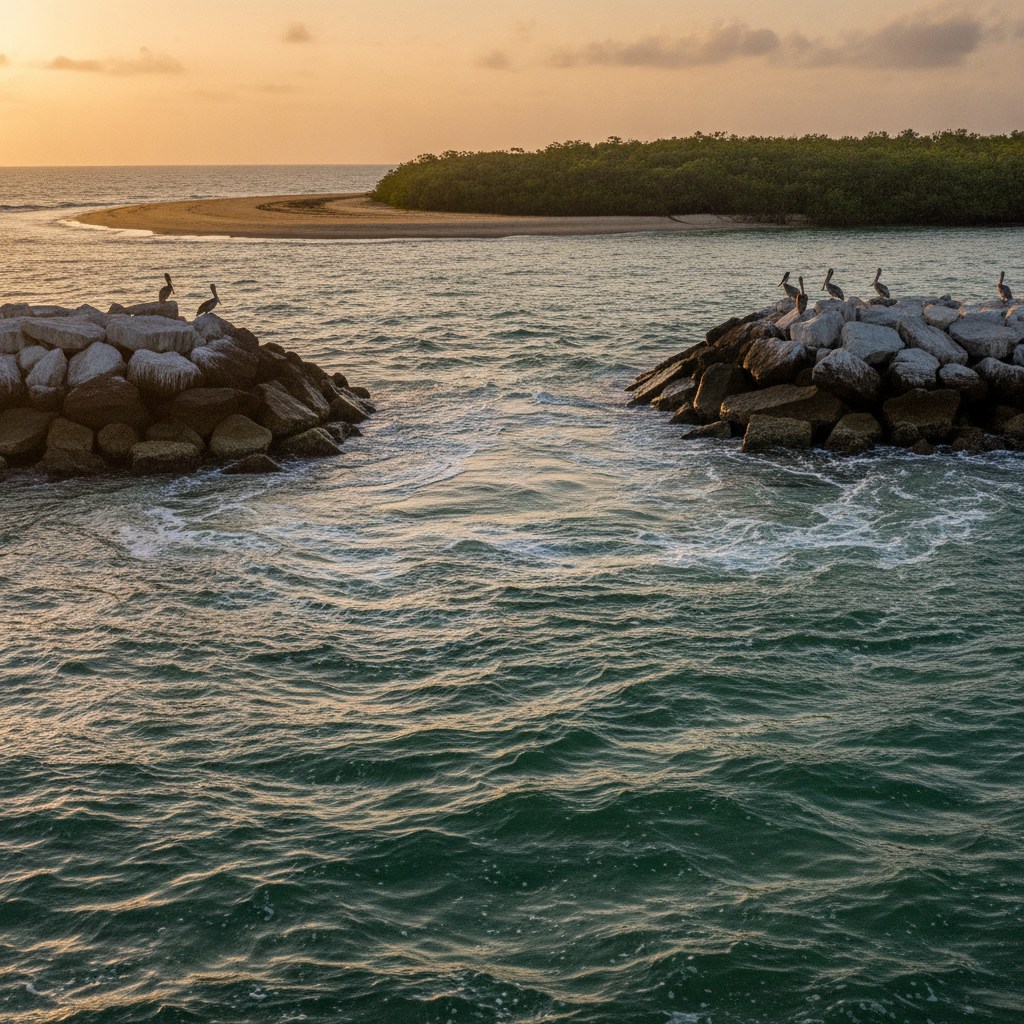
There is a particular piece of water roughly half a mile inside the St. Lucie Inlet on Florida’s Treasure Coast where four bodies of water converge: the St. Lucie River flowing in from the west, the Indian River Lagoon pushing down from the north, the southern Indian River extending toward the south, and the Atlantic Ocean pulling in from the east through the inlet itself. The locals call it the Crossroads. On a chart, it looks like an unremarkable widening of the waterway. On the water, in the right conditions, it’s one of the most productive single pieces of inshore fishing structure on Florida’s Atlantic coast.
I moved from New Jersey to Palm City in late 2024 and the Crossroads has become my regular working water — close enough that I can run an hour before sunrise from the South Fork ramp, fish productively for three or four hours, and be back at the desk by mid-morning. After eighteen months of fishing it consistently, I’ve stopped being surprised by what comes out of it. Tarpon, snook, redfish, jacks, bluefish, ladyfish, the occasional cobia, and in the right month a tripletail or a permit — all from the same general piece of water on different tides and different days.
This is what I’ve learned about reading it. It applies to the Crossroads specifically, but the framework — multiple water bodies converging, current acceleration, structure on the seams — translates to other Florida inshore intersections worth understanding.
What the Crossroads actually is
Geographically, the Crossroads is the confluence point where the St. Lucie River discharges into the broader estuary just inside the St. Lucie Inlet. The river drains roughly 850 square miles of central Florida through the system, including significant releases from Lake Okeechobee via the C-44 canal. The Indian River Lagoon — itself a 156-mile-long brackish estuary running from Volusia County south to Jupiter — meets the river at this point. The Atlantic enters through the inlet. The whole system is bounded by Sewall’s Point to the north, Hutchinson Island to the east, and the Stuart mainland to the west.
What this means tactically: four distinct water masses, each with its own salinity, temperature, and bait profile, mixing twice daily on the tide cycle. Predators stage at the seams. Bait gets pushed by current changes from one water type into another. The fishing is built on the transition zones.
The productive water is roughly bounded by:
- The southern tip of Sewall’s Point on the north
- The Sailfish Point seawall on the east
- The bridge spans of the St. Lucie River bridge complex on the west
- The northern reaches of the Hell Gate area on the south
Within that roughly half-mile-by-half-mile zone, there are at least eight distinct micro-fisheries depending on the tide stage, the wind direction, and the time of year.
The four water bodies and what they bring
To fish the Crossroads productively, you need to read which water body is dominating the local zone at any given time. The bait, the predators, and the productive technique change with the water source:
The Atlantic (incoming). Pushes cleaner, saltier, often clearer water through the inlet. Brings ocean bait — pilchards, threadfin, the occasional school of pinfish — and triggers the snook and tarpon push from the inlet rocks into the inner waters. The first three hours of the incoming are typically the productive offshore-pelagic window.
The St. Lucie River (outgoing dominated). Carries the freshwater outflow, including Lake Okeechobee discharge water, plus the bait the river holds — mullet (especially in fall), shad, freshwater-tolerant baitfish. On strong outgoing tides, this water dominates the western and southern parts of the Crossroads. The productive zone shifts to where the river water meets the still-saltier Lagoon water.
The Indian River Lagoon (northern push). The Lagoon water tends to push down on outgoing river tide and incoming ocean tide both. Brings the seagrass-based bait — pinfish, croaker, juvenile mullet, smaller pilchards — and the predators that follow them. The productive Lagoon-water fishing is on the northern edge of the Crossroads, around the deeper hole off Sewall’s Point.
The southern Indian River (extension). Quieter water, more residential, less current. The southern boundary of the Crossroads bleeds into this zone. Productive on the slack tides when the bigger Crossroads currents stall.
The mental model that’s served me is: figure out which water body is dominant in any given square of the Crossroads, what bait that water carries, and which predator will be staged at the boundary line of that water. The boundary line is where the fish are.
The structure that holds fish
Beyond the water-body dynamics, the Crossroads has specific physical structures that hold fish at every tide stage. The eight productive areas I’ve come to recognize, roughly from west to east:
1. The St. Lucie Bridge complex. The Roosevelt Bridge spans across the river just upstream of the Crossroads. Snook stage on the up-current side of the pilings on the outgoing tide. Big fish (28+ inches) hold tight to structure here in summer. Live mullet on heavy fluoro is the high-percentage approach.
2. The river mouth gravel bar. A submerged bar just inside where the river opens into the Crossroads. Holds snook and tarpon on the falling tide. Soft plastics fished slowly along the bar produce. Topwater at dawn produces when conditions are calm.
3. The Sewall’s Point flat. A shallow grass and sand flat extending south from Sewall’s Point. Holds resident snook in summer, redfish in winter and spring, seatrout year-round. Sight casting from a flats skiff is productive on the lower tides.
4. The Hell Gate channel. The deeper cut between the Sewall’s Point flat and the Sailfish Point area. Strong current on the moving tides. Tarpon move through here on the migration. Live crabs on circle hooks anchored in the channel produce daily during the May-July peak.
5. The Sailfish Point seawall. The eastern edge of the Crossroads. Snook stack on the seawall structure on the moving tides, especially the falling tide that pushes them tight to the wall. Skipping soft plastics under the dock structures along the wall is the technique.
6. The Manatee Pocket entrance. A small inlet leading to the southern marina area. Often holds a school of smaller snook (slot-class) and the occasional bigger fish on the moving tides. Live shrimp on light tackle.
7. The inlet jetty rocks. The St. Lucie Inlet jetties themselves, just east of the Crossroads. Heavy structure, big snook in summer, big jacks year-round, the occasional tarpon during migration. Heavy tackle required.
8. The Crossroads hole. A deeper basin (15-18 feet) in the center of the Crossroads itself. Holds bigger predators during the heat of the day and through the night. Live mullet or threadfin drifted through the hole with the tide produces.
Each of these eight spots fishes differently at each of the eight tide stages (early outgoing, mid outgoing, late outgoing, slack low, early incoming, mid incoming, late incoming, slack high). That’s 64 distinct fishing scenarios within a half-mile of water. The local knowledge is what tells you which scenario is productive on any given morning.
What I’ve learned about the timing
A few specifics that took the first eight or ten trips to internalize:
The first hour of any tide change is gold. Whether it’s the start of the incoming or the start of the outgoing, the first hour of moving water after slack tends to be the most concentrated bite. Fish that have stalled out during slack are repositioning. Bait that was holding gets pushed. Predators that were resting start hunting.
The Atlantic-incoming-on-a-falling-river tide is the magic combination. This happens regularly because the river drains constantly while the ocean tide oscillates. When the incoming Atlantic tide is pushing against an outgoing river flow, you get a hard convergence line right in the middle of the Crossroads. Bait stacks at the boundary. Predators feed.
The dark phases of the moon fish harder than the bright phases. This isn’t unique to the Crossroads — it’s true across most of South Florida inshore. But the Crossroads in particular has dramatic dark-moon outgoing tide bites where the entire complex turns on for a forty-minute window. The most consistent big-fish trips I’ve had have been on the new moon or quarter moon outgoing.
Cold fronts trigger windows. A front pushing through Treasure Coast (typically October through March) drops water temperatures, concentrates fish at thermal refuges (the deeper hole, the bridge structure that absorbs sun, the south-facing protected basins), and creates feeding windows in the first 24-48 hours after the front passes. Front days themselves are typically slow; the day-after-front is the producer.
The afternoon thunderstorm window in summer is real. From June through September, the daily storm pattern produces a window roughly 30-45 minutes before the storm hits when fish feed aggressively. The barometric pressure drop seems to trigger it. The window closes when the rain actually arrives. The afternoon storm pattern means dawn fishing and that pre-storm window are the two productive periods of the day in summer.
Tackle for the Crossroads
I run three setups depending on the day’s target:
Light: 7′ medium-fast spinning rod, 3000 reel, 10-15 lb braid, 20 lb fluoro leader. For snook on the dock lights, light-tackle bait fishing on the grass flats, schoolie tarpon in the calmer mornings.
Standard: 7’6″ medium-heavy spinning rod, 4000-5000 reel, 20-30 lb braid, 30 lb fluoro leader. The all-purpose Crossroads rig. Covers slot snook, big redfish, smaller tarpon, the general species mix.
Heavy: 7′ medium-heavy to heavy spinning rod, 5500-6500 reel, 50 lb braid, 60-80 lb fluoro leader. For tarpon during the migration, bigger snook around the bridge structure and the jetty rocks, big jacks. The fish that head for structure require breaking strength.
Lures I keep in the boat at all times: a handful of paddle-tail soft plastics (DOA C.A.L., Z-Man) in white and natural colors with 1/4 oz weedless jigheads, two or three suspending twitch-baits (MirrOdine, Yo-Zuri 3D), one topwater walking plug (Spook Jr.), one larger surface plug for tarpon (a Yo-Zuri Hydro Pencil or similar), and a gold spoon. That kit covers 90% of what comes up.
Live bait is the high-percentage approach for the bigger fish — live mullet, threadfin, and pilchards from the bait shops at Manatee Pocket or Sandsprit Park.
A note on the water
The St. Lucie watershed has been the center of a long political and environmental battle over Lake Okeechobee discharge water and its effects on the river and the Indian River Lagoon. When the Army Corps releases water from the lake through the C-44 canal, the resulting freshwater inflow can dramatically alter Crossroads salinity, drop bait populations, and trigger algae events that hurt the fishery.
The years I’ve been here have included both productive and difficult periods. The local fishing community — captains, recreational anglers, and conservation groups like the Rivers Coalition — has been active in advocating for water management that prioritizes estuary health. The fishery’s long-term future depends on the politics as much as on biology.
This is the kind of context that matters to anglers who care about the water beyond a single trip. The Crossroads is a real place with real environmental pressures, and the easiest way for visiting anglers to be good guests is to follow regulations, release fish carefully, and pay attention to which local conservation groups are doing the work.
Final thought
I came to the Crossroads as a Northeast angler used to fishing tides on water that ran inlet-to-bay-to-ocean in a more linear way. The Crossroads doesn’t fish like that. It’s a four-way intersection where the productive water shifts every two hours and the same spot that produced at 8 AM is dead at 10 AM and producing again differently at 3 PM.
That complexity is also the appeal. After eighteen months of fishing it consistently, I’m still learning. There are tide-and-moon combinations I haven’t fully figured out. There are bait dynamics in the spring that I’m watching this year for the second time. The water is generous to anglers who put in the time to read it.
For visiting anglers coming through Stuart, the Crossroads is worth a half-day with a local captain. The captains who fish this water for a living — the Joel Brandenburg-era operations, the various Sandsprit Park-based guides — know the eight zones and the sixty-four scenarios by feel. A morning trip with the right captain compresses a season of learning into a single day. Once you’ve seen how the water works, DIY trips on subsequent visits become productive.
For Florida residents who haven’t fished this stretch, the Crossroads is a stop on every Treasure Coast tour. The combination of accessibility (close to ramps, sheltered from weather), species variety (the year-round species mix is broader than most single locations), and the visual quality of the water (mangroves, the inlet, Sewall’s Point homes, the Sailfish Point complex) makes it a memorable piece of water beyond the catching.
It’s been my home water for eighteen months now. The longer I fish it, the more there is to read.
Dennis Suler is a career outdoors writer and lifelong angler. He spent six years on the editorial staff of The Fisherman magazine as a field editor and managing editor — first editing the New Jersey reports section, then managing editor of the Mid-Atlantic edition. He also served as managing editor of Boater’s Digest magazine. He’s a member of the Outdoor Writers Association of America and writes for fishing.digital — covering 40+ U.S. fishing destinations with weekly reports, location guides, and feature articles.
This article is part of fishing.digital’s Florida Atlantic regional coverage. For weekly reports across Stuart, the Indian River Lagoon, Palm Beach, and the rest of Florida’s Treasure Coast, visit fishing.digital/newsletter and subscribe to fishing.digital Florida Atlantic Weekly.
Planning a trip to Indian River Lagoon?
This report tells you what happened. ReelAI tells you what to do about it — a briefing for your date, your target species and how you're fishing, built from our reports plus live NOAA and USGS data.
Powered by ReelAI — fishing.digital's intelligence layer. Answers are generated from fishing.digital reports and public NOAA, NWS and USGS data, and may be incomplete or out of date. Regulations and marine safety information are summaries only; always confirm with the responsible authority before you fish.