
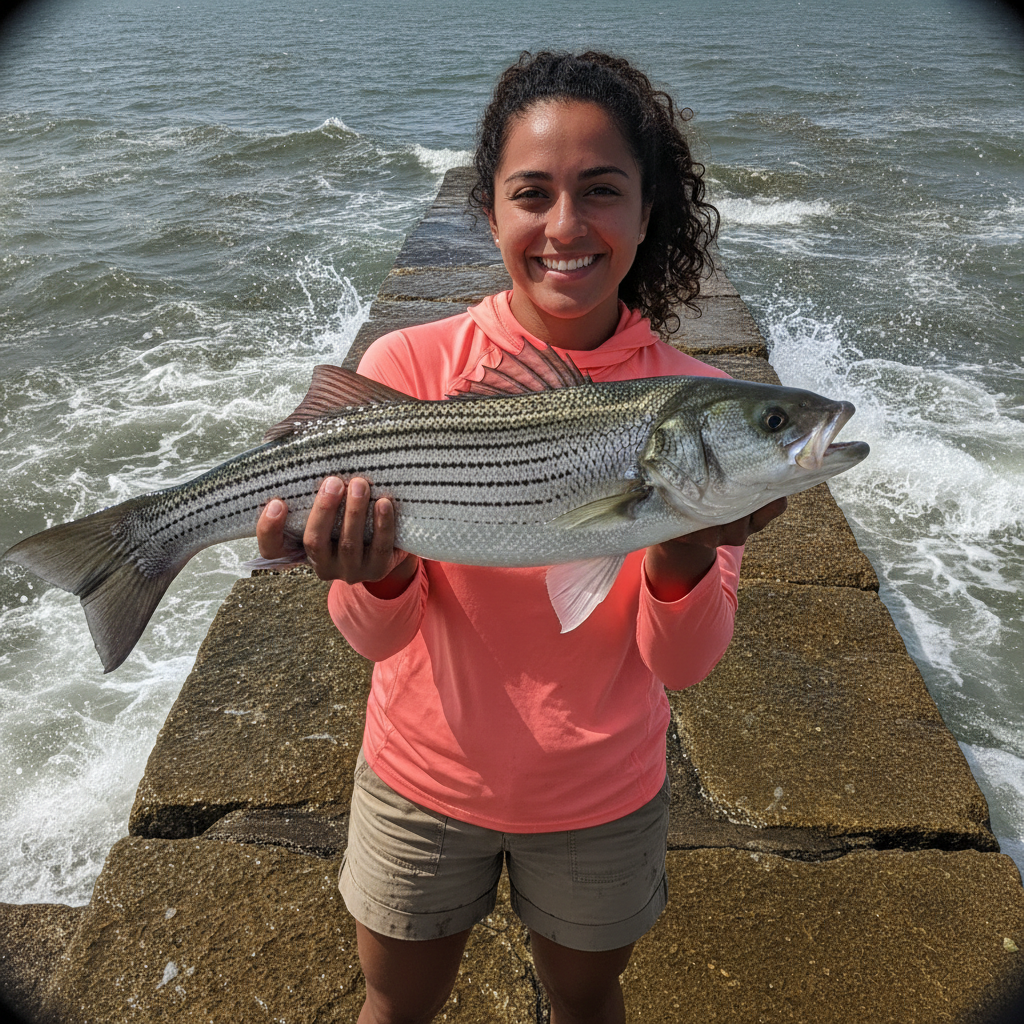
Striped bass (Morone saxatilis) — rockfish in the Chesapeake, linesiders on the beach, stripers everywhere else — are the fish the Northeast and Mid-Atlantic organize their season around. They range from the Carolinas to the Canadian Maritimes, they move on a schedule you can plan a year against, and they can be caught from a jetty with a bucktail or from a boat with a fifty-pound live bunker. The fall run, when big fish push down the beaches from Montauk to Hatteras, is the most anticipated event in American saltwater fishing.
They are also a fish that rewards understanding over equipment. A striper is a current-oriented ambush predator with a strong preference for low light. Almost everything that works on them follows from those two facts.
Range, stocks, and migration
The coastal migratory population is produced primarily by three spawning stocks: the Chesapeake Bay, which contributes the majority of the fish; the Hudson River; and the Delaware. Fish spawn in fresh and brackish river water in spring, then disperse. Larger fish run north along the coast through the summer and return south in fall. Some populations — notably fish in the upper Chesapeake and in a number of coastal rivers — are effectively resident and do not make the coastal run.
What this means practically is that striper fishing on any given piece of water is a timing problem. The fish are either there or they are not, and the difference between a blank day and the best day of your year is often a week.
The striper year
Spring (March–May). Pre-spawn and post-spawn fish stage in the Chesapeake, the Hudson, and the Delaware. Catch-and-release fishing in the rivers can be exceptional. The coastal migration follows warming water north; fish reach New Jersey in April, Long Island and southern New England in May. Bunker schools arriving on the coast set the whole thing in motion. Our field guide to the Chesapeake spring run covers how the light cycle drives the bite.
Summer (June–August). Fish are distributed from the Chesapeake to the Maritimes. Cape Cod, Buzzards Bay, Narragansett Bay, Block Island, Montauk, and the Maine coast all fish well. Daytime fishing gets hard as water warms and the fish go deep or nocturnal; night fishing carries the season. See our Maine coast late-June guide and the Block Island rip.
Fall (September–November). The migration reverses and compresses. Bass, bluefish, and albies chase bait south along the beaches in a moving front. This is when surfcasters get their shots at genuinely large fish from shore. Peak timing moves south through the season — Maine and Cape Cod in September, Montauk and New Jersey in October and early November, Virginia and the Outer Banks into December.
Winter (December–February). Fish overwinter off the Virginia and North Carolina coast and in the deeper reaches of the Chesapeake. Most coastal fisheries are closed or unproductive.
Reading water for stripers
Stripers position where current does work for them. Learn to find these five things and you can fish new water competently on the first trip.
- Rips. Where current runs over a bar, a reef, or a ledge, it forms a standing wave with a slack pocket behind it. Bass hold in the slack and eat what tumbles over the edge. Block Island’s southwest rips, Race Point, and the bars off Monomoy are the famous examples; every tidal coast has smaller versions.
- Structure edges in moving water. Bridge pilings, jetty tips, breachway mouths, and channel edges all create current shadows. Fish the down-current side.
- Beach structure. Sandbars, cuts through bars, points, and the deep troughs alongside them. The place worth fishing is where water is moving through a gap, not the featureless stretch beside it.
- Bait concentrations. Bunker schools, sand eels on a shoal, mullet moving down a beach in fall, worm hatches on mud flats in June. Find the bait and the timing question mostly answers itself.
- Light lines at night. Bridges and lit docks in the Northeast produce the same shadow-line fishing that dock lights produce in Florida. Bass sit in the dark and eat what drifts through the light.
Tackle
| Setting | Rod | Reel | Line | Leader |
|---|---|---|---|---|
| Open beach surf | 9’–11′ medium-heavy to heavy | 5500–8000 spinning | 30–50 lb braid, 300+ yd | 40–60 lb mono or fluoro shock leader |
| Jetty and rocks | 9’–10′ medium-heavy | 5000–6000 sealed spinning | 30–50 lb braid | 50–60 lb, longer for abrasion |
| Boat, casting and jigging | 7’–7’6″ medium-heavy | 4000–6000 spinning or conventional | 20–40 lb braid | 30–50 lb fluorocarbon |
| Live-lining bunker or eels | 7’–7’6″ heavy, moderate-fast | 5000–8000 spinning or conventional | 40–50 lb braid | 50–80 lb fluorocarbon |
| Light tackle and schoolies | 7′ medium, fast | 3000–4000 spinning | 15–20 lb braid | 25–30 lb fluorocarbon |
Surf reels take direct water and belong to the sealed category — see our inshore spinning reel guide for what the sealing ratings actually mean. For the braid-to-leader connection, learn the FG knot or a well-tied double uni; both are covered in our knots guide.
Baits and lures
Natural bait
- Live bunker (menhaden). The best big-fish bait on the coast when bunker are around. Snag a bait from the school, drop it back, and wait. Circle hooks are required in most jurisdictions when fishing bait for striped bass — check your state’s rules.
- Live eels. The most consistently effective trophy bait, and the one that works after dark from a jetty, a boat, or a rock pile when nothing else will. Hook through the lower jaw and out an eye socket, cast, and retrieve slowly.
- Cut bunker and clams. The classic anchored-surf presentation on a fish-finder rig. Fresh bait matters more than most anglers admit. Clams are particularly good after a storm churns the bottom.
- Sand eels and worms. Local and seasonal, but during a worm hatch or when the fish are locked on sand eels, nothing else will get bit.
Lures
- Bucktail jigs, 1 to 6 ounces. The most versatile striper lure ever made. White or chartreuse with a pork rind, soft-plastic, or Gulp trailer. Fished in the Canal, in rips, along bridge pilings, and in the surf. Learn to fish one properly and you can catch stripers anywhere.
- Metal-lipped and jointed swimmers. The traditional Northeast night plug — a slow, deliberate wake across a rip or a beach trough. Nothing looks more like a struggling baitfish at two in the morning.
- Darters and needlefish. Rip and current specialists. A darter swung through the outflow of a breachway is a Rhode Island institution for good reason.
- Pencil poppers and surface swimmers. Daytime lures for breaking fish and for bunker schools. Loud, visible, and hard to fish badly.
- Large soft-plastic swimbaits, 6 to 10 inches. The modern substitute for a live eel and a genuinely good one. White and alewife patterns, fished slow and deep.
- Soft-plastic jerkbaits and eel imitations. Versatile enough to swim, twitch, or dead-drift, and far easier to carry than a bucket of live eels.
- Trolling gear. Bunker spoons, umbrella rigs, tube-and-worm, and deep-diving plugs at three to five knots. Trolling covers water when fish are scattered and is the standard method on the open Chesapeake and in Long Island Sound.
Techniques by setting
The surf
Surfcasting is a water-reading discipline before it is a casting discipline. Walk the beach at low tide and photograph or memorize where the bars, cuts, and troughs are; then fish those places on a rising tide in the dark. Distance is less important than most beginners think — a great many big beach bass are caught within forty feet of dry sand, in the trough, at night.
Canals and breachways
Man-made and natural channels that connect two bodies of water produce enormous current, and stripers use it. The Cape Cod Canal is the extreme case: the bite is governed by the direction and stage of the tide, and being on the right side of the ditch at the right hour matters more than what you are throwing. See reading the east tide in the Canal.
Rips
Fishing a rip means positioning the boat up-current, casting or drifting a bait into the standing wave, and letting the current do the presentation. Jigs and eels fished on the down-current face of the rip get eaten. This is the fishing at Montauk, Block Island, and the Race, and it is the best way to catch a large fish in daylight.
Live-lining
When bunker schools are on the surface, the method is simple and devastating: snag a bunker with a weighted treble, let it swim back into the school on a circle hook, and hold on. The strike is usually a slow, heavy pull rather than a hit. Do not set the hook — let the circle do its work as the line comes tight.
Jigging and bottom fishing
In deeper water — the Chesapeake, Long Island Sound, the deeper rips — a bucktail or a soft-plastic on a leadhead worked with sharp hops along the bottom is the highest-percentage presentation, especially in daylight and in summer when fish sit deep.
Night fishing is the whole game
Large stripers feed heavily after dark and are far more catchable then, particularly from June through September. The gear does not change much; the approach does. Fish slower, fish quieter, and fish tighter to structure than you would in daylight. Use a red headlamp and use it as little as possible. A metal-lipped swimmer worked at a walking pace, or a live eel on a slow retrieve, will produce fish from water you could not buy a bite in at noon.
Handling and conservation
Striped bass are a rebuilding stock, and release mortality is the reason management keeps tightening. A few habits genuinely reduce it:
- Use circle hooks with bait. Non-offset inline circle hooks are required in most Atlantic coast jurisdictions when fishing with natural bait for striped bass, and they cut deep-hooking dramatically. Do not swing on the bite.
- Fight the fish quickly. A long fight on light gear is what kills a fish you intended to release, particularly in warm water. Use enough drag to end it.
- Keep the fish in the water. Support the body horizontally with wet hands. Never lift a large bass by the jaw alone and never lip-gaff a fish you intend to release.
- Cut the leader on a deep hook. Do not dig for it.
- Skip the photo in hot water. Above about 75°F, air exposure adds meaningfully to mortality.
Regulations
Atlantic striped bass are managed coastwide by the Atlantic States Marine Fisheries Commission, and states implement the measures individually. The coastal recreational baseline in recent years has been one fish per angler per day within a narrow slot — 28 to 31 inches on the ocean coast — with separate, smaller measures inside Chesapeake Bay. ASMFC has been working through Addendum III with the goal of further reducing removals beginning in 2026, and the resulting measures include seasonal closures that differ significantly from state to state.
Circle hooks are required when fishing with natural bait in most coastal jurisdictions. Because these rules have changed more than once in recent seasons and vary by state and by water body, verify current size limits, bag limits, and closed seasons with your state marine fisheries agency before every trip.
FAQ
What is the best bait for striped bass?
Live eels for trophy fish after dark, and live bunker when bunker schools are present on the coast. For anchored surf fishing, fresh cut bunker on a fish-finder rig is the standard. Among lures, a bucktail jig with a soft-plastic or pork trailer catches more stripers across more situations than anything else made.
What is the best time of day to fish for striped bass?
Night, and the hours around dawn and dusk. Large bass are strongly nocturnal from late spring through early fall, and the difference between a night tide and a midday tide on the same piece of water is often total. Daytime fishing is productive in rips, in deep water, and around breaking fish in the fall.
What tide is best for striped bass?
Moving water, more than any particular direction. Most spots have a stage that fishes best — the last two hours of the drop through a breachway, the first of the flood over a bar, the east tide in the Canal — and learning that stage for your water is worth more than any lure. Slack water is usually the worst hour of the cycle.
Do I have to use circle hooks for striped bass?
When fishing with natural bait, yes, in most Atlantic coast jurisdictions. Non-offset inline circle hooks became a coastwide requirement for bait fishing under ASMFC management to reduce release mortality. They are not required when using artificial lures. Confirm the specifics with your state agency.
What size rod and reel do I need for surf fishing stripers?
A 9- to 11-foot medium-heavy to heavy surf rod matched to the weight range of the plugs and jigs you throw, with a 5500 to 8000 class spinning reel holding at least 300 yards of 30- to 50-pound braid, and a 40- to 60-pound shock leader. Because a surf reel takes direct water, sealing matters more here than in any other striper application.
Why are striped bass regulations so restrictive right now?
The coastwide stock has been declared overfished and is under a rebuilding plan with a legally binding deadline. Several weak year classes followed the strong 2015 and 2018 classes, which means the fishery has been leaning heavily on a small number of cohorts. The narrow slot limits, one-fish bag, circle-hook requirement, and seasonal closures are all aimed at reducing total removals — including release mortality — until those year classes recover.
Where to go from here
For current conditions from Maine to the Outer Banks, browse our weekly fishing reports, updated every Thursday. For deeper reading on specific striper fisheries, see the Block Island rip, the Cape Cod Canal east tide, and Maine coast stripers in late June. And if you fish rips and beaches in daylight, the right polarized lens is worth more than another plug in the bag.
Dennis Suler is a career outdoors writer and lifelong angler. He spent six years on the editorial staff of The Fisherman magazine as a field editor and managing editor — first editing the New Jersey reports section, then managing editor of the Mid-Atlantic edition. He also served as managing editor of Boater’s Digest magazine. He’s a member of the Outdoor Writers Association of America and writes for fishing.digital.
Planning a trip to Striped Bass?
This report tells you what happened. ReelAI tells you what to do about it — a briefing for your date, your target species and how you're fishing, built from our reports plus live NOAA and USGS data.
Powered by ReelAI — fishing.digital's intelligence layer. Answers are generated from fishing.digital reports and public NOAA, NWS and USGS data, and may be incomplete or out of date. Regulations and marine safety information are summaries only; always confirm with the responsible authority before you fish.