
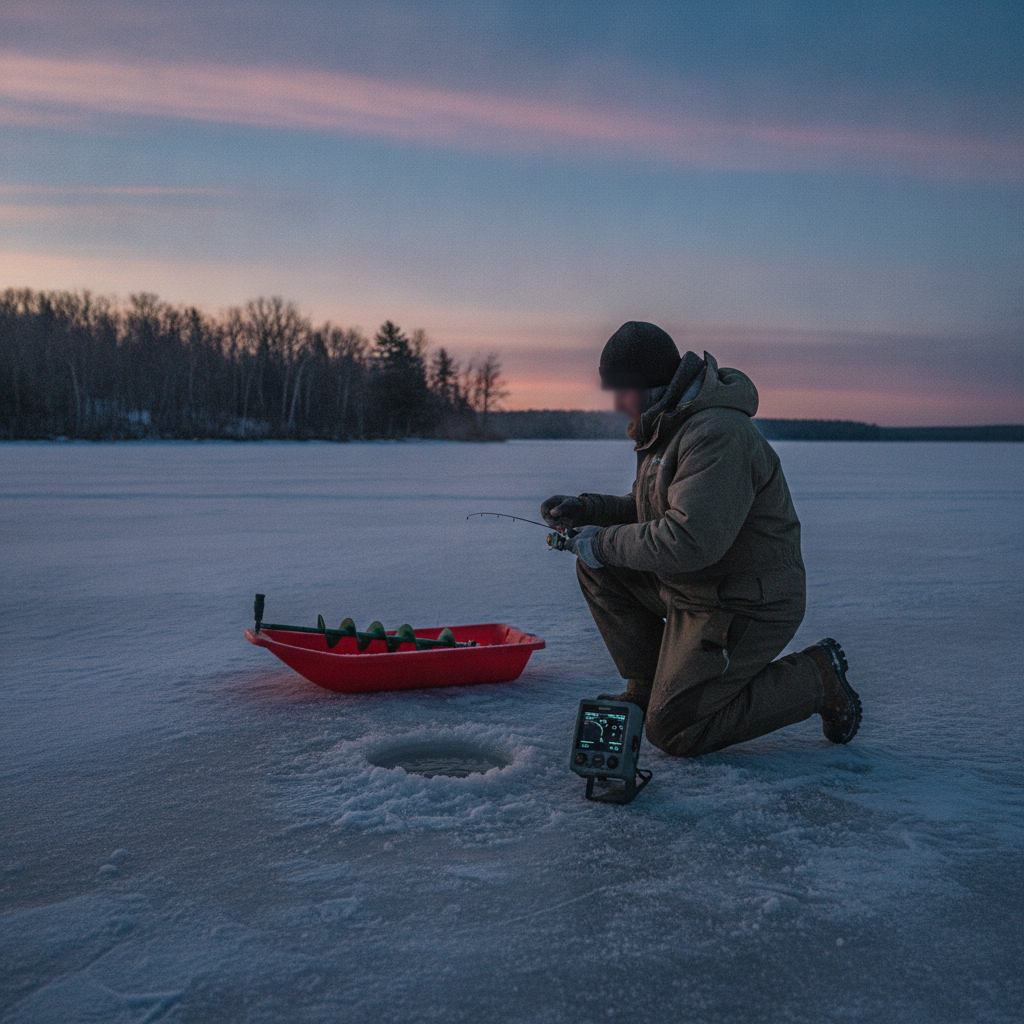
Ice fishing has a reputation as a cold, uncomfortable waiting game — an impression that couldn’t be further from the truth once you’ve drilled into a productive lake, dropped a jig to the right depth, and felt the sharp telegraphed strike of a walleye at 20 feet on a taut fluorocarbon line. The sport has been revolutionized in the past decade by advances in sonar (flashers and underwater cameras), portable shelters, lithium-powered augers, and refined jigging techniques that have transformed catch rates. Modern ice fishing is active, technical, and produces fish at rates that summer anglers on the same lakes often can’t match.
Affiliate disclosure: fishing.digital earns a small commission on qualifying Amazon purchases at no extra cost to you.
Ice Safety — The Non-Negotiable Foundation
- Always carry ice picks — two sharpened metal spikes worn around your neck that allow you to self-rescue from the ice if you fall through. They cost $15 and weigh nothing. Carry them every single trip.
- Never fish alone on early-season or late-season ice. The two most dangerous periods are first ice (November–December) and last ice (March–April) when ice is forming or deteriorating. Always fish with a partner during these windows.
- Test ice continuously as you move. Use a chisel or spud bar to test ice thickness as you walk — tap it ahead of you and listen for the solid thud of thick ice vs. the hollow sound of thin ice.
- Keep your vehicle off early-season ice. Even if foot traffic is safe, vehicles should wait for 12–15 inches of solid ice minimum.
- Know the location of open water leads and pressure cracks. Ice expands and contracts with temperature, creating predictable fractures. Note these features and avoid fishing adjacent to active pressure ridges.
Essential Ice Fishing Gear
Ice Auger
You need to drill through the ice — the size and type of your auger is one of the most important gear decisions. Hand augers (6-inch) work adequately in ice under 18 inches but become exhausting in thick ice. Electric augers (Ion, K-Drill, Strikemaster Lithium) are the dominant choice for modern ice fishing — quiet, lightweight, and capable of drilling dozens of holes on a single battery charge. Gas augers drill faster in very thick ice but are heavier, require fuel, and start poorly in extreme cold. Most ice anglers have graduated to electric in recent years.
Hole diameter: 6-inch holes for panfish and perch; 8-inch holes for walleye, bass, and trout; 10-inch holes for large pike and lake trout.
Browse electric ice augers on Amazon →
Sonar — The Game Changer
A sonar unit is the single biggest upgrade for new ice anglers. Seeing fish on the screen — watching them rise from the bottom to investigate your jig, watching their reaction to subtle lure movement — transforms ice fishing from blind guessing to a visual interactive sport. Flasher units (Vexilar, Humminbird Ice) provide real-time depth and fish position in a circular display. LCD sonar units (Garmin, Lowrance) display traditional graph-style sonar. Both work; flashers are faster and easier to read in bright light; graph units provide more historical context. Carry a 12V lithium battery to power units for a full day.
Browse ice fishing flashers on Amazon →
Shelter
Flip-over shelters (Clam, Eskimo, Frabill) are the most versatile ice fishing shelters for mobile anglers — fold flat for transport, flip open in seconds to form a wind and snow break, and sit two anglers comfortably. Hub shelters are larger, warmer, and better for stationary fishing but take longer to set up and break down. No shelter is appropriate for mild days (above 20°F with no wind) when you’re on well-studied ice and drilling multiple holes to stay mobile.
Rods, Reels, and Line
Ice fishing rods are short (24–36 inches) with sensitive tips for detecting light bites through the ice. The St. Croix Avid Ice and 13 Fishing Widow Maker are top mid-range options. Pair with a small spinning reel (or inline ice reel — better line lay, reduces line twist). Fluorocarbon line in 2–8 lb test is the standard mainline for ice fishing — it has near-zero stretch for sensitivity and near-invisible presentation in clear ice water. Never use standard monofilament in extreme cold — it stiffens and becomes unmanageable. Use monofilament labeled for cold-weather performance or fluorocarbon exclusively.
Ice Fishing Jigs
The most productive ice fishing presentations are small, subtle, and natural-looking. Tungsten jigs in 1/32–1/8 oz are the universal ice fishing lure — heavier than lead at the same size, they sink faster and jig more crisply. Key ice jigs: Jigging Rapala (wobbles and flashes when jigged, deadly on walleye and perch); Swedish Pimple (flash spoon, walleye and lake trout); Custom Jig and Spin Ratfinkee (panfish standard); Clam Drop jigs (versatile). Tip with waxworms, spikes (maggots), Eurolarvae, or small minnow heads for scent and action.
Browse ice fishing jigs on Amazon →
Finding Fish Under the Ice
Fish location under the ice follows the same principles as open-water fishing — find the structure, temperature, and bait that fish need, and you’ll find the fish. But the compressed, three-dimensional nature of ice fishing means these factors are even more critical.
- Points and humps: Underwater points and rocky humps consistently hold walleye, perch, and pike throughout winter. Find them with mapping apps (Navionics, LakeMaster) before you drill.
- Weed edges: Green weeds still produce oxygen under the ice and attract perch and pike. The edge of the last living weedbed, typically in 6–12 feet, is the most productive perch and pike location early and late in the ice season.
- Deep basins: Lake trout and walleye hold in the deepest basins of northern lakes in midwinter when oxygen and temperature are stable.
- Thermoclines: In large, deep lakes a thermocline still exists under the ice. Fish suspended at the thermocline depth can be located with sonar and targeted precisely.
Ice Fishing Technique — The Jigging Sequence
The most productive ice fishing presentation is a series of small, subtle jigging motions followed by extended pauses. The sequence: lift the rod tip 3–4 inches sharply (activating the jig), then drop it back quickly (allowing the jig to fall and flutter). Hold the pause for 5–10 seconds, watching the sonar for approaching fish. When a fish appears on the screen, slow your jigging or stop completely. Most strikes occur on the pause or as you resume gentle shaking. Resist the urge to jig constantly — the fish sees the lure moving all the time and ignores it. It’s the sudden stillness that triggers the strike.
Best Ice Fishing Lakes in the US
| Lake / Region | Top Species | State | Peak Month |
|---|---|---|---|
| Lake Erie (western basin) | Walleye (world’s best) | OH/PA/NY | January–February |
| Devils Lake | Walleye, yellow perch | ND | December–March |
| Lake Winnebago | Walleye, perch, sturgeon spearing | WI | January–February |
| Mille Lacs Lake | Walleye, perch | MN | January–February |
| Lake of the Woods | Walleye, sauger, lake trout | MN/Canada | December–March |
| Lake Champlain | Yellow perch, walleye, pike | VT/NY | January–February |
| Sebago Lake | Lake trout, salmon | ME | February–March |
| Green Bay (Lake Michigan) | Yellow perch, walleye | WI | January–February |
| Lake Gogebic | Walleye, yellow perch | MI | January–March |
| Upper Red Lake | Walleye — exceptional density | MN | January–February |
Planning a trip to Freshwater Fishing?
This report tells you what happened. ReelAI tells you what to do about it — a briefing for your date, your target species and how you're fishing, built from our reports plus live NOAA and USGS data.
Powered by ReelAI — fishing.digital's intelligence layer. Answers are generated from fishing.digital reports and public NOAA, NWS and USGS data, and may be incomplete or out of date. Regulations and marine safety information are summaries only; always confirm with the responsible authority before you fish.