
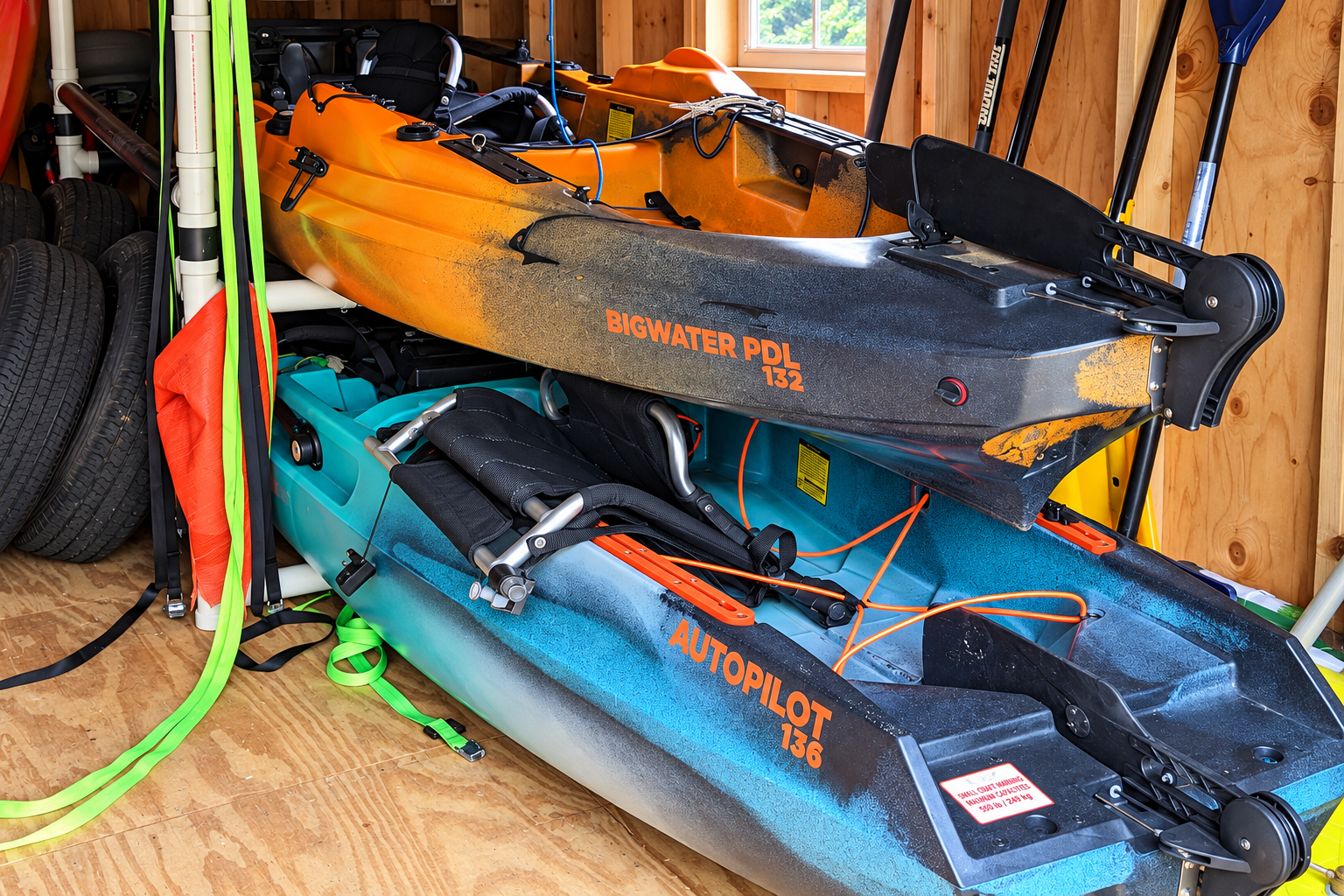
Bottom line: The Old Town Sportsman PDL 120 is the best all-around choice for most anglers, the BigWater PDL 132 is the better pedal kayak for covering exposed water, and the AutoPilot 136 is the specialist for anglers who value Spot-Lock and motorized position control enough to manage substantial weight. The discontinued Salty PDL 120 remains an appealing used-market choice for surf, current and coastal mobility.
Owner disclosure: Fishing.Digital owner Dennis Suler has owned examples from this Old Town lineup, including the Sportsman AutoPilot, Sportsman PDL 120, Salty PDL 120 and the classic 13-foot PDL platform now represented by the BigWater PDL 132. Old Town supplied an AutoPilot for editorial use. Old Town did not review or approve this comparison. Fishing.Digital may earn commissions from qualifying purchases through shopping links at no additional cost to you.
Old Town Sportsman Kayak Comparison

| Model | Best for | Length / width | Assembled weight | Usable capacity | Propulsion |
|---|---|---|---|---|---|
| Sportsman PDL 120 | Best all-around | 12 ft / 36 in | 116 lb | 384 lb | PDL pedal drive |
| BigWater PDL 132 | Open water and range | 13 ft 2 in / 36 in | 122 lb | 378 lb | PDL pedal drive |
| AutoPilot 136 | Spot-Lock and motorized control | 13 ft 6 in / 37 in | 158 lb before battery | 502 lb | 45 lb-thrust Minn Kota motor |
| Salty PDL 120 | Coastal speed and used value | 12 ft / 34.5 in | 104 lb | 346 lb | PDL pedal drive |
Specifications are current manufacturer figures. The Salty PDL 120 has been discontinued, so condition, model year and included equipment matter when shopping used.
Best Overall: Old Town Sportsman PDL 120

The PDL 120 is the lineup’s safest default because it balances stability, capacity, pedal control and manageable dimensions better than the specialists. Its 36-inch DoubleU hull is designed to provide a reassuring fishing platform, and the PDL Drive offers instant forward and reverse without a battery or remote.
The assembled boat weighs 116 pounds, including the removable 19-pound pedal console and six-pound seat. That is still a heavy kayak. A cart, pickup-bed extender or trailer may be more realistic than routine solo roof loading. Its 384-pound usable capacity must cover the angler, tackle, safety equipment, electronics and everything else carried aboard.
Buy it if: you want one pedal kayak for protected bays, tidal rivers, lakes and general inshore fishing. Skip it if: you routinely cross exposed water, launch through surf, or need GPS anchoring.
Check current Sportsman PDL 120 availability
Best Pedal Kayak for Open Water: BigWater PDL 132

The BigWater PDL 132 extends the waterline to 13 feet 2 inches while retaining a 36-inch beam. The longer performance-oriented hull is the better choice when efficiency, tracking and confidence in larger water matter more than compact storage. It is the modern continuation of the classic Old Town Predator PDL concept familiar to longtime owners.
At 122 pounds assembled, the BigWater is only six pounds heavier than the PDL 120 on paper, but its extra length affects storage, turning radius and transport. The usable capacity is 378 pounds—slightly lower than the PDL 120—so buyers should not assume the larger kayak carries more personal gear.
Buy it if: you fish larger bays, broad rivers, big lakes or nearshore water where tracking and hull efficiency matter. Skip it if: your launches are tight, your storage is short, or most trips involve protected creeks.
Check current BigWater PDL 132 availability
Best for Spot-Lock: Old Town Sportsman AutoPilot 136
The AutoPilot 136 is not simply a kayak with an add-on trolling motor. Its integrated, saltwater-ready 45-pound-thrust Minn Kota motor and i-Pilot remote provide GPS Spot-Lock, speed control and directional control. The oversized rudder is operated with adjustable foot braces, keeping the angler’s hands free.
This is the strongest platform when holding on a bridge shadow line, reef, channel edge or windblown point materially improves the fishing. The tradeoff begins before the kayak reaches the water. Old Town lists a 158-pound assembled weight before adding the required 12-volt battery and fishing gear. The 24-pound motor console and four-pound battery box are removable, but a trailer or carefully planned truck system is still the sensible answer for many owners.
The AutoPilot’s 502-pound usable capacity is the highest in this comparison. Capacity does not cancel launch difficulty, battery care or the need to carry an immediately accessible paddle.
Buy it if: Spot-Lock and motorized positioning solve recurring problems in your fishing and you have an appropriate transport system. Skip it if: you carry across sand or stairs, roof-load frequently, or prefer mechanical simplicity.
Check current AutoPilot 136 availability
Best Used Coastal Option: Salty PDL 120
The Salty PDL 120 is the leaner coastal specialist. At 34.5 inches wide and 104 pounds assembled, it is narrower and 12 pounds lighter than the Sportsman PDL 120. That makes it attractive to anglers who prioritize speed, current, surf-zone handling and easier transport over the broad stability and storage of the standard Sportsman hull.
Old Town has discontinued the Salty, so this is now primarily a used-market decision. Inspect the hull around the drive opening and scuppers, test the rudder, check the seat frame and hardware, and confirm that the PDL Drive operates smoothly in forward and reverse. Replacement-drive compatibility does not eliminate the need to price worn parts into the purchase.
Buy it if: you find a well-maintained example and favor coastal mobility over maximum stand-up stability. Skip it if: you want a current-model warranty, maximum capacity or a broad inland fishing platform.
See current used Salty PDL 120 listings
Which Old Town Should You Buy?
- Choose the PDL 120 when versatility matters most.
- Choose the BigWater PDL 132 when longer crossings and open-water tracking dominate your trips.
- Choose the AutoPilot 136 when GPS anchoring and powered positioning justify a trailer, battery and added maintenance.
- Choose a used Salty PDL 120 when you value a lighter, narrower coastal pedal kayak and can inspect it carefully.
Transport Costs Belong in the Purchase Decision
Do not compare kayak prices without comparing the equipment needed to move them. A realistic total may include a heavy-duty cart, pickup-bed extender, roof system, trailer, locks, battery, charger and storage hardware. The wrong transport plan can turn the most capable kayak into unused garage equipment.
Before buying, rehearse the complete trip: storage to vehicle, loading, launch, recovery at low tide and unloading when tired. That sequence often separates the right model from the impressive model.
Frequently Asked Questions
Is the AutoPilot 136 better than the PDL 120?
It is better at powered travel and GPS position control, but it is considerably heavier and requires a battery. The PDL 120 is the better all-around ownership experience when simplicity, transport and independence from battery power matter more than Spot-Lock.
Is the BigWater PDL 132 more stable than the PDL 120?
Both are 36 inches wide, but hull shape and length change how stability feels in waves and while turning. The BigWater is designed around efficiency and confidence in larger water; the PDL 120 emphasizes broad all-around stability. A dealer demo is more useful than comparing width alone.
Can one person load these kayaks?
That depends on the person, vehicle height and loading system. Removing the seat and drive helps, but published assembled weights range from 104 to 158 pounds before batteries and fishing equipment. Many owners will be safer and fish more often with a cart, bed extender or trailer.
Do I still need a paddle with an AutoPilot or PDL kayak?
Yes. Carry an accessible paddle on every trip. Motors, batteries, pedal drives, rudders and remotes can fail or become damaged, and a paddle remains essential emergency propulsion.
Continue comparing: Read our best inshore fishing kayaks guide, the AutoPilot 136 long-term review and the BigWater PDL 132 review.
Planning a trip to Fishing Kayaks?
This report tells you what happened. ReelAI tells you what to do about it — a briefing for your date, your target species and how you're fishing, built from our reports plus live NOAA and USGS data.
Powered by ReelAI — fishing.digital's intelligence layer. Answers are generated from fishing.digital reports and public NOAA, NWS and USGS data, and may be incomplete or out of date. Regulations and marine safety information are summaries only; always confirm with the responsible authority before you fish.