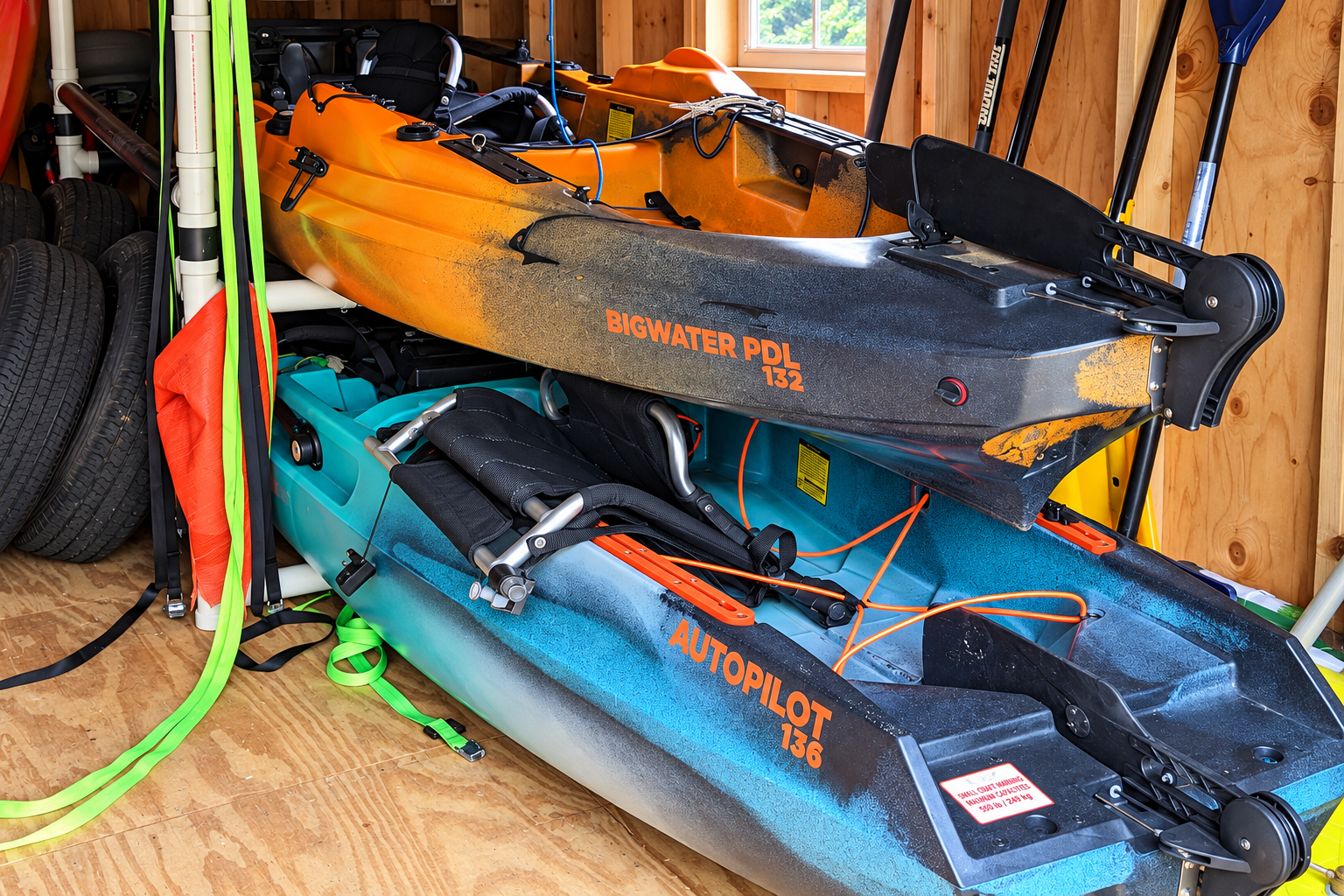
Bottom line: The Old Town Sportsman AutoPilot 136 is best understood as a small motorized fishing platform rather than a lightweight kayak. Its integrated 45-pound-thrust Minn Kota motor, GPS Spot-Lock and foot-controlled rudder can transform fishing in wind and current, but the 158-pound assembled weight creates real launch, transport and battery-management demands. It is a strong fit for anglers who value precise boat control more than simple portability.
Editorial disclosure: Old Town supplied Fishing.Digital with a Sportsman AutoPilot for editorial use. Old Town did not review, approve or control this article. The embedded 300-hour video is an independent long-term test and is identified separately from Fishing.Digital’s own observations. Fishing.Digital may earn commissions from qualifying purchases through shopping links at no additional cost to you.
Old Town AutoPilot 136 Specifications

| Specification | AutoPilot 136 | Why it matters |
|---|---|---|
| Length | 13 feet 6 inches | Long waterline favors tracking and usable deck space |
| Width | 37 inches | Wide fishing platform, with a transport penalty |
| Assembled weight | 158 pounds | Trailer, cart and launch planning are essential |
| Usable capacity | 502 pounds | Capacity remaining for angler, battery and gear |
| Motor | Saltwater-ready 45-pound-thrust 12V Minn Kota | Integrated propulsion and GPS boat control |
| Battery | Group 27 or smaller; not included | Battery chemistry changes range and total transport weight |
These are current manufacturer specifications for the AutoPilot 136. Old Town distinguishes usable capacity from total capacity; the usable figure is the meaningful number when calculating the angler, battery, safety equipment and fishing load.
What the AutoPilot Changes on the Water
The defining feature is not simply electric propulsion. Spot-Lock uses GPS to hold the kayak near a selected position while the angler casts, rigs or fights a fish. That capability matters around bridge shadow lines, reefs, channel edges, dock lights and current seams where repeatedly drifting away from the productive angle wastes time.
The i-Pilot remote controls speed, direction and position, while the oversized rudder is operated by adjustable foot braces. This separates propulsion from steering and keeps both hands available. It also introduces additional systems—remote, motor console, wiring, battery and steering—that must be checked before every launch.
300-Hour AutoPilot Long-Term Test
The independent video above evaluates a Sportsman AutoPilot after approximately 300 hours across multiple applications. Long-term evidence is valuable because a short demo cannot reveal launch fatigue, battery habits, corrosion prevention, remote dependence or whether Spot-Lock continues to justify the system’s weight after the novelty wears off.
Use any long-term review as evidence rather than a universal verdict. Water type, battery, payload, cart, trailer and launch surface can change the ownership experience substantially.
The Biggest Strength: Position Control
For many anglers, Spot-Lock is the purchase decision. It can reduce repeated repositioning in wind and moderate current, making it easier to work a small target thoroughly. It is particularly useful when fishing vertically, presenting bait to structure or holding outside a breaking surf line. The benefit is less dramatic in protected ponds where an ordinary pedal kayak is already easy to control.
GPS anchoring does not remove the need for judgment. Strong current, waves, changing wind and nearby traffic still require space and an exit plan. The system holds a GPS position; it does not make an unsafe location safe.
The Biggest Drawback: Weight and Launch Logistics
At 158 pounds assembled before the battery and fishing equipment, the AutoPilot 136 is not a casual roof-top boat for most owners. A trailer, bed extender or carefully designed cart system is often more realistic. Buyers should evaluate the complete movement sequence: storage to vehicle, vehicle to ramp, parking area to water, and the return trip when tired.
A launch with pavement and a gentle ramp is different from soft sand, stairs, riprap or a long low-tide carry. Transport accessories are part of the purchase, not an afterthought.
Battery Choice and Real Cost
Old Town says the battery box accepts a group 27 or smaller 12V lithium-ion, sealed lead-acid or AGM deep-cycle battery. The battery is not included. Lithium can reduce weight and usually delivers a more useful voltage curve, but costs more and requires a compatible charger. Lead-acid alternatives reduce initial cost while adding significant mass.
Range depends on battery capacity, speed, current, wind and payload. Avoid treating a single advertised runtime as a guarantee. Build a reserve into every trip and carry a paddle that is immediately accessible.
AutoPilot Battery and Transport Shopping List
- Compare 12V lithium trolling-motor batteries
- Compare compatible lithium battery chargers
- Compare heavy-duty kayak carts
- Compare kayak-trailer options
Confirm battery dimensions, chemistry, charger compatibility and cart capacity against your exact kayak and model year before ordering.
Rigging and Electronics
The AutoPilot 136 includes accessory tracks, pre-drilled wire ports and a universal transducer mounting system. That makes a clean fish-finder installation possible without immediately drilling the hull. Plan screen, transducer, power and cable routing together; an electronics installation can interfere with loading, the motor console or standing space if each component is added independently.
Start with our fish finders under $500 guide and the broader inshore fishing kayak comparison.
Maintenance After Saltwater Use
- Rinse the motor exterior, prop area, rudder hardware and exposed fittings with fresh water.
- Inspect the prop for fishing line and confirm the motor can stow and deploy freely.
- Dry the remote and inspect its tether before storage.
- Check battery terminals, connectors and wiring for looseness or corrosion.
- Charge and store the battery according to its manufacturer’s instructions.
- Inspect hull, cart contact points and tie-down areas after transport.
Who Should Buy the AutoPilot 136?
Buy it if: you regularly fish wind, current or offshore structure; precise positioning materially improves your fishing; you can manage the complete loaded weight; and you are comfortable maintaining a motor-and-battery system.
Skip it if: you need frequent roof-top transport, carry across sand or stairs, prefer simple pedal propulsion, or fish small protected water where Spot-Lock provides little advantage.
AutoPilot 136 vs PDL 120
The AutoPilot prioritizes motorized range and GPS position control. The Sportsman PDL 120 is lighter, mechanically simpler and keeps propulsion independent of battery state. The right choice is not “motor versus pedals” in isolation; it is whether Spot-Lock saves enough effort and improves enough presentations to justify the additional weight, cost and maintenance.
Verdict
The AutoPilot 136 is compelling when it is treated as a specialized fishing platform and supported by the right transport system. Spot-Lock can be transformative, but the honest buying decision begins on land: if the owner cannot launch, recover and store the complete system comfortably, the technology will not get used. Anglers with suitable logistics gain unusual boat control in a kayak-sized footprint; anglers prioritizing simplicity should remain with the PDL line.
Sources: Old Town AutoPilot 136 specifications and Old Town propulsion technology overview.
Track relevant seasonal offers through the Fishing.Digital electronics and kayak deal tracker.
Planning a trip to Fishing Kayaks?
This report tells you what happened. ReelAI tells you what to do about it — a briefing for your date, your target species and how you're fishing, built from our reports plus live NOAA and USGS data.
Powered by ReelAI — fishing.digital's intelligence layer. Answers are generated from fishing.digital reports and public NOAA, NWS and USGS data, and may be incomplete or out of date. Regulations and marine safety information are summaries only; always confirm with the responsible authority before you fish.