
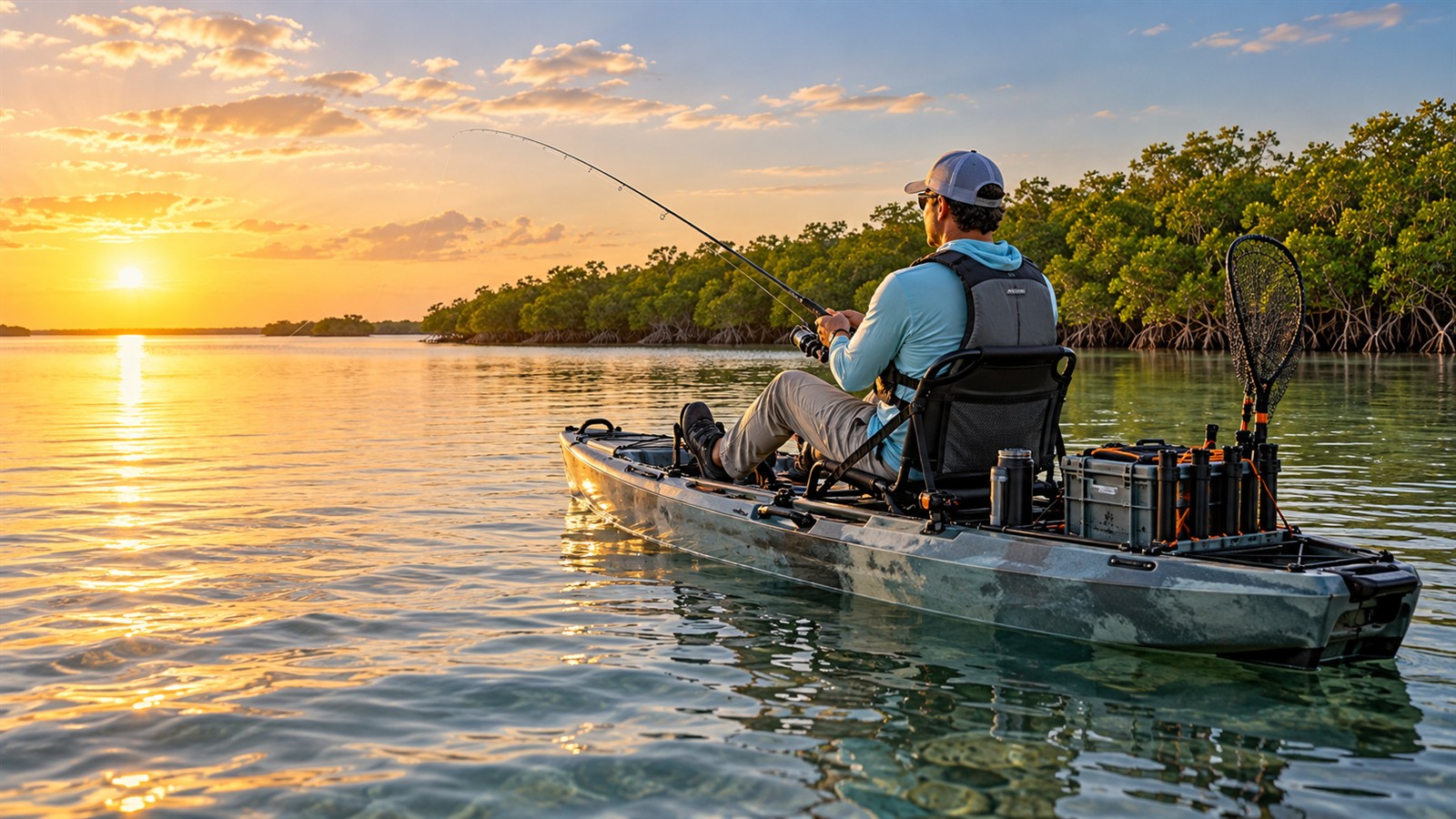
Bottom line: The best inshore fishing kayak is the one you can transport, launch, control in wind and current, and bring home safely. For most anglers, the Old Town Sportsman PDL 120 offers the strongest all-around mix of pedal control, stability, capacity, and saltwater readiness. Buyers who prioritize affordability or easy transport should consider a lighter paddle kayak instead of automatically moving to a heavy pedal platform.
Disclosure: Fishing.Digital may earn a commission from qualifying purchases made through links on this page, at no additional cost to you. This is a specification- and use-case-based buyer’s guide. We do not claim hands-on testing of products we have not personally used.
Quick Comparison
| Best for | Kayak | Length / width | Published capacity | Propulsion |
|---|---|---|---|---|
| Best overall | Old Town Sportsman PDL 120 | 12′ / 36" | 500 lb total; 384 lb usable | Pedal |
| Best value paddle kayak | Perception Pescador Pro 12 | 12′ / 32.5" | 375 lb maximum | Paddle |
| Premium shallow-water pick | Hobie Mirage Outback | 12’9" / 34" | 425 lb | Pedal |
| Best for motor-ready rigging | NuCanoe Unlimited | 12’6" platform class | 650 lb maximum; 400 lb self-bailing | Paddle / motor-ready |
| Best for creeks and mixed water | Bonafide RVR119 | 11’9" / 35" | 425 lb | Paddle / motor-ready |
Best Overall: Old Town Sportsman PDL 120
The Sportsman PDL 120 is the most balanced choice for anglers fishing bays, lagoons, protected coastal water, and larger tidal rivers. Its pedal drive provides instant forward and reverse, leaving both hands available for casting, fighting a fish, or correcting position near a shoreline. Old Town describes the drive as saltwater-ready and covers it with a five-year warranty.
The 12-foot hull is 36 inches wide and uses a stable DoubleU design. Its total capacity is 500 pounds, but the more useful number is the manufacturer’s 384-pound usable capacity after the assembled boat is accounted for. That distinction matters: paddler, tackle, battery, cooler, water, safety gear, and electronics all consume usable capacity.
Fishing features include accessory tracks, three rod holders, a universal transducer mount, bow storage, a large tankwell, and an adjustable seat. The tradeoff is weight. At 116 pounds assembled, this is not a casual solo roof-topper for everyone. The seat and 19-pound pedal console are removable, but many owners will still prefer a truck-bed extender, cart, or trailer.
Best for: anglers who want hands-free boat control and can manage the transport system. Skip it if: you must carry the kayak far from the vehicle or lift it alone onto a tall roof.
Check Old Town Sportsman PDL 120 availability
Best Value Paddle Kayak: Perception Pescador Pro 12
The Pescador Pro 12 is the practical entry point for anglers who want a purpose-built fishing kayak without paying for a drive system. Perception lists it at 12 feet long, 32.5 inches wide, 64 pounds, and 375 pounds maximum capacity. That lower hull weight can be more valuable than pedals if you frequently load alone or use unimproved launches.
It has a removable two-position mesh seat, front and rear open storage, accessory tracks, a fish-finder console, two molded rod holders, and a replaceable skid plate. The narrower hull and paddle propulsion demand more active boat positioning than a wide pedal kayak, particularly in wind. In exchange, the boat is simpler, lighter, less expensive, and has no underwater drive to strike an oyster bar.
Best for: budget-conscious anglers, simpler launches, and people who genuinely prefer paddling. Skip it if: holding position while casting in wind is your highest priority.
Check Perception Pescador Pro 12 availability
Premium Shallow-Water Pick: Hobie Mirage Outback
The Mirage Outback is a premium inshore platform built around Hobie’s MirageDrive 180 with Kick-Up Turbo Fins. The fins can deflect when they contact an underwater obstacle, an appealing feature around variable-depth flats, though no drive should be treated as immune to hard impacts. The drive provides forward and reverse, while dual steering controls and a kick-up rudder help manage drift.
Hobie lists the Outback at 12 feet 9 inches long, 34 inches wide, 85 pounds fitted hull weight, 103 pounds fully rigged, and 425 pounds capacity. It includes a retractable transducer shield, H-Rail mounting areas, organized tackle storage, rod holders, and an adjustable Vantage seat. It is refined and capable, but expensive—and still heavy enough that transport planning is necessary.
Best for: serious shallow-water anglers who value an efficient fin drive and integrated electronics management. Skip it if: price or simple field repair is more important than a polished pedal ecosystem.
Check Hobie Mirage Outback availability
Best Motor-Ready Platform: NuCanoe Unlimited
The NuCanoe Unlimited is better understood as a configurable small-watercraft platform than a minimalist kayak. Its open deck, high capacity, and mounting options suit anglers who want to add a trolling motor, electronics, battery, anchoring system, and substantial tackle. NuCanoe publishes a 650-pound maximum capacity with scuppers plugged and a 400-pound self-bailing capacity with scuppers open. For normal fishing decisions, the self-bailing figure is the more conservative reference.
This is an attractive choice for anglers who expect their rig to evolve, but every accessory adds weight and complexity. A motor can also trigger registration requirements depending on the state. Check current state rules before powering any kayak, carry required safety equipment, and calculate the total load rather than relying on the headline capacity.
Best for: anglers building a motorized, electronics-heavy inshore platform. Skip it if: you want a light, simple boat that reaches the water quickly.
Check NuCanoe Unlimited availability
Best for Creeks and Mixed Water: Bonafide RVR119
The RVR119 was designed around moving water and difficult access, but several features also translate to tidal creeks and protected inshore exploration. Its retractable skeg can improve tracking across open water and retract for maneuvering. Bonafide lists it at 11 feet 9 inches, 35 inches wide, 85 pounds, and 425 pounds capacity.
The removable pod can carry a fish-finder system, while rod organization, accessory tracks, anchor-routing provisions, skid plates, and motor-ready options support serious rigging. Its rocker and responsive hull make more sense for creeks and mixed conditions than a long, speed-focused open-water boat. For regular exposed-bay crossings, however, prioritize seaworthiness, forecast discipline, and a hull designed for those conditions.
Best for: tight tidal creeks, rivers, mixed water, and anglers who value maneuverability. Skip it if: maximum open-water speed or a factory pedal drive is essential.
Check Bonafide RVR119 availability
How to Choose an Inshore Fishing Kayak
Start with transport, not features
A kayak that looks perfect online can become unused garage furniture if it is too heavy to load. Add the hull, seat, drive, battery, motor, cart, crate, and electronics—not just the published hull weight. Decide whether you will use a roof rack, pickup, bed extender, or trailer before buying.
Use usable capacity, not a marketing maximum
Capacity must include the paddler and everything aboard. Leave a generous operating margin; a kayak at its limit may sit lower, drain poorly, and handle worse. Manufacturers do not all describe capacity the same way, which is why Old Town’s separate usable-capacity figure and NuCanoe’s self-bailing figure are especially helpful.
Pedal versus paddle
Pedals make it easier to hold position and keep casting, but add cost, weight, draft, and maintenance. Paddles are lighter and simpler, pass over very shallow water, and remain essential emergency equipment even on a pedal kayak. In oyster country, learn how quickly the drive retracts and never charge blindly across a flat.
Stability versus efficiency
Wide hulls generally feel reassuring and provide room to stand, but often require more effort to move. Narrower boats may track and paddle more efficiently but feel livelier. Standing is optional, not a test of whether a kayak is good. Sit when conditions, balance, or boat traffic make that safer.
Match the water
A sheltered mangrove creek, broad lagoon, tidal river, and ocean launch are different environments. Wind forecast, current, fetch, boat wakes, water temperature, and distance from a safe landing matter more than a product label saying “inshore” or “offshore.”
Essential Safety and Rigging
- Wear a properly fitted paddling or fishing PFD whenever underway.
- Carry a paddle on every pedal or motorized kayak.
- Use a whistle, waterproof light, communication device, sun protection, drinking water, and a basic first-aid kit.
- Leash or secure essential gear without creating an entanglement web.
- Check marine forecasts, tides, lightning risk, and launch closing times.
- File a float plan with your launch, route, and return time.
- Practice deep-water re-entry close to shore under controlled conditions.
- Check current Coast Guard and state requirements, including registration rules for motorized kayaks.
A fish finder can be valuable once the basic boat is sorted. Our fish finders under $500 guide explains GPS, CHIRP, screen size, and kayak-friendly installation tradeoffs.
What We Would Buy
For frequent inshore fishing with easy vehicle access, we would choose the Old Town Sportsman PDL 120 and build the transport plan at the same time. For a first kayak, limited budget, or solo loading, the Perception Pescador Pro 12 is the smarter decision. The Hobie earns its premium for anglers committed to its fin-drive system, while the NuCanoe makes sense for a deliberate motorized build. The Bonafide is the specialist for creeks and varied access.
Before ordering, sit in the exact model if possible and test the loading process. A dealer demo can reveal seat-fit, pedal reach, standing comfort, and transport problems that no specifications table can answer.
Frequently Asked Questions
Is a 10-foot or 12-foot kayak better for inshore fishing?
Twelve-foot kayaks commonly provide a useful balance of tracking, capacity, and deck space. A 10-foot kayak may be easier to transport and turn in tight water. Choose for your water and logistics rather than length alone.
Do I need a pedal kayak?
No. Pedals improve boat control while fishing, but a well-designed paddle kayak is less expensive, lighter, and capable in very shallow water. Many anglers are better served by a boat they can launch frequently.
Can I take a fishing kayak offshore?
Only with the right hull, skills, safety equipment, weather window, and experience. An “offshore capable” label does not make surf launches or open-water crossings safe. Start in protected water and seek local instruction.
Should I add a motor?
A motor increases range but also adds battery weight, complexity, cost, and legal requirements. Learn the kayak under paddle or pedal power first and verify registration rules before installation.
Keep planning: Explore the tackle guide hub, prepare with our saltwater rods under $200, and find current conditions in the weekly fishing reports.
Planning a trip to Fishing Gear?
This report tells you what happened. ReelAI tells you what to do about it — a briefing for your date, your target species and how you're fishing, built from our reports plus live NOAA and USGS data.
Powered by ReelAI — fishing.digital's intelligence layer. Answers are generated from fishing.digital reports and public NOAA, NWS and USGS data, and may be incomplete or out of date. Regulations and marine safety information are summaries only; always confirm with the responsible authority before you fish.