
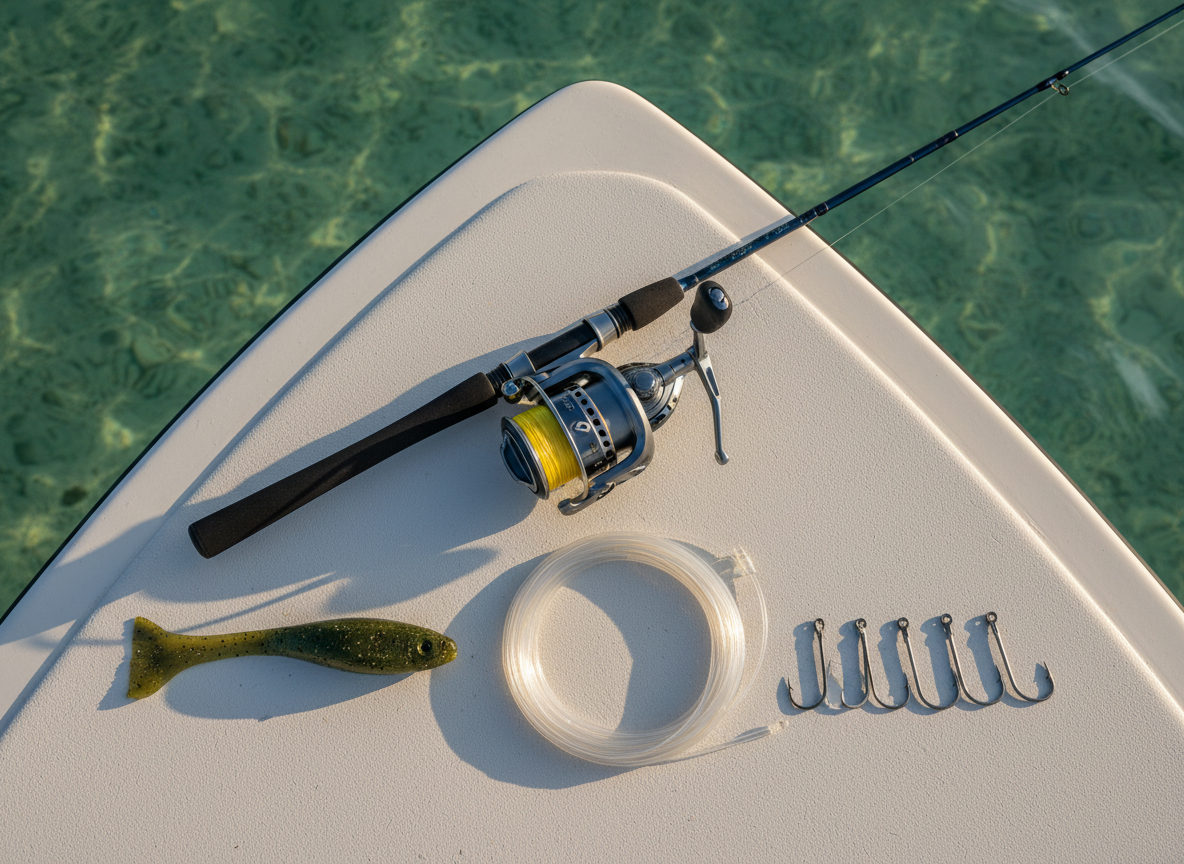
Tarpon test every component of a setup at once. A mature fish runs 80 to 200 pounds, clears the water repeatedly, and finds the weakest link in the system on the first jump — a dull hook, a poorly seated knot, a grooved guide, a drag that stutters at the top of its range. The tackle does not catch the fish for you, but the wrong tackle will lose it.
This guide covers complete tarpon setups across the four scenarios that account for nearly all tarpon fishing: boat work in channels and passes, sight-casting on the flats, dock-light fishing at night, and fly fishing. It covers rods, reels, braid, leader, and hooks at entry, mid, and premium tiers, plus the rigging details that decide outcomes. No prices appear here — tackle pricing moves constantly and any figure published today is wrong within a season.
Quick reference: tarpon setups at a glance
| Scenario | Rod | Reel | Braid | Leader |
|---|---|---|---|---|
| Boat fishing (channels/passes) | 7′ medium-heavy, fast | 6000–8000 class | 50–65 lb | 80–100 lb fluoro |
| Sight-casting flats | 7’6″ medium, moderate-fast | 5000 class | 30–50 lb | 60–80 lb fluoro |
| Dock light night fishing | 7′ medium, fast | 4000–5000 class | 30–40 lb | 50–60 lb fluoro |
| Fly fishing | 11–12 wt, 9′ | 12 wt saltwater reel | 250 yd of 30 lb backing | 16–20 lb class, 60–80 lb bite |
Rods
Entry tier: Penn Battalion II Inshore
For an angler getting into tarpon fishing without committing to a four-figure outfit, the Penn Battalion II Inshore in a 7-foot medium-heavy with a 15–30 pound line rating is the sensible starting point. The graphite blank carries more backbone than its position in the lineup suggests, and the fast action gives you what you need most on a tarpon: the ability to drive a hook into a bony mouth on a long line. The components are plainer than premium rods — less refined guides, simpler grips — but the blank does the work.
Best configuration: 7’0″ or 7’6″ medium-heavy, 15–30 lb line rating.
Mid tier: Star Rods Stellar Lite Inshore
The Stellar Lite is a Florida regional favorite that gets less national attention than it deserves. The blank is sensitive enough to register a tarpon’s soft pickup of a free-lined crab and still has the lifting power to turn a fish away from a bridge fender. Fuji guides, EVA grips, and a proper fighting butt put its component package above where it sits in the market. It is a common rod on charter boats along the Gulf coast for exactly that reason.
Best configuration: 7’6″ medium-heavy for sight-casting, 7’0″ medium-heavy for boat work.
Premium tier: G. Loomis NRX+ Saltwater
At the top of the market, the NRX+ Saltwater series is the reference point. High-modulus graphite delivers a level of sensitivity and recovery speed that lower-tier blanks do not match, and the saltwater models carry the lifting power for fish well into three figures. Where the money shows most is casting accuracy under pressure — when a laid-up fish gives you one shot at forty feet with a crosswind, a rod that loads and unloads cleanly is the difference between a presentation and a spooked fish.
Best configuration: 7’6″ medium-heavy for sight-casting, 7’0″ heavy for boat tarpon.
Reels
Entry tier: Penn Slammer IV
The Slammer IV in the 5500 or 6500 size is the workhorse tarpon reel. It carries an IPX6 sealed body and a sealed HT-100 carbon drag, which means salt spray and a wave over the gunwale are non-events rather than a service appointment. The drag holds its setting deep into a run, which is the specific thing a tarpon demands of a reel. For fish in the 60 to 120 pound class it is entirely sufficient, and it will take years of hard use.
Best size: 5500 for sight-casting and lighter scenarios; 6500 for boat tarpon and big-fish situations.
Mid tier: Shimano Saragosa SW A
The Saragosa SW A is built as a saltwater reel first — X-Protect water resistance, the X-Shield and X-Rigid body treatments, and a Cross Carbon drag stack that stays smooth through the long runs a large tarpon produces. It is heavier than a comparable inshore reel and smoother on the retrieve than anything at its tier. If you want one reel that handles tarpon and then goes offshore for kingfish and tuna, this is the pick.
Best size: 5000 for sight-casting, 6000 or 8000 for boat tarpon and the largest fish.
Premium tier: Shimano Stella SW or Van Staal VR / VS
At the top tier the Stella SW and the Van Staal reels solve the same problem from opposite directions. The Stella is the precision option: exceptionally smooth, light for its class, and sealed. Van Staal reels are fully sealed and submersible, built to be rebuilt indefinitely, and considerably heavier — the reels surfcasters have run for decades. Choose the Stella when weight and feel matter, as in a full day of sight-casting from a poling platform. Choose the Van Staal when the reel is going to get soaked, sanded, and abused.
Best size: Stella SW 8000; Van Staal in the equivalent heavy-inshore size.
For a broader treatment of size classes, sealing ratings, and drag construction, see our guide to inshore saltwater spinning reels.
Line and leader
Main line
Braid is not optional for tarpon. The thin diameter relative to breaking strength is what lets a 6000-class spool hold the 300-plus yards a big fish can demand, and the near-zero stretch is what lets you bury a hook in bone at forty yards.
- Light: 30–50 lb braid for sight-casting on flats and for dock-light work.
- Standard: 50–65 lb braid for boat fishing channels and passes.
- Heavy: 65–80 lb braid for the largest fish and for fisheries with heavy structure — Boca Grande Pass, the Louisiana rigs, the Costa Rica river mouths.
Respool annually. Braid does not rot, but the top hundred yards abrade, and the section that failed is always the section that took the fish.
Leader
Tarpon have excellent eyesight in clear water and a mouth surface that behaves like sandpaper on monofilament. Fluorocarbon is the standard for both reasons.
- Light: 60–80 lb fluorocarbon in 6 to 8 feet for sight-casting, where a long leader keeps the braid away from the fish’s eyes.
- Standard: 80–100 lb fluorocarbon in 4 to 6 feet for boat fishing.
- Heavy: 100–130 lb fluorocarbon in about 4 feet for the biggest fish in heavy structure.
The connection
The braid-to-leader connection is where tarpon setups fail most often. Two approaches are acceptable: the FG knot, which is the slimmest and strongest and runs cleanly through guides but takes real practice; and the Bristol (or no-name) knot, which is easier to tie under pressure and slightly bulkier. Avoid the Albright on heavy leader unless you tie it well and seat it carefully — it slips when it is not fully bedded. Our fishing knots guide covers both connections step by step.
Hooks
Tarpon have hard, bony mouths and a habit of throwing hooks in the air. Hook choice and hook maintenance matter more here than in almost any other fishery.
- Owner Mutu Light Circle, 5/0 to 8/0. The standard for live-bait tarpon fishing. The lighter wire penetrates a bony jaw better than a heavy-wire hook of the same size, and the circle geometry sets in the corner of the mouth, which is both more secure and far better for the fish.
- Gamakatsu Octopus Circle, 6/0 to 7/0. A heavier-wire alternative for big live baits — mullet, threadfin, large crabs — on heavier setups where the extra wire diameter is warranted.
- Tournament-grade inline circle hooks from VMC, Owner, or Mustad are worth the premium if you fish tarpon often; they arrive genuinely sharp and hold a point longer.
Whatever you choose, use non-offset inline circles for live bait, and do not swing on the bite — let the fish turn and let the line come tight. Check hook points constantly. A dull hook is the leading cause of a thrown hook on the first jump.
Setup by scenario
Boat tarpon: channels, passes, and beaches
The classic presentation: anchored or drifting in a pass on the outgoing tide, free-lining live crabs or threadfin on a circle hook. You need backbone to lift a fish away from a hull, an anchor line, or bridge structure.
- Rod: 7’0″ medium-heavy, fast action, 20–40 lb line rating
- Reel: 6000 to 8000 class with a strong sealed drag
- Braid: 50–65 lb
- Leader: 80–100 lb fluorocarbon, 4 to 6 feet
- Hook: 7/0 or 8/0 inline circle
Our field guide to the Boca Grande Pass anchor bite covers this presentation in a specific fishery.
Sight-casting on the flats
A lighter outfit built for accuracy and a quiet entry. You are throwing crabs or flies at laid-up and daisy-chaining fish in three to six feet of water, and they leave on a heavy splash or a visible leader.
- Rod: 7’6″ medium, moderate-fast, 15–25 lb line rating
- Reel: 5000 class with a smooth low-startup drag
- Braid: 30–50 lb
- Leader: 60–80 lb fluorocarbon, 6 to 8 feet
- Hook: 5/0 or 6/0 inline circle
Dock lights at night
Tarpon under dock and bridge lights eat smaller baits — finger mullet, pilchards, small flies and jigs — and the fishing is a presentation problem rather than a power problem. Fish the dark side of the light line, up-current, and let the bait drift through.
- Rod: 7’0″ medium, fast, 12–20 lb line rating
- Reel: 4000 to 5000 class
- Braid: 30–40 lb
- Leader: 50–60 lb fluorocarbon, about 5 feet
- Hook: 4/0 or 5/0 inline circle
Fly fishing
- Rod: 11 or 12 weight, 9 feet — the Sage Salt R8 is the current reference in this class, and every major maker has a credible 12-weight
- Reel: 12-weight saltwater reel with a sealed drag and a large arbor
- Backing: 250 yards of 30 lb gel-spun
- Line: floating tropical saltwater taper matched to the rod
- Leader: roughly 9 feet tapered, 16–20 lb class tippet, 60–80 lb bite tippet
- Flies: toad patterns in black/purple and chartreuse, tarpon bunnies in olive and white, and a few smaller baitfish patterns for dock lights
Pre-trip rigging checklist
- Respool the braid if it is more than a season old, or at minimum strip and reverse it.
- Run a cotton swab through every guide. Any fiber that catches means a grooved insert, and a grooved guide will saw through braid under load.
- Retie every leader connection. Not most of them — all of them.
- Sharpen or replace every hook, and carry a file on the boat.
- Test the drag against a scale. Set it near one third of your leader’s breaking strength and confirm there is no stutter on startup.
- Check the rod butt cap. Tarpon fights are fought off the butt, and a loose cap fails at the worst possible moment.
- Pack a fighting belt for anything over 100 pounds, and a release tool you can reach one-handed.
What actually costs people fish
- Dull hooks. The single most common reason a tarpon throws the hook on its first jump. Check the point every thirty minutes of active fishing.
- The braid-to-leader knot. Practice the connection before the trip, not on the boat. Tie it slowly, seat it fully, and pull-test it.
- Drag set too light. Most anglers under-set drag for tarpon. A big fish fought on a soft drag never comes to the boat, and the extended fight is what kills released fish.
- Fighting from the arms instead of the butt. Get the rod butt into your hip or a belt and use short pumps. Long-arm fighting loses fish and wrecks anglers.
Handling and regulations
Tarpon in Florida are a catch-and-release fishery. Harvest or possession requires a tarpon tag, which is limited to one per person per year and is intended for the pursuit of an IGFA record. Any tarpon over 40 inches must remain in the water — it cannot be lifted out for a photograph or for removal of the hook. Verify current rules with FWC before you fish.
Beyond the law, handling drives survival. Use the heaviest tackle the fishery allows, end the fight quickly, keep the fish horizontal and in the water, support it behind the head and at the base of the tail, and revive it facing into current until it swims off under its own power. Never lift a tarpon by the jaw; the jaw structure is not built to carry the fish’s weight. The fish you are holding may be older than you are.
FAQ
What size reel do I need for tarpon?
A 6000 to 8000 class spinning reel holding at least 300 yards of 50- to 65-pound braid for boat fishing in passes and channels. A 5000 class is sufficient for sight-casting on flats, where you can follow a fish, and a 4000 to 5000 works for smaller dock-light fish. What matters more than size is a sealed, smooth drag that does not stutter at the top of its usable range.
What pound test leader for tarpon?
Eighty to 100 pound fluorocarbon is the standard for boat fishing. Drop to 60 to 80 for sight-casting on clear flats, where a visible leader costs you shots, and go up to 100 to 130 for the largest fish or where structure is unavoidable. Length runs from about four feet in a pass to eight feet on a flat.
Circle hooks or J hooks for tarpon?
Non-offset inline circle hooks, without exception, when fishing live or natural bait. They set in the corner of the jaw rather than in the throat, which improves both hookup security on a bony mouth and post-release survival. Do not set the hook — let the fish turn and come tight on its own.
Can you keep a tarpon in Florida?
Effectively no. Tarpon are managed as a catch-and-release species; possession requires a tarpon tag limited to one per person per year and intended for IGFA record pursuit. Any tarpon over 40 inches must stay in the water at all times, including for photographs and hook removal.
Do I need premium tackle to catch tarpon?
No. An entry-tier medium-heavy inshore rod, a sealed 6000-class reel with a strong drag, 50-pound braid, 80-pound fluorocarbon, and a sharp 7/0 inline circle hook is a complete, capable tarpon outfit that will land triple-digit fish. Premium tackle buys sensitivity, casting accuracy, weight savings over a long day, and longevity — not the ability to catch the fish.
How much drag should I set for tarpon?
Roughly one third of your leader’s breaking strength, tested against a scale rather than estimated by hand. On 80-pound fluorocarbon that is in the neighborhood of 25 pounds at strike setting. Just as important as the number is startup smoothness — a drag that grabs before it moves is what breaks leaders on the first surge.
Find Used & New Deals on eBay
eBay is a good source for lightly used heavy spinning tackle and discontinued models. Browse current listings:
- Heavy spinning reels, 6000–8000 size →
- Penn Slammer IV spinning reels →
- Star Rods Stellar Lite inshore rods →
- Owner Mutu Light circle hooks →
As an eBay Partner Network affiliate, fishing.digital earns from qualifying purchases at no additional cost to you.
The bottom line
Tarpon tackle rewards investment, but the investment that matters most is not the most expensive item on the list. A sound entry outfit — a medium-heavy inshore rod, a sealed 6000-class reel with a strong drag, 50-pound braid, 80-pound fluorocarbon, and a sharp inline circle — will land fish over 100 pounds for years. Upgrade when you know which part of your fishing the current setup is limiting.
Then sharpen the hooks, retie the connection, set the drag against a scale, and get the fish in fast. That sequence is worth more than any single component on this page.
Related reading: how to catch tarpon, how to catch snook, and choosing fishing sunglasses for sight-fishing.
Dennis Suler is a career outdoors writer and lifelong angler. He spent six years on the editorial staff of The Fisherman magazine as a field editor and managing editor — first editing the New Jersey reports section, then managing editor of the Mid-Atlantic edition. He also served as managing editor of Boater’s Digest magazine. He’s a member of the Outdoor Writers Association of America and writes for fishing.digital.
Planning a trip to Fishing Gear?
This report tells you what happened. ReelAI tells you what to do about it — a briefing for your date, your target species and how you're fishing, built from our reports plus live NOAA and USGS data.
Powered by ReelAI — fishing.digital's intelligence layer. Answers are generated from fishing.digital reports and public NOAA, NWS and USGS data, and may be incomplete or out of date. Regulations and marine safety information are summaries only; always confirm with the responsible authority before you fish.