
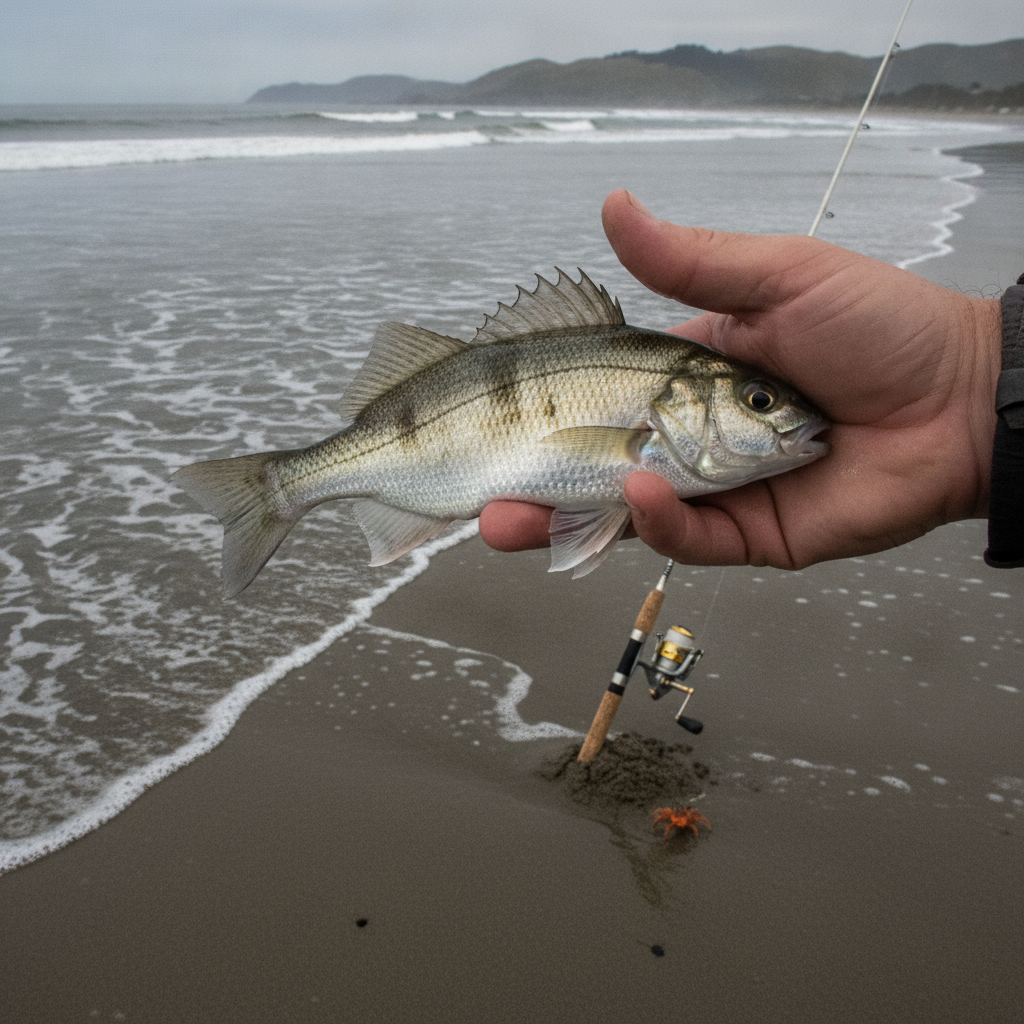
Surfperch — a family of small to mid-size live-bearing fishes (Embiotocidae) found along the U.S. West Coast — are one of the most accessible saltwater fisheries in North America. Available year-round from any sandy beach between Baja and Alaska, surfperch require nothing more than waders, a sandspike, a 9-12′ rod, and a pocket of sand crabs. This guide covers the species, the techniques, and the spots that produce limits of these scrappy little fighters.
The Surfperch Species
Over a dozen surfperch species are caught from West Coast beaches; the most common targets:
- Barred Surfperch (Amphistichus argenteus) — the dominant Southern and Central California species. Vertical bars on the silver flanks. Most abundant of all the perch. Range: northern Baja to Bodega Bay.
- Redtail Surfperch (A. rhodoterus) — the prized target of the Pacific Northwest. Larger than other perch (up to 16″+, 4 lbs). Range: Monterey north to British Columbia; strongest fishery is Oregon and Washington beaches.
- Walleye Surfperch (Hyperprosopon argenteum) — schooling fish, smaller, with a deeply forked tail and a “walleye” appearance. Common in California from the kelp zone to the surf.
- Calico Surfperch (A. koelzi) — mottled coloration, common in Northern California to Washington.
- Silver Surfperch (H. ellipticum) — schooling species often caught alongside walleyes.
- Pile Perch and Striped Seaperch — caught from piers, jetties, and rocky structure rather than open beach.
Where to Find Surfperch: Range & Habitat
Surfperch live in the surf zone — typically 20-150 yards off the beach in 4-12 feet of water. They feed in the troughs and rip channels behind the breakers, where sand crabs, mole crabs, and small invertebrates concentrate. Look for the “structure” of the surf: rip currents (darker, calmer water cutting through the breaker line), sandbars with deep troughs immediately landward, and the seams where one bar meets another. Northern California through Washington produces the largest fish (redtails); Southern California beaches produce numbers (barreds and walleyes).
Tackle for Surfperch
Standard Surfperch Setup
Rod: 9-12′ medium-action surf rod. Lamiglas Surf, St. Croix Mojo Surf, Okuma Longitude, Daiwa Sealine Beachpower. Reel: 4000-6000 size spinning reel with smooth drag. Penn Battle, Daiwa BG, Shimano Saragosa. Main line: 12-20 lb monofilament or 20-30 lb braid. Leader: 12-15 lb fluorocarbon, 18-24 inches. Sinker: 2-4 oz pyramid or sputnik sinker for current.
Light Surfperch / Finesse Setup
Anglers chasing smaller perch on calmer beaches scale down: 8-9′ medium-light rod, 2500-4000 spinning reel, 10 lb braid, 8 lb fluoro leader. The lighter setup transforms a 12″ perch into a real fight and improves bite detection.
Fly Tackle
Rod: 7-8 weight, 9′ rod. Line: Intermediate or fast-sinking integrated line (Outbound Short S6, Type III shooting head). Leader: 6′ 12 lb fluoro. Flies: Sand crab patterns (Surf Candy, Tahuya Surf Crab, Clouser Minnow in tan/orange). Wading the trough on the bottom drop is a Northern California specialty.
Top Techniques
Carolina-Rigged Sand Crabs
The dominant technique. Rig: 2-3 oz pyramid sinker → barrel swivel → 18-24″ fluoro leader → size 4 or 2 octopus hook. Bait: a fresh sand crab (the larger soft-shell “papershells” are best), hooked from the underside through the body. Cast: Out to the back of the second trough, then walk slowly down the beach with the rod tip up, dragging the rig through fish-holding water. Bites feel like sharp taps; set with a sharp lift.
High-Low Rig with Gulp! or Berkley Sandworm
The artificial alternative. A double-dropper rig with two size 4 hooks above a 2-3 oz pyramid sinker. Bait each hook with a 2-3″ Berkley Gulp! Sandworm in camo or new penny, or a sandworm-style soft plastic. Cast and let the rig sit, with the rod in a sandspike. Bites register as taps on the rod tip.
Reading the Surf
Surfperch live in three zones: the trough (between beach and the first sandbar — fish here at higher tides), the second trough (between the first and second bar — productive on average tides), and the outside (beyond the outer breaker — surfcasters reach this with heavy gear on flat days). Look for the “darker water” of rip channels — these funnel sand crabs and concentrate perch. Sandbars that taper to deeper water on one side are predictable holding spots.
Walking the Beach (Roving Method)
Northern California and Oregon redtail anglers rarely fish from one spot. Cast, let bait soak 60-90 seconds, retrieve slowly, take 10-20 steps down the beach, and cast again. Cover water until you find fish; perch usually school, so when you find one, work that pocket hard.
Bait Tank or Sand Crab Pump
Live sand crabs vastly outproduce frozen, preserved, or artificial baits. Bring a “crab rake” — a small wire-mesh rake or a sand-crab pump — and harvest fresh crabs at the wet-sand boundary as the wave retreats. Larger “papershell” (recently molted) crabs are gold; firm-shell crabs catch fewer fish.
Best Baits
Live sand crabs / mole crabs — the unquestioned #1 bait. Mussels — fresh, with the meat carefully threaded — excellent in Northern California. Berkley Gulp! Sandworm (2″) — the best artificial; new penny, camo, and natural colors. Marine worms / pile worms — bought at bait shops; effective but expensive. Shrimp pieces / clam necks — backup options when sand crabs unavailable.
Best Times to Fish
Tide: The two hours leading into and following high tide are universally best on most West Coast beaches. Some beaches fish better on outgoing tides; experiment locally. Time of day: Early morning and the last hour before dark generally outproduce midday — though calm overcast days extend the bite window. Season: Year-round, with peaks: Southern California barred perch — December through April (spawning period). Pacific Northwest redtails — June through October (calmer surf, biggest fish). Northern California — March through June and again September through November.
Hot Spots
Southern California: Doheny, San Onofre, Trestles, Carlsbad, Torrey Pines, La Jolla Shores, Coronado, Imperial Beach. Central California: Pismo Beach (consistent), Morro Bay, Cayucos, Carmel River Beach, Marina State Beach. Northern California: Salmon Creek, Stinson, Dillon Beach, Limantour (Point Reyes), the beaches between Bodega Bay and Eureka. Oregon: Cape Lookout, Cape Kiwanda, Pacific City, Lincoln City beaches, Cannon Beach, Gold Beach. Washington: Long Beach Peninsula, Westport beaches, Twin Harbors area, Kalaloch on the Olympic Peninsula.
Safety in the Surf
Surf fishing has real hazards. Never turn your back to the ocean — sneaker waves and shore breaks can knock anglers down and pull gear out. Stay above the wet-sand line whenever possible; cast from there if conditions are big. Wear hip boots or chest waders with a wading belt cinched tight, and consider a PFD on dangerous beaches. Pacific Northwest beaches have notably stronger sneaker-wave activity than Southern California. Check NOAA marine forecasts and surf reports before heading out.
Cleaning & Eating
Surfperch are excellent on the table. Larger redtails fillet well; smaller perch are usually pan-dressed (scaled, gutted, head and tail removed) and fried whole. The flesh is white, mild, and tender. Bleed perch immediately after the catch for best quality. Yield is moderate — about 25-30% as fillets, 60% as pan-dressed.
Regulations
California: No minimum size for most surfperch, 20-fish daily aggregate bag (no more than 10 of any one species except shiner perch). Oregon: No minimum size, 15 fish daily aggregate. Washington: No minimum size on most species; daily bag varies by area (often 12-15). Always verify current state regulations before each trip — surfperch rules are updated periodically.
More Resources
Surf Fishing Hub · Oregon Coast Guide · All How-To Guides
Planning a trip to Saltwater Fishing?
This report tells you what happened. ReelAI tells you what to do about it — a briefing for your date, your target species and how you're fishing, built from our reports plus live NOAA and USGS data.
Powered by ReelAI — fishing.digital's intelligence layer. Answers are generated from fishing.digital reports and public NOAA, NWS and USGS data, and may be incomplete or out of date. Regulations and marine safety information are summaries only; always confirm with the responsible authority before you fish.