
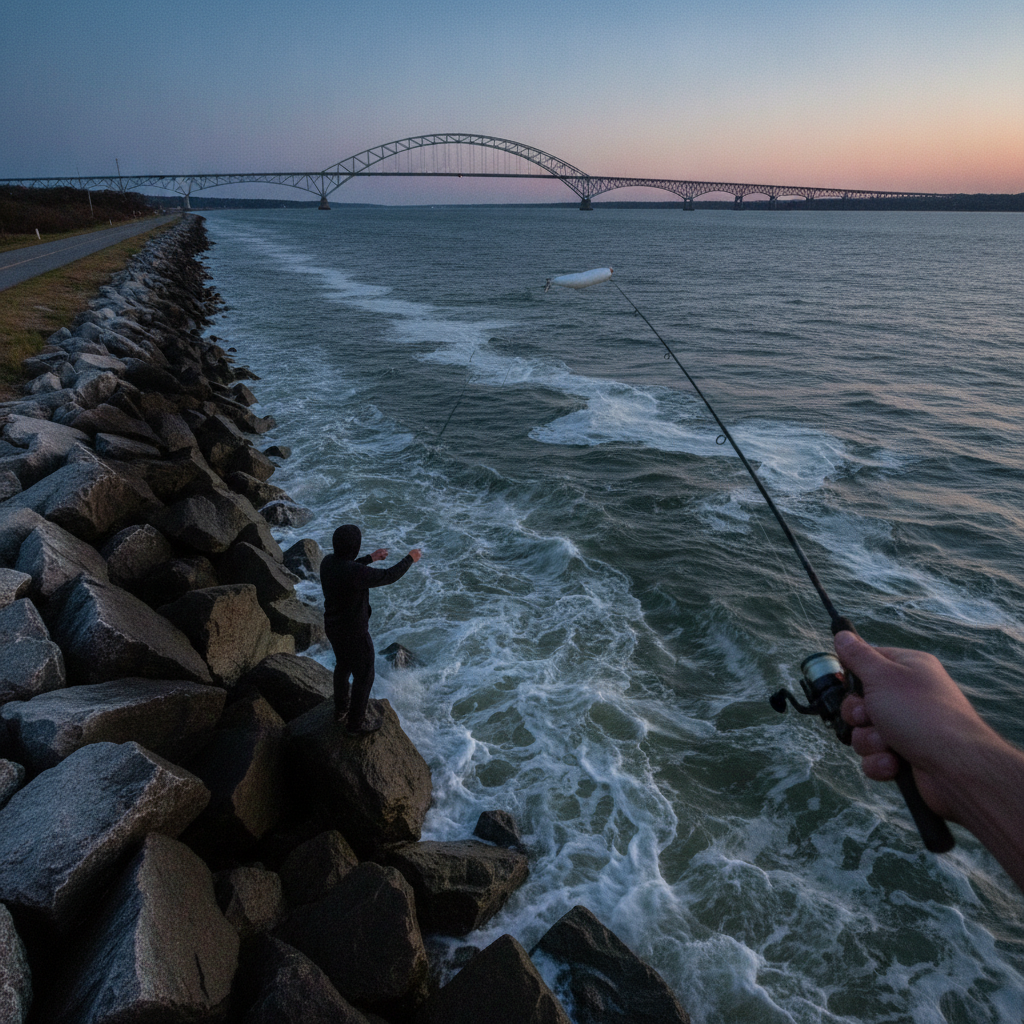
The Cape Cod Canal is the closest thing the East Coast has to a standing, predictable river. Three hundred and fifty feet wide, fifty feet deep, and seven miles long, it cuts straight through the elbow of the Cape and carries water at a hard angle between Buzzards Bay and Cape Cod Bay four times every twenty-four hours. The current can hit eight knots at peak flood. The bait flushes through. The stripers follow. And for sixty or so days a year — late May into August — the Canal is the most productive striper fishery on the eastern seaboard.
I’ve been fishing it since the early 1990s. Most of what I learned in the first decade was wrong. Most of what I see new Canal anglers do today is wrong in the same ways. So this is the writeup I would have wanted at twenty-five: how to read the east tide on the Canal, where to stand, what to throw, and why most people miss the bite by an hour and a hundred yards.
The Canal is a tide, not a place
The first mistake newcomers make is treating the Canal as a fishing spot. It isn’t. It’s a tidal feature with maybe a dozen genuinely productive fishing positions, and which ones produce depends entirely on which way the water is moving and how fast.
There are four tides a day on the Canal — two going east into Cape Cod Bay, two going west into Buzzards Bay. The “east tide” — water flowing east toward the bay end — is the legendary one. It pushes bait that has been stacking in Buzzards Bay through the funnel and into the strike zone for stripers staged on the east side. It is, statistically, the better tide for big fish. But it is not always the better tide for YOUR fish. More on that.
The current peaks roughly two and a half hours before the high tide listed on the Cape Cod Bay tide table at Sagamore. Plan your trip backward from peak current, not from high tide. Be on the water for the hour before peak and the hour after — that’s the heart of the bite.
Where to stand on an east tide
The Canal has rip-rap on both banks the entire length. That changes the structure underneath. Some sections have boulders the size of pickup trucks fifteen feet from shore. Some have a clean sandy bottom three feet down. Some have a ledge that drops from six to thirty feet within a single cast distance. You need to know which is which.
On an east tide, the producing sections in my experience, in priority order:
The Mouth at Sandwich (East End). Where the Canal opens into Cape Cod Bay, the current dumps into a much wider, shallower area. Stripers stage there to ambush bait being flushed out. The fishing position is the rocks just west of the East End on the south bank — you cast across the current, let your offering swing on the current down toward the mouth, and strikes come on the swing as your lure rides the current line. This is the textbook East Tide bite.
The Power Lines (mid-canal, south bank). A boulder field with a structural rip on the south side. Stripers hold on the down-current side of the boulders, picking off bait swept past. Cast across, work parallel to shore on the swing. This is a wading-shoe spot — you’re stepping on slick rock, the current is hard, and a slip on big tides has consequences.
Bell Road and Herring Run (north bank). Less famous but often less crowded. Bait flushes out of the Herring Run on outgoing tides. On an east-flowing Canal tide, that means the early morning east tide right after a herring spawn run is a particular kind of magic.
The Railroad Bridge. Difficult access, sketchy in the dark, but the structure under the bridge changes the current’s behavior in a way the fish respect. If you’re going to fish it, daylight only, low tide for safety.
What is NOT a producing east tide spot, despite people fishing it: the long flat sections in the middle of the Canal where the bank just runs straight with nothing structural underneath. The water moves through; the fish do not stage. Move on.
The bait window matters more than the lure
Most Canal anglers obsess over lures. The lure matters, but it’s a distant second to having the right bait stage AT the right tide. The Canal produces in waves keyed to specific bait migrations:
- Late May through mid-June: herring run aftermath. Stripers gorge on tail-end herring. Big plugs (Super Strike Bullet, the now-discontinued Stan Gibbs Pencil) and large soft plastics imitate.
- Mid-June through July: bunker (menhaden). Bunker move into Buzzards Bay and get sucked through the Canal. Big soft plastics in white, large plugs that wobble like wounded bunker (Sebile Magic Swimmer 165, Daiwa Salt Pro Minnow 170), and the occasional eel.
- Late July through August: peanut bunker and small bait. The big fish move offshore. The Canal’s striper bite shifts to schoolies on smaller plugs (5-inch SP minnows, Yo-Zuri Crystal Minnows).
- Black-eyed bass (a.k.a. squid) on warm-water years. When squid migrate into Cape Cod Bay (some years yes, some years no), the Canal sees a brief, intense night bite on squid-pattern bucktails.
When in doubt about what’s happening, walk the rocks at dawn before fishing. Bait stages first. If you see schools of bunker or herring shouldering through, you’re going to fish a big-profile lure. If you see scattered peanut-sized bait, downsize.
The retrieve everyone gets wrong
Here is the single biggest mistake I see at the Canal: people retrieving across the current.
The Canal’s stripers hold facing INTO the current. They are reading bait drifting past them. A lure retrieved across the current, perpendicular to the flow, looks unnatural and unthreatening. The bait being flushed through never moves that way.
The correct retrieve: cast straight across the current or slightly upcurrent. Let the lure sink and swing. Your retrieve does almost nothing — the current is doing the work, sweeping the lure on a long arc through the strike zone. As the lure reaches the down-current end of the swing, the line tightens and the lure “swims” briefly as it comes up off the bottom. THAT is when most strikes happen. The fish has been watching the lure swing for ten or fifteen seconds — and the moment it starts to look like it’s coming up to escape, the strike commits.
You are not actively retrieving. You are MENDING line to keep the lure in the strike zone longer. If you’ve ever swung a fly through a salmon river, the technique is identical. The Canal fishes more like a Pacific Northwest steelhead river than like Long Island Sound.
Tackle that actually works
I fish a 10′ or 11′ surf rod, conventional reel (Penn Squall 25 or Daiwa Saltist 30T) with 50 lb braid and a 4-foot 50 lb fluoro shock leader. Some Canal regulars go heavier — 60 or 80 lb braid — because of the rocks and the size of fish that occasionally show up. I think 50 is fine for 99% of fish and a bit easier to cast.
Conventional over spinning for the long cast across the wide section of the Canal. You can spin if you must, but the haul from a 10-foot rod with a conventional reel and a heavy plug is what gets your lure to the down-current side where the bigger fish stage.
Two lures in the box at all times:
- Sebile Magic Swimmer 165 in white or bunker pattern — does 80% of the work
- A 4-inch bucktail with a pork rind trailer in white or chartreuse — does the other 20%, especially after dark and when bait is small
Everything else is a luxury or a specialist tool.
Why most people miss the bite
If you fish the Canal four hours either side of high tide and don’t catch a fish, here’s what to check, in order:
1. Were you there for peak current? Not peak HIGH. Peak CURRENT — two and a half hours before published high. Get this right or nothing else matters. 2. Were you on the correct bank for the tide? East tide = south bank generally. West tide = north bank, with exceptions. 3. Were you casting WITH the current, retrieving with the swing? Or were you yarding a lure back across the current the whole time? 4. Was there bait in the area? If not, you’re casting at empty water. Move. 5. Were you fishing the right two hours? Last hour of slack, first hour of moving, last hour of moving, first hour of slack — that’s the four-hour producing window. Outside it, fish dropping off.
When the Canal goes off
Most days at the Canal, the bite is good — solid fish, a few keepers, a handful of memorable hookups. Maybe once or twice a season, the Canal “goes off” — a true blitz where 100+ stripers per hour come through. Bait stacked at the East End. Birds working. The water surface boiling. Anglers in line on the rocks hooked up two and three at a time.
When it happens, the bite usually lasts about forty-five minutes. You can lose your mind chasing it. But the secret to fishing those events is to NOT cast at the boiling water. Cast into the dark water just inside or outside the blitz, where the bigger fish hold without competing with their schoolie cousins for surface bait. The trophies on a blitz tide are almost never in the blitz itself.
That, more than anything, is the kind of thing only experience teaches.
Dennis Suler is a career outdoors writer and lifelong angler. He spent six years on the editorial staff of The Fisherman magazine as a field editor and managing editor — first editing the New Jersey reports section, then managing editor of the Mid-Atlantic edition. He also served as managing editor of Boater’s Digest magazine. He’s a member of the Outdoor Writers Association of America and writes for fishing.digital — covering 40+ U.S. fishing destinations with weekly reports, location guides, and feature articles.
This article is part of fishing.digital’s Northeast regional coverage. For weekly reports across Cape Cod, Montauk, Long Island, and the Maine coast, visit fishing.digital/newsletter and subscribe to fishing.digital Northeast Weekly.
Planning a trip to Cape Cod?
This report tells you what happened. ReelAI tells you what to do about it — a briefing for your date, your target species and how you're fishing, built from our reports plus live NOAA and USGS data.
Powered by ReelAI — fishing.digital's intelligence layer. Answers are generated from fishing.digital reports and public NOAA, NWS and USGS data, and may be incomplete or out of date. Regulations and marine safety information are summaries only; always confirm with the responsible authority before you fish.