
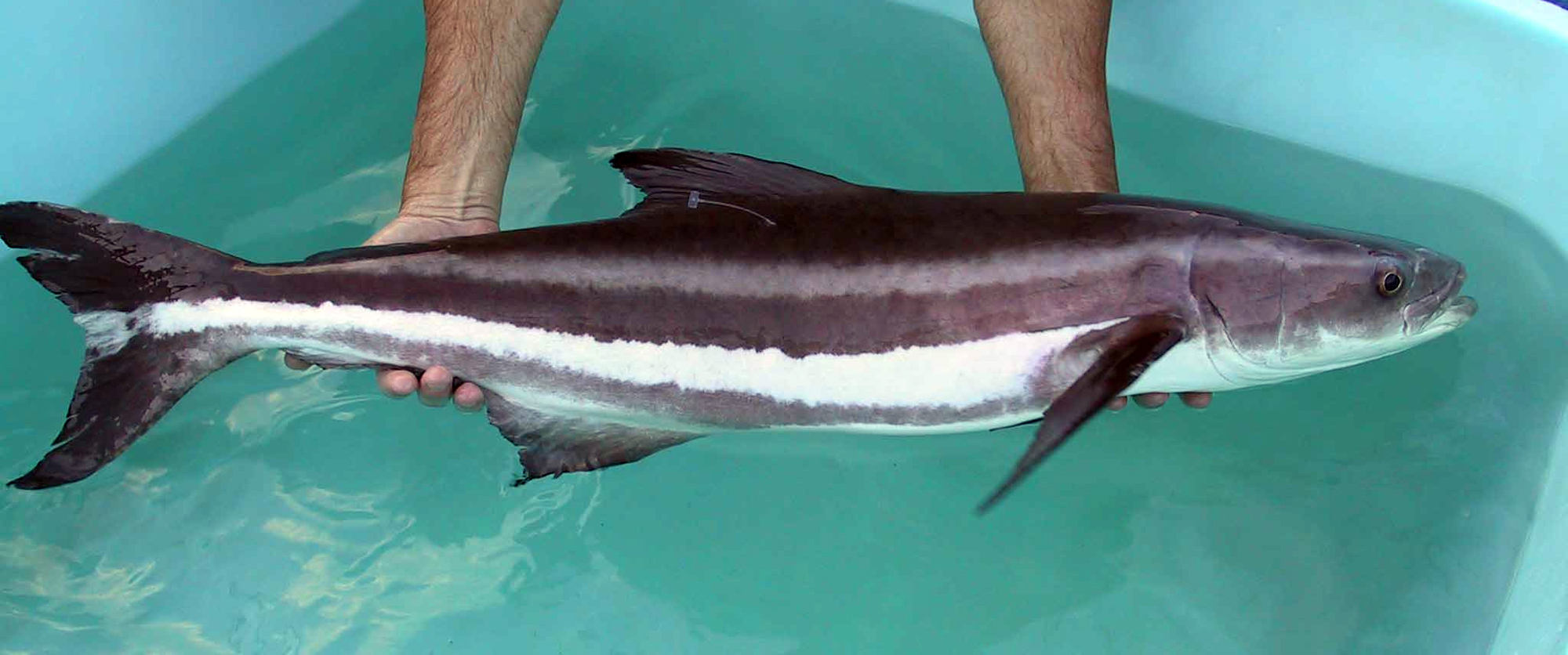
For two years I was managing editor of the Mid-Atlantic edition of The Fisherman, and during that stretch I spent a lot of time on the lower Chesapeake in June, mostly chasing cobia. It is, by my reckoning, the most fun light-tackle saltwater fishing in the Mid-Atlantic — a sight fishery for a powerful, weird-looking, hard-fighting fish that you can find sitting on top of the water in 20 feet of visibility, ten miles from the closest dock.
Cobia season on the Chesapeake runs roughly June through August. The fish push north out of the Atlantic on the spring migration, stage at the mouth of the Bay, and then push up into the deeper water of the lower-to-middle Bay following the warming temperatures and the bait. By peak season — late June into July — you can find them sunning at the surface, holding on buoys, riding sharks and rays, and stacked at known structure like the CBBT pilings and the artificial reefs.
This is the cobia fishery the writers don’t talk about as much as the Gulf Coast or the Carolinas. It deserves more attention than it gets. Here is what I learned about it.
What you’re fishing for
Cobia (Rachycentron canadum) is one of the strangest-looking fish in saltwater — a long, dark-brown, sharklike body with a flat head, a small lower jaw, a row of dorsal spines, and a paddle tail that looks like a remora’s. Adults run 15-60+ pounds. The Chesapeake produces cobia of 30-50 lbs reliably and 60+ pound fish enough times each season that it’s not a fluke.
They’re a hybrid in behavior: pelagic feeders that follow bait and rays through open water, but also structure-oriented predators that hold on buoys, channel markers, and the pilings of the Chesapeake Bay Bridge Tunnel. You can fish them as a sight cast (top water, visible), as a structure soak (bottom rig with cut bait at a buoy), or as a chum-and-wait (anchored at productive water, chumming).
In Virginia, the Chesapeake cobia season has had specific harvest regulations and slot limits for years — they were significantly tightened in the 2010s after population concerns and have been adjusted multiple times since. Always verify current Virginia Marine Resources Commission and Maryland DNR regulations before keeping a fish. The slot is typically around 40-50 inches with a low daily limit (often one fish), with some years requiring catch-and-release only or harvest permits.
When to fish
The Chesapeake cobia run divides into stages:
Late May through mid-June: arrival. First fish push into the lower Bay around the mouth and the CBBT. Water temperatures climbing through the upper 60s into the 70s trigger the move. Fish are spread out, often deeper, and the bite is sporadic but quality.
Mid-June through late July: peak. Fish stack at the southern structure and push north up the Bay. The classic “sunning” pattern — cobia laying on their sides at the surface in calm water — develops as water temperatures climb past 75°F. Sight casting becomes the primary technique.
Late July through August: transition. Bigger fish push further up the Bay. The middle Bay (around Smith Point, the Targets, the Hampton Roads area) holds fish. Heat means dawn-and-dusk windows are sharper.
September: most fish drop back down and out. By mid-September the season is effectively over, though scattered cobia can be caught into early October some years.
If you can pick one window for a Chesapeake cobia trip, the last week of June into the first week of July is the magic. Water clear and warm, fish stacked at known spots, sight fishing in full effect.
Where to go
The Chesapeake cobia fishery has a hierarchy of productive spots:
The CBBT (Chesapeake Bay Bridge Tunnel) complex. The classic structure. Pilings, tunnels, abrupt depth changes, current. Cobia hold around the pilings and stage at the depth changes. Fishing the CBBT is regulated — verify VMRC rules — and it’s a crowded, competitive fishery in peak season. But it produces big fish year after year.
The artificial reefs of the lower Bay. Numerous reefs — Triangle Reef, Tower Reef, Wolf Trap Reef — hold cobia stacked on the structure. Anchoring upcurrent and chumming is the classic technique. These spots are less crowded than the CBBT but require a real boat and offshore experience.
Buoys and channel markers. Every red and green can in the lower Bay can hold a cobia in season. The technique is to motor slowly, check each marker from 50-100 yards out, and look for a fish on or near the structure. If you see one, pitch a live eel, jig, or bucktail at it. Some markers hold a single resident fish for days at a time.
The open Bay, around rays. This is the sight-cast game most associated with Chesapeake cobia. Cobia have a symbiotic relationship with cownose rays — they hide in the rays’ shadow and grab bait flushed up by the ray. In June and July, every cownose ray cruising the surface of the lower Bay needs to be checked. Many have a cobia or two riding on the back or just behind.
The mouth of the Bay (Cape Henry, Cape Charles). First-arrival zone in late May/early June, and the staging area for fish leaving in September.
The middle Bay (Smith Point, Reedville, the Targets). Later-season zone for fish that have pushed up the Bay.
The sight cast — how it actually works
If you’ve never sight-cast a cobia, here’s what it looks like:
It’s a flat-calm day, mid-morning. You’re idling slowly across 20-30 feet of clear water, looking. Two people on the bow, polarized sunglasses, scanning. You’re not running a search pattern — you’re putting yourself in the path of known cobia traffic between two pieces of structure.
Then someone says: “Ray, ten o’clock, fifty yards.” You idle toward it.
The cownose ray is hanging in the upper water column, dark wings flapping slowly. You ease the boat to within casting distance. As you get closer, you see it — a dark, sharklike shape sitting just over the ray’s back. The cobia.
Cast a 4-inch white bucktail with a Z-Man Jerk ShadZ trailer past the cobia and let it sink in front of him. Twitch it. Pause. Twitch.
He comes off the ray, follows the lure, and crushes it.
That’s the textbook. In reality, half the cobia don’t commit. Some swim under the boat. Some sound. Some refuse the lure and you watch them disappear into the murk. But when one eats, you get a 30-40 pound fish making a hard, sustained run on light tackle. The strike, the follow, and the commitment are the most visual fishing in the Mid-Atlantic.
The “stay and soak” approach
If you don’t want to chase rays, the other reliable Chesapeake technique is to anchor up at known structure and wait.
Pick a productive reef or buoy. Anchor up-current of it. Set out a chum slick (ground menhaden in a chum bag overboard). Drop two or three rods with live eels, live spot, or cut bait (mullet, menhaden chunks) on circle hooks with light egg sinker rigs.
This technique requires patience. You may sit two hours without a hit. Then a fish comes through and crushes one or two baits in five minutes. The bite is binary — nothing happens or everything happens.
It’s the technique to use when:
- The water’s too rough or stained for sight fishing
- You’re fishing with a less mobile crew (older anglers, kids)
- The fish are deeper / scattered / not on the surface
Tackle
Cobia tackle is heavier than light-tackle inshore but lighter than offshore.
Sight-cast spinning setup:
- 7’6″ to 8′ medium-heavy spinning rod
- 5000-6000 size spinning reel (Penn Slammer IV 5500, Shimano Saragosa SW 6000)
- 30-50 lb braid mainline
- 4 ft 50-80 lb fluorocarbon leader
Lures for sight casting:
- 4 to 6-inch white bucktail with a paddle-tail trailer (the classic Chesapeake cobia bait)
- 5-inch Z-Man Jerk ShadZ on a heavy weighted hook
- A SubWalk or a topwater spook for active feeding fish
- A live eel on a 7/0 circle hook (the absolute deadliest)
Anchored / chumming setup:
- 7′ medium-heavy conventional rod, 6500-class reel
- 50-65 lb braid, 80 lb fluoro leader
- 7/0-10/0 circle hooks, 1-3 oz egg sinker rigs
What I learned
Some specific things from those Mid-Atlantic editor years that I wish someone had told me at the beginning:
Chum is more important than people think. A productive chum slick doesn’t just attract cobia. It attracts the bait the cobia follow — and the rays. A fresh chum slick at the right structure on a good day will bring rays in within 30 minutes, and the cobia follow.
Cobia are SMART. They follow lures back to the boat constantly. Many are caught on the second or third cast at the same fish — the cobia gets curious, the lure gets a few twitches at boatside, and the fish commits on the figure-8 (yes, the figure-8 isn’t just for muskies). Don’t pull the lure out the moment a cobia follows it. Slow it down, give the fish a second look, let him commit.
Live eels are devastating. Where allowed, a live eel on a circle hook is the single most effective cobia bait in the Bay. Bait shops in Virginia Beach, Cape Charles, and Hampton stock them in season. They’re worth the cost.
A cobia’s first run will spool a careless angler. They go HARD on the first run, sometimes for 100+ yards. Don’t overtighten the drag. Let them take line, then work them back with smooth, sustained pressure.
Boat handling is half the game. Sight fishing cobia means stopping in time, drifting properly, repositioning quickly when a fish moves. A good captain on the cobia grounds is half the equation. The other half is the angler making the cast.
A note on conservation
The Chesapeake cobia stock has been in management discussions for over a decade. Population concerns in the 2010s led to tightened regulations. The fishery has shown signs of recovery, but the harvest pressure on a fish that grows slowly and concentrates in known structure is real.
The best practice among Mid-Atlantic cobia anglers I respect:
- Keep one fish per trip MAX, even when the legal limit might allow more
- Use circle hooks on all bait rigs
- Release any fish under 40 inches even if legal to keep
- Don’t drag cobia over the gunwale by the head — they injure easily
- Don’t release a fish that fought to exhaustion in 85+ degree water without proper revival
- Pinch your hook barbs if you’re catch-and-release fishing
The Mid-Atlantic cobia run is a fishery worth protecting. Every angler who fishes it has a vote in whether it survives.
What a great day looks like
A great Chesapeake cobia day for me — and I had a handful of them across those two managing-editor years — meant three or four sight-cast fish hooked, two landed, one bigger than 35 lbs. The other half of the day was looking. Looking at the water. Looking at the rays. Idling slowly between productive zones. Reading the surface for sunning fish.
The trip I remember most was an early July day out of Reedville with a captain whose name I’m keeping to myself. Slick calm. Water 76 degrees. Twenty feet of visibility. We saw 30+ cobia in eight hours, sight-cast probably fifteen of them, hooked five, landed three. The biggest was 48 lbs and ate a white bucktail on the second twitch from about 6 feet away. The captain didn’t even get the boat in neutral before the fish ate.
That’s the Chesapeake cobia at its best. You don’t get that every day. You don’t even get it most days. But when the conditions line up, in late June or early July, with the right captain and a calm enough surface to see the rays — there’s nothing else in the Mid-Atlantic quite like it.
Dennis Suler is a career outdoors writer and lifelong angler. He spent six years on the editorial staff of The Fisherman magazine as a field editor and managing editor — first editing the New Jersey reports section, then managing editor of the Mid-Atlantic edition. He also served as managing editor of Boater’s Digest magazine. He’s a member of the Outdoor Writers Association of America and writes for fishing.digital — covering 40+ U.S. fishing destinations with weekly reports, location guides, and feature articles.
This article is part of fishing.digital’s Mid-Atlantic regional coverage. For weekly reports across the Chesapeake Bay, Outer Banks, Delaware, and the rest of the Mid-Atlantic, visit fishing.digital/newsletter and subscribe to fishing.digital Mid-Atlantic Weekly.
Planning a trip to Chesapeake Bay?
This report tells you what happened. ReelAI tells you what to do about it — a briefing for your date, your target species and how you're fishing, built from our reports plus live NOAA and USGS data.
Powered by ReelAI — fishing.digital's intelligence layer. Answers are generated from fishing.digital reports and public NOAA, NWS and USGS data, and may be incomplete or out of date. Regulations and marine safety information are summaries only; always confirm with the responsible authority before you fish.