
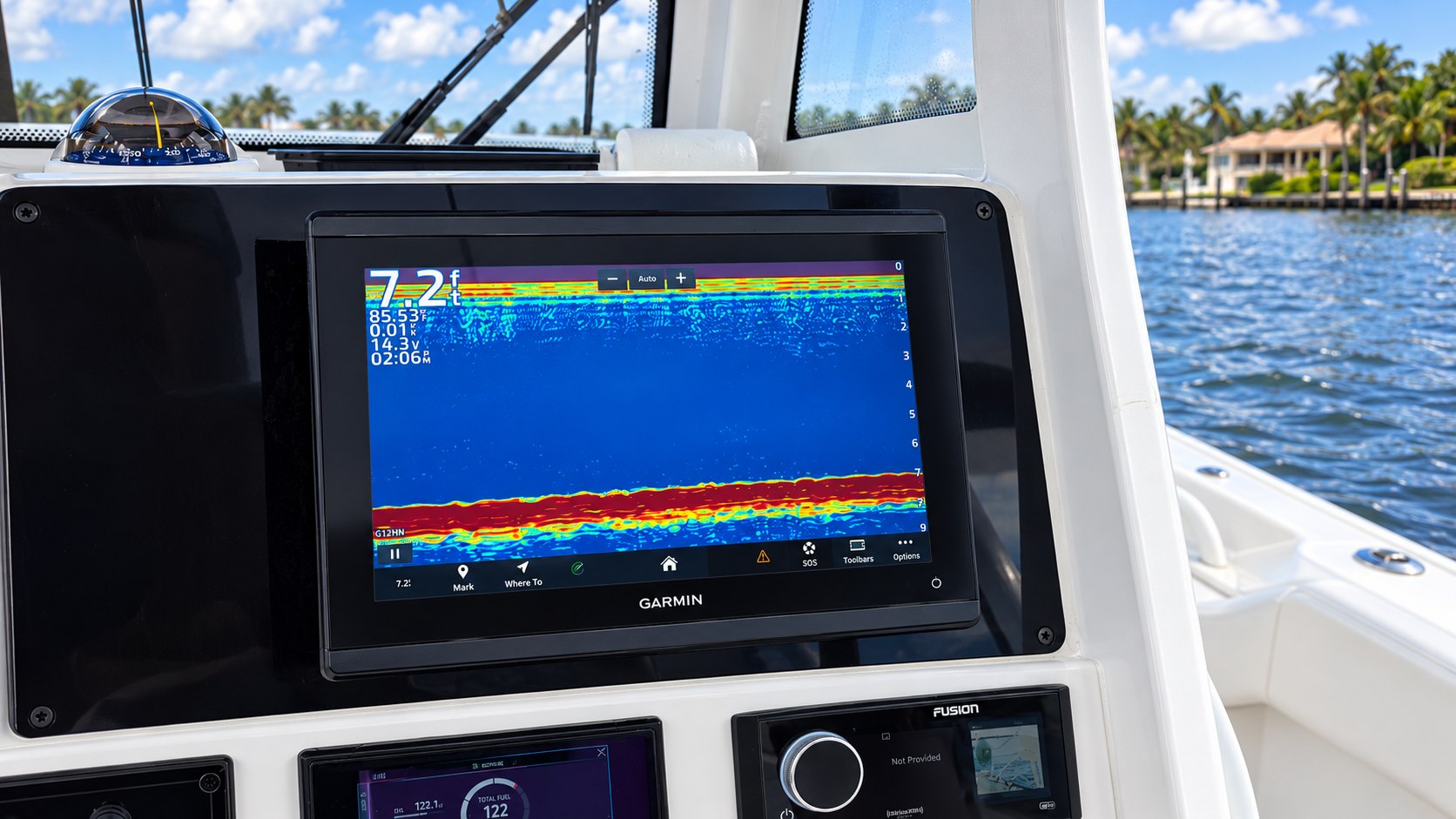
Bottom line: The Garmin STRIKER Vivid 7sv is our best sonar-value pick when the GT52 side-imaging package is available below $500. Choose the Lowrance Eagle 7 SplitShot when an easy-to-read screen, chart options and down-looking imaging matter more than side imaging. The Garmin STRIKER Vivid 5cv is the smarter compact choice for a kayak or small skiff. The Humminbird HELIX 5 CHIRP GPS G3 remains a strong five-inch mapping platform, but suffixes matter: the basic GPS model does not include down or side imaging.
Disclosure: Fishing.Digital may earn a commission from qualifying purchases through links on this page, at no additional cost to you. Dennis owns and uses Garmin marine electronics, and the installation photograph below is original. The individual sub-$500 recommendations are based on current manufacturer specifications, package contents, fishing application and value; we do not claim hands-on testing of every unit.
Reviewed October 31, 2026. Prices move frequently. Treat $500 as the maximum checkout price for the complete display-and-transducer package, not merely the display.

Best Fish Finders Under $500: Quick Comparison
| Pick | Best for | Included capability to verify | Main tradeoff |
|---|---|---|---|
| Garmin STRIKER Vivid 7sv | Best sonar value | GT52 transducer; CHIRP, ClearVu and SideVu | GPS plotting and Quickdraw, not a full ECHOMAP chartplotter ecosystem |
| Lowrance Eagle 7 SplitShot HD | Best screen and mapping path | SplitShot HD; CHIRP and DownScan | No side imaging in the SplitShot package |
| Humminbird HELIX 5 CHIRP GPS G3 | Best compact mapping platform | XNT 9 HW T transducer; Dual Spectrum CHIRP | Five-inch display; basic model has no DI or SI |
| Garmin STRIKER Vivid 5cv | Best kayak/small-skiff value | CHIRP and ClearVu transducer package | No SideVu; compact split views |
How We Selected These Units
We compared the features that materially change a fishing day: the transducer actually included, sonar views, display size and visibility, mapping capability, power needs, mounting space, warranty and the cost of completing the installation. We checked the current product descriptions against the manufacturers’ own specifications for Garmin, Lowrance and Humminbird.
We did not award points for features that require a different transducer, an extra chart card or a more expensive model. That is the most common weakness in budget fish-finder comparisons.
Best Overall Sonar Value: Garmin STRIKER Vivid 7sv
With the GT52 package, the seven-inch STRIKER combines traditional CHIRP, ClearVu, SideVu, GPS waypoints and Garmin Quickdraw Contours. SideVu is the decisive advantage for anglers searching broad flats, seawalls, creek channels, bridge approaches and freshwater structure without driving directly over every target.
- Pros: seven-inch display; three useful sonar views; user-generated one-foot contours; strong capability for the money.
- Cons: not the same full chart and networking platform as an ECHOMAP; package prices vary; good SideVu depends on a level, unobstructed transducer.
- Buy it if: locating structure and fish to both sides matters more than premium chartplotter features.
- Skip it if: detailed coastal charts, networking or future live-sonar expansion are requirements.
Compare current STRIKER Vivid 7sv GT52 packages
Best Screen and Mapping Path: Lowrance Eagle 7 SplitShot HD
The Eagle 7 SplitShot HD pairs wide-angle high CHIRP with DownScan Imaging on a seven-inch IPS display. Lowrance specifies an 800×480 display, 1,000-nit brightness, wide viewing angles and visibility through polarized sunglasses. Genesis Live can create half-foot contours, while the card slot supports software updates and chart additions.
- Pros: readable IPS screen; CHIRP plus DownScan; FishReveal; simple connectors; chart-upgrade path.
- Cons: SplitShot does not scan to the sides; listings differ by basemap or included chart package; the complete package may cross $500.
- Buy it if: you want straightforward sonar, strong screen visibility and a clearer path to conventional charting.
- Skip it if: side imaging is central to how you search shallow water.
Compare Eagle 7 SplitShot HD packages
Best Compact Mapping Platform: Humminbird HELIX 5 CHIRP GPS G3
The HELIX 5 CHIRP GPS G3 combines a five-inch 800×480 display, Dual Spectrum CHIRP, internal GPS, Humminbird Basemap, AutoChart Live and a microSD slot compatible with additional Humminbird and Navionics charts. Humminbird lists the XNT 9 HW T transducer with the base model.
- Pros: true built-in basemap; AutoChart Live; mature keypad interface; useful chart-card compatibility.
- Cons: small display for split views; one-year warranty; model suffixes can be confusing; base CHIRP GPS package is not a DI or SI model.
- Buy it if: mounting space is limited but built-in mapping matters.
- Skip it if: you regularly run multiple panels or need side imaging.
Compare HELIX 5 CHIRP GPS G3 packages
Best for Kayaks and Small Skiffs: Garmin STRIKER Vivid 5cv
The 5cv delivers traditional CHIRP, ClearVu, GPS waypoints and Quickdraw contours in a smaller package. For a kayak, the practical advantage is not merely price: the compact display leaves more room for rod holders, a camera, controls and safe paddle or pedal movement.
- Pros: compact footprint; proven CHIRP/ClearVu combination; money remains for a proper battery and mount.
- Cons: no SideVu; smaller split views; GPS plotting is not full marine charting.
- Buy it if: you fish vertically or along known structure from a kayak, jon boat or compact skiff.
- Skip it if: you want to scan large areas to both sides.
Compare current STRIKER Vivid 5cv packages
Which One Should You Buy?
- Inshore boat: STRIKER 7sv for SideVu and structure search.
- Kayak: STRIKER 5cv for compact simplicity; move to the 7sv only when screen space and battery capacity support it.
- Freshwater mapping: HELIX 5 when built-in basemap and compatible lake cards outweigh screen size.
- Polarized-glasses visibility and chart options: Eagle 7 SplitShot.
- Mostly vertical jigging: save money on side imaging and prioritize traditional CHIRP, target separation and screen placement.
The Package-Number Trap
A display name does not tell you what is in the box. Confirm the manufacturer part number, exact transducer, mapping package, power cable, mounting bracket and warranty before checkout. A display-only bargain can cost more after adding a transducer. Likewise, “GPS” may mean waypoints and tracks rather than detailed navigational charts.
Budget for the Complete Installation
| Item | Why it matters |
|---|---|
| Marine or kayak battery | Must cover display draw and trip duration with reserve |
| Fuse and wiring protection | Protects the circuit and reduces voltage problems |
| Display mount | Positions the screen for glare, reach and safe operation |
| Transducer mount | Keeps the transducer level and in clean water |
| Sealant and cable management | Protects penetrations and prevents chafe |
| Chart card, if needed | Adds detailed charting only when compatible |
Installation Lessons That Matter More Than Brand
Mount the display where it can be read without leaving the helm or fishing position. Put the transducer in clean water, level at normal running attitude and clear of strakes, propeller turbulence and hull obstructions. Fuse the positive lead near the source. Keep sonar wiring away from trolling-motor power where practical. On a kayak, use a mount that protects the transducer during launching and landing.
Frequently Asked Questions
Is side imaging worth paying for?
Yes for anglers who search shorelines, flats, docks and structure away from the boat. It matters less when fishing vertically over known spots.
Is a seven-inch screen much better than five inches?
For split sonar and chart views, yes. Five inches remains useful when mounting space, cost and power consumption matter more.
Can a fish finder replace a marine chartplotter?
Not automatically. Some budget units emphasize waypoints, tracks and user-generated contours. Confirm detailed chart compatibility and carry an independent navigation backup when navigation is safety-critical.
What is the best choice for saltwater?
Any of these can work when installed correctly and protected from corrosion. Rinse exposed hardware, use marine-grade connections and verify that the selected charts and transducer fit the depth and water you fish.
Final Verdict
Buy the STRIKER Vivid 7sv with the GT52 when SideVu and maximum sonar capability lead the decision. Buy the Eagle 7 SplitShot when screen visibility, DownScan and chart options matter more. Choose the HELIX 5 for compact built-in mapping, or the STRIKER 5cv when a simple kayak installation is the priority. Do not purchase until the exact transducer and package number are visible.
Related Fishing.Digital Guides
Compare our best inshore fishing kayaks, then monitor verified seasonal offers in the fish-finder and kayak deal tracker.
Planning a trip to Fishing Gear?
This report tells you what happened. ReelAI tells you what to do about it — a briefing for your date, your target species and how you're fishing, built from our reports plus live NOAA and USGS data.
Powered by ReelAI — fishing.digital's intelligence layer. Answers are generated from fishing.digital reports and public NOAA, NWS and USGS data, and may be incomplete or out of date. Regulations and marine safety information are summaries only; always confirm with the responsible authority before you fish.