
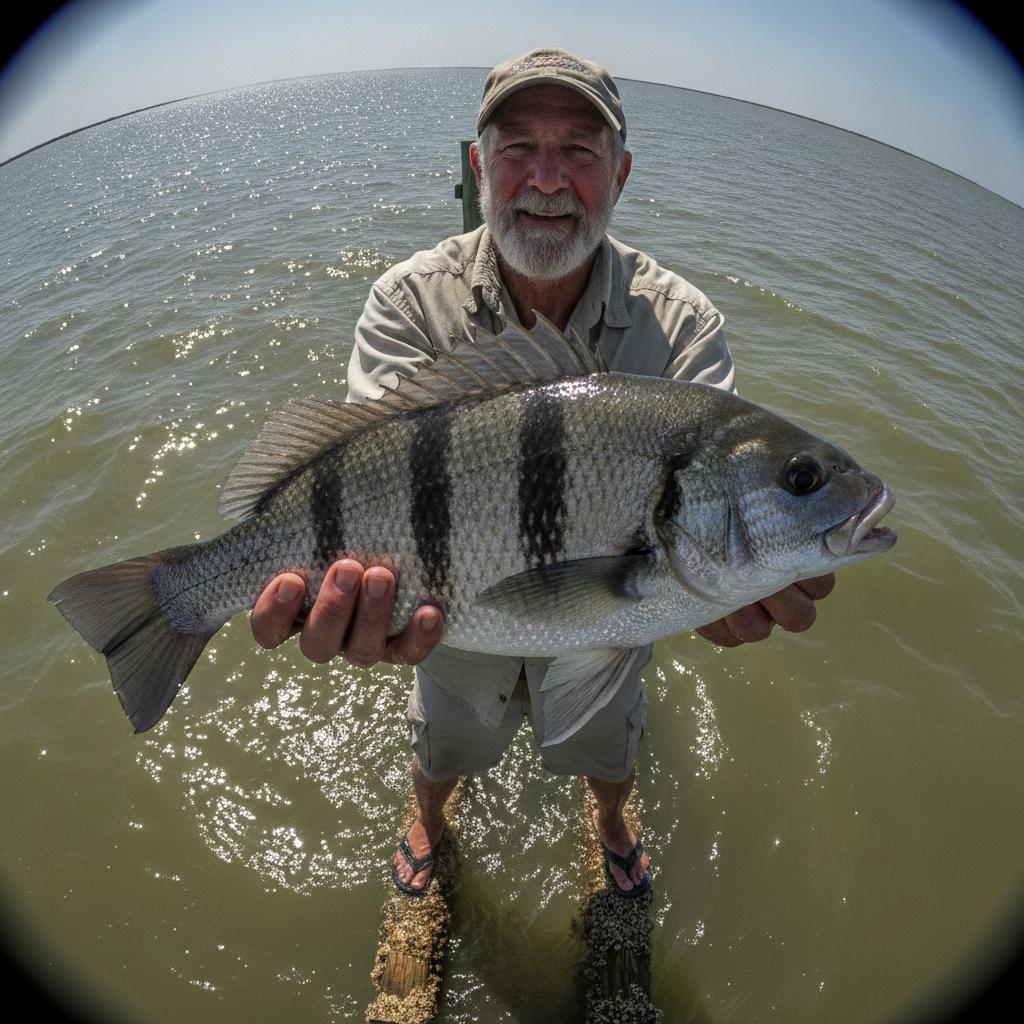
Sheepshead are one of the most rewarding inshore fish in saltwater. They’re delicious, they fight harder than their reputation suggests, and they’re famously difficult to hook. The combination of a soft, careful bite and a mouth full of human-looking teeth designed to crush shellfish makes them a true puzzle to solve. Once you crack the code, you’ll have a year-round inshore target available from Massachusetts to Texas.
This guide covers everything you need to catch sheepshead consistently: when and where to find them, the tackle that works, the baits that actually produce, and the regulations that vary by state.
About Sheepshead
Sheepshead (Archosargus probatocephalus) get their nickname — the “convict fish” — from the five to seven distinctive black vertical stripes running down their silver-gray flanks. They have a deep, compressed body shape and a mouth full of incisors and crushing molars that look uncannily like human teeth. Those teeth aren’t decoration: they’re specialized tools for crushing shellfish, barnacles, crabs, and the occasional small fish.
Sheepshead range from Nova Scotia south through the Atlantic, around Florida, and throughout the Gulf of Mexico to northern Mexico. They’re most abundant from the Carolinas south through the Gulf states. The state record varies widely by region but the IGFA all-tackle world record stands at just over 21 pounds — caught off New Orleans, Louisiana. A 5 to 8 pound fish is a quality catch anywhere.
When to Catch Sheepshead
The best sheepshead fishing happens during the cooler months when the fish stack tight on structure ahead of their spring spawn. Late January through April is peak season across most of their range, with the absolute best window typically running February through March. During these months, large numbers of fish concentrate around bridge pilings, jetties, oyster bars, and offshore artificial reefs in preparation for spawning.
That said, sheepshead can be caught year-round in their range. Summer fish are scattered and harder to target, but they’re still around inshore structure. After spawning, the larger fish move offshore to deeper reefs and wrecks where they can be caught alongside snapper and grouper through summer and fall. As water cools again in October and November, they return inshore and the cycle repeats.
Tide-wise, sheepshead bite best during moving water — the first two hours of an outgoing tide and the last two hours of an incoming are prime windows. Slack tides almost always produce a noticeable slowdown. New and full moon periods, with their stronger tidal flow, tend to produce the most aggressive feeding.
Where to Find Sheepshead
Sheepshead are structure fish. They feed on barnacles, crabs, mussels, and other crustaceans scraped from hard surfaces, so any vertical or horizontal structure with growth on it can hold fish. The classic sheepshead spots include:
- Bridge pilings. Concrete or wooden pilings encrusted with barnacles are sheepshead magnets. Every major saltwater bridge in their range — the Skyway in Tampa, the Bob Sikes in Pensacola, the Hathaway in Panama City, the Mayport jetty rocks in Jacksonville, the Three Mile Bridge — has produced trophy sheepshead.
- Jetty rocks. The rocks at every major inlet hold sheepshead, especially the deeper outer ends where current creates eddies. Fish the seams where current meets calm water.
- Dock pilings. Private docks in canals and marinas hold staging sheepshead during cooler months. The bigger fish often hold under the deeper end of the dock during outgoing tides.
- Oyster bars. Live oyster bars in 3 to 8 feet of water at high tide hold sheepshead feeding on the crabs and shrimp hiding in the shells.
- Artificial reefs and wrecks. Offshore reefs in 30 to 80 feet of water hold post-spawn sheepshead through summer. Fish them like you’d fish snapper but with sheepshead-specific bait.
- Channel markers and pilings. Any standalone piling in a channel attracts barnacles and crustaceans, which attracts sheepshead.
Tackle for Sheepshead
Rod and Reel
You need a rod with a sensitive tip that telegraphs the soft sheepshead bite, paired with enough backbone to pull a 5-pound fish away from barnacle-covered structure before it cuts you off. A 7-foot medium-action spinning rod is the classic choice for inshore sheepshead. For bridge and offshore work where bigger fish are common, step up to a medium-heavy rod with more lifting power.
Pair it with a quality saltwater spinning reel in the 3000 to 4000 class, like a Penn Battle III or Shimano Stradic FL. The drag matters more than the gear ratio for this fishery — sheepshead make short, powerful runs into structure when first hooked.
Line and Leader
Run 15 to 20 pound braided line for the main line — its thin diameter handles current well and gives you the sensitivity needed to feel the bite. Tie on a 20 to 30 pound fluorocarbon leader, typically 18 to 24 inches long. Heavier leader (25 to 30 lb) is justified around heavy structure where abrasion is a real risk. For the lighter inshore docks and oyster bars, 20 pound fluoro is plenty.
Hooks and Rigs
The hook is everything. Use a small, sharp hook — sizes 1, 1/0, or 2/0 are standard. Many sheepshead anglers swear by the Owner Mosquito hook or Gamakatsu Octopus hooks for their needle-sharp points that penetrate the bony sheepshead mouth.
The two standard rigs are a knocker rig (a sliding egg sinker right above the hook with no swivel between) or a jighead with the bait threaded on. The knocker rig keeps the bait pinned to the structure where the fish feed. A 1/4 to 1/2 ounce jighead is the favorite of many guides because it keeps everything on one hook and feels every bite directly.
Bait: What Sheepshead Actually Eat
The single most important bait for sheepshead is the fiddler crab. Small (thumbnail-sized) live fiddlers are the gold standard everywhere sheepshead swim. Hook them through the carapace from the back, threading the hook so the point exits between the eyes. A fiddler crab on a small jighead, fished tight to structure, will outproduce any other bait on a given day 9 times out of 10.
Other proven sheepshead baits:
- Live shrimp. Always productive, easy to find at any bait shop. Hook through the tail and let it drift naturally with the current.
- Oysters. Fresh oyster meat is killer, especially at the bigger structures where fish are conditioned to feeding on them. Use cracked oysters if you can get them.
- Sand fleas. Excellent at the jetties and around beach pilings. Hook from underneath so the point exits between the legs.
- Mussel meat. A favorite around bridge pilings. Tougher than shrimp and stays on the hook longer.
- Barnacles. Some guides scrape barnacles off the pilings and chum with the live meat. The fish go nuts.
- Hermit crabs. Small hermit crabs, with the shell broken off, are dynamite. Effort-intensive to catch but produce big fish.
Technique: How to Hook a Sheepshead
Here’s the secret that takes most anglers years to figure out: sheepshead bite by sucking, not biting. When a sheepshead picks up your bait, you don’t feel a strike. You feel pressure that wasn’t there a moment ago, or a slight twitch, or just the bait stopping. By the time you feel anything resembling a “bite,” the fish has already had the bait in its mouth, crushed it, and possibly spit it back out.
The technique that works:
- Lower the bait straight down tight to the structure. No casting — you want to be vertical so you can feel everything.
- Keep a tight line. Any slack and you’ll miss the bite.
- The moment you feel anything different — pressure, twitch, mush, or weight that wasn’t there — set the hook immediately. Don’t wait to “feel” the bite.
- Reel down to the fish on the hookset, sweeping the rod tip up and to the side rather than over the head.
- Lift the fish away from structure immediately. If you let them dive back to the pilings, they will cut you off on barnacles.
Most beginners miss 80% of sheepshead bites. With practice and the right hooks, that number drops to 40%. The best sheepshead anglers in the country still miss 20%. It’s part of the game.
Eating Sheepshead
Sheepshead are excellent table fish. The meat is white, firm, and mild with a slight sweetness. They clean a little harder than other inshore fish because of the scales and bone structure — the rib bones are tough — but the fillets are worth the effort. Pan-fried, blackened, or fried in a beer batter, sheepshead are first-class eating fish. Many Gulf Coast anglers rate them above redfish for the table.
State-by-State Regulations
Sheepshead regulations vary significantly by state. Always verify current rules with the state wildlife agency before keeping fish.
- Florida: 12-inch minimum size, 8-fish daily bag limit per angler. No closed season.
- Alabama: 12-inch minimum, 10-fish bag limit. No closed season.
- Mississippi: 12-inch minimum, 15-fish bag.
- Louisiana: No size limit, 8-fish bag.
- Texas: 15-inch minimum, 5-fish bag.
- Georgia: No size limit, 15-fish bag.
- South Carolina: 14-inch minimum, 10-fish bag.
- North Carolina: 10-inch minimum, 10-fish bag.
- Virginia: No minimum, 4-fish bag.
A valid state saltwater fishing license is required everywhere. Penalties for over-bag or undersized fish can be significant — when in doubt, release.
Where to Catch Sheepshead by Location
If you’re looking for the best sheepshead waters in the country, here are the standouts:
- Florida’s Tampa Bay — bridges and pilings in the bay system produce trophy fish February through April
- Pensacola Bay — Three Mile Bridge, Bob Sikes Bridge, and the artificial reefs in 30-60 feet
- Panama City Beach — Hathaway Bridge pilings and the offshore reefs
- Jacksonville — Mayport jetty rocks, the bridges of the St. Johns, and Sister’s Creek railroad bridge
- Mobile Bay, Alabama — bridges and oyster reefs throughout the bay
- Louisiana’s marshes — oyster reefs in the brackish bays
- Texas’s bay system — Galveston, Matagorda, San Antonio Bay piers and bridges
Sheepshead reward patience and attention to detail. Once you learn to feel the bite and time the hookset, they become a fish you can catch reliably, year after year, on the same structure. That makes them one of the best “always available” inshore options anywhere in their range.
Tight lines and may your hookset timing be true.
Affiliate disclosure: Some of the links above are Amazon affiliate links. If you click through and buy something, fishing.digital may earn a small commission at no extra cost to you. We only recommend gear we’d use ourselves.
Planning a trip to Saltwater Fishing?
This report tells you what happened. ReelAI tells you what to do about it — a briefing for your date, your target species and how you're fishing, built from our reports plus live NOAA and USGS data.
Powered by ReelAI — fishing.digital's intelligence layer. Answers are generated from fishing.digital reports and public NOAA, NWS and USGS data, and may be incomplete or out of date. Regulations and marine safety information are summaries only; always confirm with the responsible authority before you fish.