
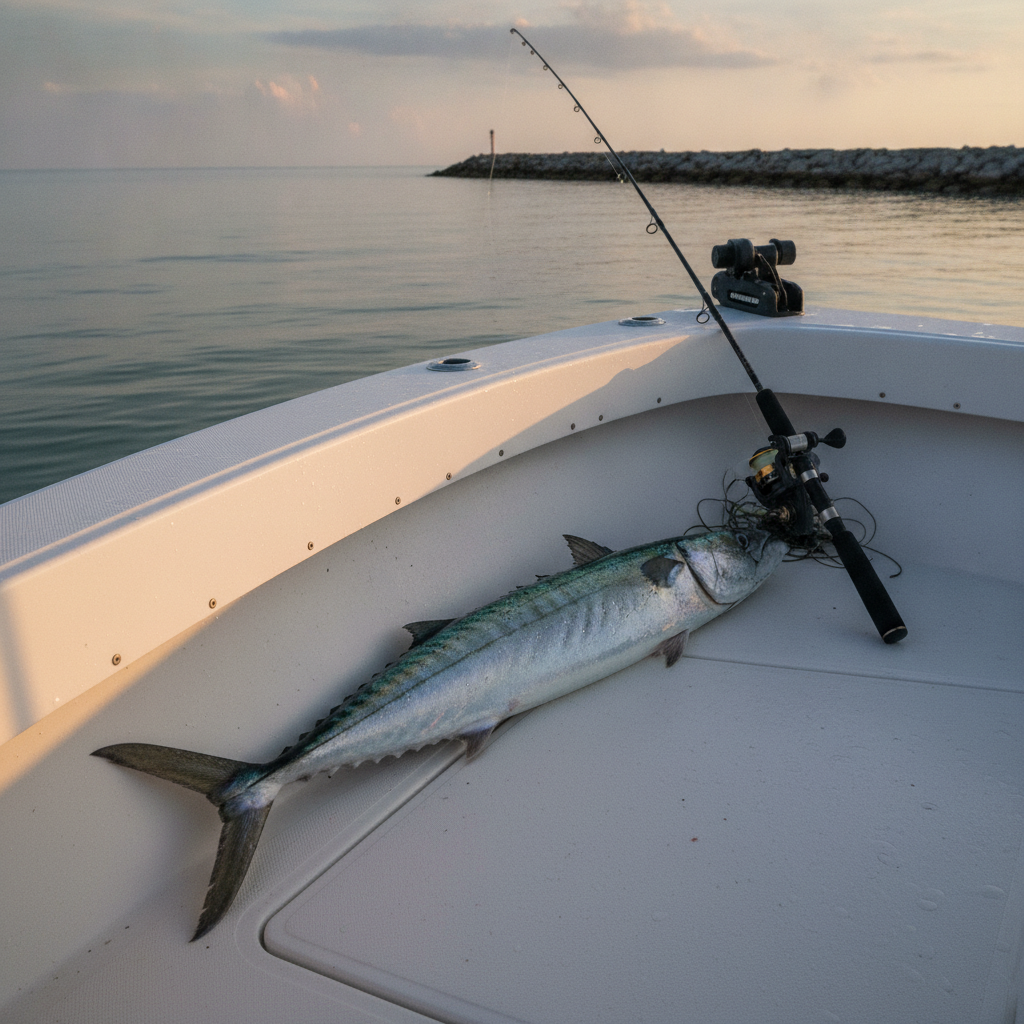
This week the Northeast Florida coast is in the deepest part of its summer pattern. Ocean water is holding in the low 80s, the river is warm and stained from the summer rain, and the sea breeze goes from nothing at daybreak to fifteen knots by early afternoon. It is a morning fishery right now, and a very good one if you are on the water before the sun clears the trees.
What’s Hitting
Kingfish are the headline on the nearshore reefs and wrecks, mixed with hard-charging Spanish mackerel and the occasional cobia. Mangrove snapper are excellent along the St. Johns jetty rock and the deeper river structure. Redfish are working the marsh grass hard on the flood tide, with schools in the creek mouths on the fall. Flounder are showing on the jetty rocks and the deeper creek bends. Offshore, bottom fishing in 90 to 130 feet has been steady for a mixed bag.
Where to Find Them
Work the reefs and wrecks in 40 to 80 feet off Mayport for kings and macks — look for bait showing on the sounder and birds working before you commit. The north and south jetties hold snapper and flounder on the last of the incoming. For redfish, the Nassau Sound marsh, the Clapboard Creek system and the flooded grass off Sisters Creek are the highest-percentage water. The Intracoastal dock lines north and south of the Sisters Creek bridge hold fish through the middle of the tide.
Tides & Conditions
Tidal range is moderating this week off the waxing moon, but Northeast Florida still moves a lot of water — plan the marsh work around the top of the flood. River water is stained and warm; ocean water clears up quickly a couple of miles out. Morning seas are two feet or less with light wind, building to three feet and a chop by early afternoon. Afternoon thunderstorms are a daily fixture inland with some drifting to the beaches.
Tackle & Tactics
For kings, slow-troll a live pogy on a stinger rig with light wire — 4000- to 6000-size spinners or light conventional gear, 30-pound braid, and patience on the drop-back. Spanish will hit the same baits but you will convert more on a long shank hook and a fast retrieve. Inshore, a 3000-size spinner with 20-pound braid and 25- to 30-pound fluorocarbon covers reds and flounder. A quarter-ounce jighead with a paddletail bumped along the bottom is the flounder rig; live mud minnows and cut mullet are the reliable redfish baits in the grass.
Local Intel This Week
The Sisters Creek Marine Park ramp is the workhorse launch for the jetties and the north marsh, Mayport’s Helen Cooper Floyd Park ramp puts you closest to the inlet, and the Goodbys Creek and Mandarin Point ramps serve the upper river. Shore anglers are catching snapper and flounder off the Huguenot Memorial Park side of the north jetty. Fish are concentrating on hard structure and current seams — jetty rock, creek mouths, dock lines. Check current FWC and federal South Atlantic regulations and seasons before keeping any fish.
This Week’s Tip
On the flood-tide marsh, do not fish the grass line — fish the drain. Every stretch of flooded spartina has one or two low spots where the water pours back off the bank as the tide turns. Position down-current of a drain and let bait wash to you. That is where the redfish set up, and they set up there every single tide.
Planning a trip to Jacksonville?
This report tells you what happened. ReelAI tells you what to do about it — a briefing for your date, your target species and how you're fishing, built from our reports plus live NOAA and USGS data.
Powered by ReelAI — fishing.digital's intelligence layer. Answers are generated from fishing.digital reports and public NOAA, NWS and USGS data, and may be incomplete or out of date. Regulations and marine safety information are summaries only; always confirm with the responsible authority before you fish.