
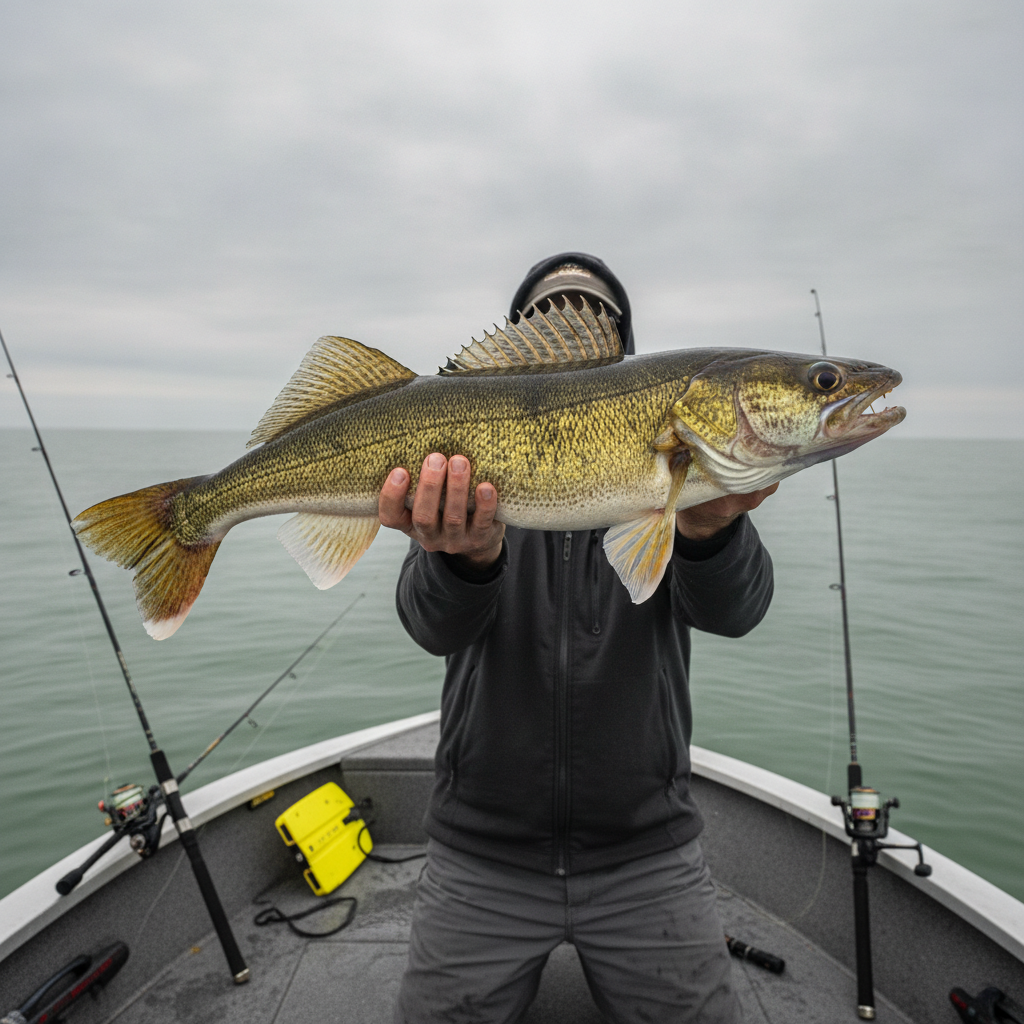
Lake Erie produces more walleye than any other body of water in the world. The 2003 spawning class — a single year-class — was so enormous that anglers were still catching its survivors as 25+ inch fish a decade later. The 2018 class was nearly as big. The 2020 and 2021 classes followed in turn. The result is a Lake Erie walleye fishery in the mid-2020s that, by any fisheries-science measure, is one of the great freshwater success stories of the post-pollution recovery era.
For traveling anglers, what this means is concrete: from May through September, the Western Basin of Lake Erie (roughly Toledo, Ohio east to Sandusky and out toward the Bass Islands) holds enough walleye to make limit catches the norm rather than the exception. Charter operations run boats every day of the season. The state of Ohio’s walleye limit (6 fish per angler per day in Ohio waters, with size and season variations) gets reached most days the weather lets boats fish.
It’s a high-volume, high-confidence fishery. It’s also a fishery that runs on specific tactics that out-of-area anglers consistently get wrong. Here is the framework for fishing it.
What you’re fishing for
Walleye (Sander vitreus) — the iconic North Central freshwater gamefish. The Lake Erie fishery is built around three classes of fish:
Eaters (15-20 inches, 1-3 lbs). The numbers fish. Limit catches are typically built around these. Excellent table fare.
Slot fish (20-25 inches, 3-6 lbs). The middle class. Strong fighters on the standard trolling tackle, excellent meals.
Trophies (25+ inches, 6-12+ lbs). The Western Basin produces 30+ inch fish (often called “magnums” by Lake Erie regulars) regularly. The state record is over 16 pounds. A 25-30 inch walleye on a downrigger is the headline catch most charter trips are chasing.
The Lake Erie walleye stock has been managed by the Lake Erie Committee (a joint Ohio/Michigan/Pennsylvania/New York/Ontario body) for decades. The science-based total allowable catch (TAC) system has produced one of the most well-managed game fish populations in North America. Always verify current state regulations before fishing — Ohio’s walleye season and limits have been adjusted multiple times over the years.
When to fish
The Lake Erie walleye season has distinct phases:
Late March through April: pre-spawn jig bite. Walleye stage at the mouths of Maumee and Sandusky river systems before spawning. The Maumee River jig bite — anglers wading or fishing from boats in 6-15 feet of water with weighted jigs — produces some of the most concentrated walleye fishing in the country. Limit catches in 90 minutes are common.
Late April through May: spawn and post-spawn recovery. Spawn happens in the river systems and on shallow reefs (4-8 feet) when water temperatures hit 42-48°F. Catch and release is encouraged during the spawn itself. Post-spawn fish drop back into the open lake and start feeding heavily.
Mid-May through July: peak open-water bite. The trolling fishery hits full stride. Fish are distributed across the Western Basin in 18-35 feet of water, feeding aggressively on emerald shiners, gizzard shad, and yellow perch. Charter pressure peaks. This is what most out-of-area anglers come to Lake Erie for.
August through September: late summer push. Fish move toward deeper, cooler water — 35-55 feet — and follow thermoclines. Trolling deeper and slower. Quality stays high; numbers decline somewhat.
October: fall feeding. Walleye push back shallower as water cools. Trolling and jigging both produce. Pressure drops dramatically as charter season winds down.
If you can pick one window for a first Western Basin trip, the third week of May through the second week of June is the textbook. Numbers, size, weather, and the charter availability all line up.
Where the fish are
The Western Basin is the shallowest, most productive area of Lake Erie. Average depth roughly 24 feet. The productive water for traveling anglers:
Off the Ohio mainland (Toledo to Port Clinton). 18-30 feet of water. Reef systems including the Camp Perry Reef, Crib Reef, Niagara Reef. The classic “in-front-of-the-Bass-Islands” fishery.
The Bass Islands area (Put-in-Bay / Kelleys / South Bass). Some of the most reliably productive open water in the lake. Reef-and-mudline edges. Productive from May through September.
The “shipping channel” area between Sandusky and the islands. 28-35 feet. Holds bigger trophy-class fish, particularly in July and August.
The Central Basin eastern edge (off Vermilion, Lorain, Cleveland). Deeper, often produces bigger average fish in summer but requires longer runs from ramps.
The Detroit River mouth area. Michigan side; produces pre-spawn fish and a strong fall run.
The standard Lake Erie charter operates out of Marblehead, Port Clinton, or Catawba Island on the Ohio side. These towns are set up around the fishery. Boat ramps, marinas, charters, hotels — all serve the walleye economy.
The dominant technique: trolling
Open-water Lake Erie walleye fishing is, overwhelmingly, a trolling fishery. The standard rig:
Setup:
- 7’6″ to 8’6″ medium-action trolling rod
- Line-counter conventional reel (Daiwa Sealine SG-LC, Shimano Tekota line counter, Okuma Magda)
- 15-20 lb monofilament mainline (NOT braid — mono stretches and acts as a shock absorber when a fish hits a deeply trolled bait)
- Bottom-bouncing or downrigger setups for depth control
The lures — three primary types:
1. Crawler harnesses with weighted spinners. A worm-trolling harness with a #4 or #5 Colorado or Indiana blade, three small hooks in series, threaded with a fresh nightcrawler. Trolled at 1.0-1.5 mph behind a bottom bouncer or off a downrigger. This is the technique that produces the bulk of Lake Erie walleye over the course of a season.
2. Stick baits (deep-divers). Reef Runners, Bandits, Smithwick Rogues — slim-profile minnow imitators that dive 15-25 feet. Trolled at 1.5-2.2 mph. Used when fish are higher in the water column or when the bite is more aggressive. Color choice matters: chartreuse, purple/silver, and the various firetiger patterns rotate through productive periods.
3. Crankbaits (general purpose). Berkley Flicker Shads, Walleye Cranks, Rapalas. Trolled at varying speeds. Often pulled from in-line planer boards to spread the lure presentation away from the boat.
Trolling speed: 1.0-2.2 mph depending on water temperature, fish activity, and lure type. Faster in warmer water, slower in early season cold water. This is dialed in by trial-and-error throughout the day.
Depth control: Downriggers, in-line weights, planer boards, snap weights, or lead-core line — multiple techniques for getting baits at the right depth. Modern Lake Erie charter boats run 6-10 rods with different presentations at different depths and the captain dials in what’s working.
The jig bite (early season and shoreline)
Apart from trolling, the other primary Lake Erie technique is jigging, particularly in early spring during the pre-spawn river run and in fall in shallower water.
Setup:
- 7′ medium-action spinning rod
- 3000-size spinning reel
- 10-15 lb braid mainline, 12-15 lb fluoro leader
- 1/4 to 1/2 oz jighead, depending on depth and current
- Plastic body (Berkley Powerbait Ripple Shad, Kalin’s, or similar) OR a fresh emerald shiner
Technique:
Cast or drift the jig to the bottom, hop it 1-2 feet off the bottom, let it fall, repeat. Walleye strike on the fall. The strike is often subtle — a tap or a slack line — and the hookset has to be immediate.
The Maumee River jig bite in late March / early April is the classic Lake Erie shoreline fishery. Hundreds of anglers stand shoulder-to-shoulder on the riverbanks at the Jerome Road and Maumee accesses. It’s a social fishery, weather-dependent, and one of the most reliable walleye experiences in the country.
What separates productive boats from the rest
Watching Lake Erie charter captains work shows specific patterns:
1. They troll different depths simultaneously. A productive Lake Erie boat runs lures from 12 feet down to 40 feet down at the same time, then dials in what’s working. Most weekend anglers run all their baits at the same depth, which guarantees they’re presenting to one slice of the water column at a time.
2. They change colors aggressively. Productive captains rotate harness blades and crank colors every 30-45 minutes if the bite is slow. Walleye color preference shifts with light angle, water clarity, and fish activity. Sticking with one color for hours misses bite windows.
3. They watch electronics constantly. Modern walleye charter boats run high-end side-scan and down-imaging sonar. The captain is reading bait, fish, and bottom contour in real time. Productive water is where the bait shows on the screen, not where it was productive yesterday.
4. They pay attention to other boats. Lake Erie charter captains all run the same general waters and watch each other. If three boats stop drifting and start trolling in tight circles, fish are there. The fleet is a real-time intelligence network.
5. They respect the wind. Lake Erie can build a 4-foot chop in 30 minutes when the wind picks up. Productive captains know when to push to the eastern productive water vs stay west, when to head to the Canadian side for protection, when to call the day. Bad weather days end early.
Trip logistics
Charter rate (2026 estimates): $500-800 for a half-day inshore trip for up to 6 anglers, $700-1200 for a full day. Most charters provide rods, reels, tackle, and the captain. You bring food, drinks, and a cooler for fish.
Ramps and home base:
- Marblehead / Catawba Island / Port Clinton, Ohio: Most charters and best ramp access
- Sandusky: Strong charter community, slightly different productive waters
- Vermilion / Lorain (Ohio Central Basin): Less crowded, deeper water focus
- Monroe, Michigan: Detroit River mouth, less crowded than Ohio waters
What to bring DIY:
- A licensed and registered boat (Ohio walleye fishing requires a registered watercraft for most productive water)
- Live emerald shiners or quality nightcrawlers (bait shops in Port Clinton are the standard source)
- The trolling tackle described above OR jigging tackle for shallower work
- A cooler for fish
- An understanding that Lake Erie can turn rough fast — radar, life jackets, weather monitoring
For first-time visitors: hire a charter for at least one day. The water-reading and gear-management skills you’ll absorb on a productive Lake Erie charter compress a season of self-learning.
What to do with the fish
Lake Erie walleye are exceptional table fare — firm, white, mild, one of the best freshwater eating fish in North America. Standard practices:
- Clean and ice quickly. Walleye go soft in warm water fast.
- Skin or fillet according to preference. Most charter captains will clean and bag fish for an additional fee ($1-2 per fish typical).
- Be aware of consumption advisories. The Ohio EPA and Michigan DNR both publish guidance on walleye consumption based on PCB and mercury levels — generally safe in moderate quantities but limits exist for sensitive populations (pregnant women, young children).
- Don’t keep more than the limit. Period.
The conservation note
Lake Erie’s walleye fishery is one of the most carefully managed game fish populations in the world. The Lake Erie Committee sets annual quotas based on stock assessment science. The recreational, charter, and commercial harvest is allocated and tracked.
What anglers should know:
- The fishery is healthy because it’s actively managed, not by accident
- Compliance with limits matters — overfishing has consequences for everyone
- Catch-and-release of trophy-class fish (25+ inches) is encouraged even when legal to keep — these are the breeders that built the modern fishery
- Don’t bring zebra mussels or invasive species between water bodies; clean, drain, and dry boats and gear
The Lake Erie walleye fishery exists in its current form because the cooperative US/Canadian management between five jurisdictions has worked for 40+ years. Each generation of anglers inherits the responsibility.
Final thought
For traveling anglers, Lake Erie offers what very few American fisheries can — a high-volume, reliably-productive game fish fishery with a robust charter infrastructure, professional captains, and a year-class structure that means good fishing almost every season.
The barriers to entry are low. The bite is reliable. The fish are excellent eating. And the experience of hauling a 25+ inch walleye to the surface on a downrigger ten miles off the Ohio coast, with the Bass Islands on the horizon, is one of the most distinctively American freshwater fishing experiences left in the country.
For anglers who’ve only fished moving-water walleye (rivers, tailrace, smaller lakes), the open-water Lake Erie experience is a different fishery entirely. The boat handling matters more. The electronics matter more. The depth control matters more. But the fundamentals — slow trolling, color rotation, bottom relationship — translate.
Worth a trip. Worth multiple trips.
Dennis Suler is a career outdoors writer and lifelong angler. He spent six years on the editorial staff of The Fisherman magazine as a field editor and managing editor — first editing the New Jersey reports section, then managing editor of the Mid-Atlantic edition. He also served as managing editor of Boater’s Digest magazine. He’s a member of the Outdoor Writers Association of America and writes for fishing.digital — covering 40+ U.S. fishing destinations with weekly reports, location guides, and feature articles.
This article is part of fishing.digital’s Great Lakes regional coverage. For weekly reports across Lake Erie, the upper Great Lakes, Lake Champlain, and the Thousand Islands, visit fishing.digital/newsletter and subscribe to fishing.digital Great Lakes Weekly.
Planning a trip to Great Lakes?
This report tells you what happened. ReelAI tells you what to do about it — a briefing for your date, your target species and how you're fishing, built from our reports plus live NOAA and USGS data.
Powered by ReelAI — fishing.digital's intelligence layer. Answers are generated from fishing.digital reports and public NOAA, NWS and USGS data, and may be incomplete or out of date. Regulations and marine safety information are summaries only; always confirm with the responsible authority before you fish.