
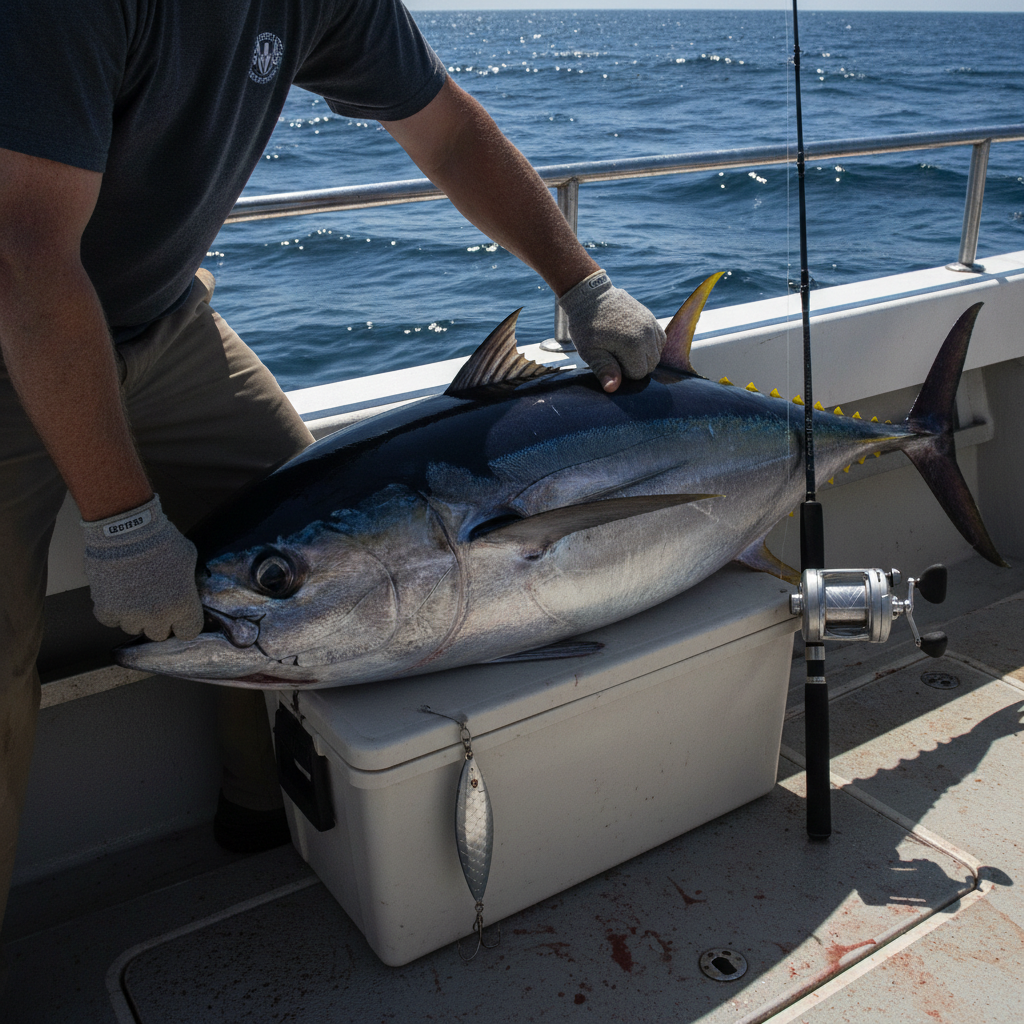
The San Diego long-range tuna fishery is one of the most distinctive sport fishing experiences in North America. From June through October, sportfishing boats running from San Diego harbors range out to fishing grounds that span from the Coronado Islands a few miles south, to the Cortes Bank 100 miles offshore, to the Mexican-permitted Lower banks 200+ miles down the Baja peninsula. The trips run from half-day local to 18-day long-range expeditions to deepwater banks most recreational anglers will never see.
The fish are bluefin tuna (50 to 300+ lbs), yellowfin (40-200+ lbs), bigeye, dorado, wahoo, and yellowtail (the local term for California yellowtail jack, a 15-50+ lb amberjack-class fish). The boats range from 60-foot day trips to 110-foot live-aboards with private staterooms. The fishery has a culture and vocabulary unlike any other US sport fishery — “sliding rigs,” “kite fishing,” “popper-fishing,” “the dollar wave” — that takes some study to enter.
For East Coast anglers used to charter boat half-day or full-day inshore work, the San Diego sport fleet is a different fishing economy. Boats run 24+ hours at sea routinely. Anglers sleep in bunks. Bait — live sardines, anchovies, and occasionally squid — is the central technique. And the productive fishing tends to happen in 50 to 100 miles offshore.
Here is the primer worth walking in with.
What you’re fishing for
The San Diego fleet targets several species across the summer season, with peak windows that shift by month:
Bluefin tuna. The headline species. The fish that have driven the West Coast tuna fishery’s expansion since roughly 2014, when warm water pushed schools north into California waters. Bluefin run from “schoolies” (50-80 lbs) to “cows” (300+ lbs, with occasional 400+ lb fish landed each season). The bluefin bite is the most unpredictable but most rewarding component of the fishery.
Yellowfin tuna. Reliable summer producer. 40-100+ lbs typical, with 200+ lb fish on the deeper grounds. Yellowfin push into California waters by mid-summer and stay through October most years.
Yellowtail (California yellowtail jack). The local hometown fish. 15-40 lbs typical, with 50+ lb fish from the lower banks. Reliable from May through October. Often the primary target on shorter trips.
Dorado (mahi mahi). Summer arrival. Found around floating kelp paddies and structure. 15-30 lbs typical.
Wahoo. Variable. Some years strong, some years thin. Often a bonus catch.
Bigeye tuna. Rare but possible on the longer-range trips. Trophy fish.
The “long-range” boats that run 5-18 day trips target Pacific Ocean banks (the Cedros, the Alijos Rocks, Hurricane Bank, the Ridge) where the largest fish hold. These trips can produce yellowfin and bluefin over 300 lbs.
The trip structure
The San Diego fleet runs trips on a clear stratification:
Half-day local (4-6 hours). Fishing around Point Loma, the kelp beds, the Coronado Islands. Yellowtail, calico bass, surface action. $50-100/person. Best for first-time visitors to learn the boat ride and the basic technique without a full commitment.
Full-day (12 hours). Out to the Coronados, the 9-Mile Bank, the 60-mile area. Yellowtail, dorado, smaller yellowfin and bluefin. $150-250/person.
Overnight (18-22 hours, 24+ if extended). The most popular tuna trip. Out to the 60-100 mile area or deeper. Bunk space included. Tuna are the primary target. $250-450/person.
1.5-day to 3-day trips. Multi-day, longer-range. Targeting bigger tuna in the productive offshore banks. Bunk sleeping, three meals/day included. $500-1500+/person.
Long-range (5-18 day trips). The premier experience. Custom boats with staterooms. Lower-banks fishing. $3,000-15,000+/person.
For traveling anglers visiting San Diego for a tuna trip, an overnight trip in late July through September is the standard recommendation. Long enough to fish productive water, short enough to be manageable, in the peak window when the fish are dependable.
When to fish
The season has phases:
May through early June: opening. Yellowtail dominate the local fishery. First bluefin show up at the Coronado Islands and offshore banks. Bite is sporadic but quality.
Mid-June through July: ramp. Yellowfin push in from the south. Bluefin numbers build. Dorado start showing. Trips diversify the catch.
Late July through September: peak. Full multi-species. Bluefin and yellowfin both reliable. Dorado abundant on kelp paddies. Yellowtail still strong. The classic San Diego summer experience.
October: late season. Bigger fish, fewer numbers. Bluefin can push into 200+ lb class. The “trophy month” for serious anglers.
November through April: The fleet shifts to local rockfish, sand bass, and the occasional bluefin pattern that stays north. The long-range overnight trips wind down.
If you want one trip, the last week of August or first week of September is the textbook San Diego experience. All species present, weather typically cooperative, water still warm.
The technique
San Diego sportfishing has its own technique culture. The fundamental approach:
Live bait fishing — the dominant method
The San Diego fleet runs on live bait. Boats stop at bait barges on the way out to load live sardines (the primary), live anchovies, and sometimes live mackerel. The bait is held in tanks aboard the boat and used throughout the trip.
The setup:
- 7′ to 8′ medium-heavy live-bait rod (specifically designed for sardine/anchovy presentations)
- 30-50 lb conventional reel or large spinning reel
- Mono mainline 40-60 lb (NOT braid for most live-bait presentations — the stretch matters)
- 30-50 lb fluoro leader, 6-15 feet, snelled to a 1/0 to 3/0 short-shank live bait hook
- A live sardine or anchovy “lip-hooked” — through the upper jaw cartilage, alive and swimming
The technique: at the productive water, the boat slows or stops. Anglers cast or “drop” live baits behind, beside, and in front of the boat. The bait swims naturally. Tuna locate it by sight, sound, and scent and strike.
When a fish hits, the angler lets the fish run, the rod loads, and the angler sets and starts the fight. Tuna on light tackle are exhausting — a 100 lb bluefin can take 30-90 minutes to land on a 50 lb setup. The boat repositions during the fight to keep the angler clear of other anglers and other lines.
Jig fishing
Vertical jigging for tuna is the secondary technique, used when fish are deeper and not committing to live bait near the surface. Heavy jigs (Shimano Butterfly, Shimano Catalina, specific California-style jigs) dropped to depth and worked vertically with a rhythm. Most effective in 80-200 feet of water.
Surface iron (the “yo-yo” / “popper” approach)
A traditional California technique. A 6-12 inch surface plug or popper, cast and worked aggressively. Effective when fish are crashing surface schools or holding around kelp paddies.
Kite fishing
A specialized technique. A kite carries a live bait at the end of a long line behind the boat. The bait dangles at the surface with no boat shadow nearby. Highly effective on tuna in clear water. Used primarily on the longer-range trips.
What separates productive boats from the rest
The San Diego long-range fleet has been refining technique for decades. Productive boats:
1. They watch bait. A productive captain is reading the sonar constantly. Bait schools, marks beneath bait, bottom contour. The boat goes to where the bait IS, not where it was last trip.
2. They know the kelp paddies. Drifting kelp paddies hold dorado, yellowtail, and tuna. Productive captains run a search pattern over the productive grounds checking each paddy. Most “where did all the fish come from?” stories on a San Diego trip start with the captain spotting a productive paddy.
3. They manage angler positioning. A long-range boat may have 20-30 anglers fishing simultaneously. Productive captains rotate anglers — bow, stern, sides — so everyone has access to where the bait is most productive. They also separate beginners from more experienced anglers so the lines don’t tangle.
4. They troll between stops. Most San Diego boats troll cedar plugs, feathers, or large lures while running between productive areas. The trolling produces incidental yellowfin, dorado, and the occasional bluefin during the ride.
5. They listen to other boats. The San Diego fleet talks on the VHF. Productive captains monitor multiple channels and adjust based on what other boats are reporting.
What East Coast anglers should know
The San Diego sport boat experience is different from East Coast charter fishing in specific ways:
Bring your own tackle (mostly). Long-range boats provide rods, but serious anglers bring their own setups. Local sport boats provide rods at no charge but the tackle is shared and basic.
Live bait is everything. The fishery’s centered on bait technique. East Coast anglers trained on cut bait, jigs, or trolling lures will need to learn the live-sardine workflow.
Crowded fishing. A 60-foot San Diego sportfisher may have 25 anglers fishing at once. Boat etiquette and crew direction matter; this isn’t the solitary inshore experience.
Mexican waters require permits. Many of the productive grounds are in Mexican waters. Boats handle Mexican fishing permits as part of trip cost on extended trips. Verify what’s included.
Bunks are small. On overnight and multi-day trips, you sleep in a bunk smaller than a college dorm twin. Bring a small pillow, light blanket if you tend to be cold, and earplugs.
Sea conditions can be rough. The Pacific isn’t the Gulf or the Mid-Atlantic. Swells of 4-8 feet are common. Take seasickness medication on day one whether you think you need it or not.
The crew is the experience. The captains and deckhands have been fishing this water for decades. Listen to instructions. Tip well at the end — standard is 10-15% of trip cost split between crew. They earned it.
The conservation note
The Pacific bluefin and yellowfin fisheries are under active international management — the Inter-American Tropical Tuna Commission (IATTC) and the International Scientific Committee for Tuna and Tuna-like Species (ISC) coordinate science and quotas across Pacific nations.
The bluefin recovery story is genuinely positive: from severe overfishing concern in the 2010s, the Pacific bluefin population has rebuilt to where quotas are being relaxed. Anglers should know this and respect the current management framework.
What anglers can do:
- Follow current limits exactly. They’ve been adjusted as the population has rebuilt.
- Release any oversized fish caught beyond limit allowances. Don’t fight to keep a fish if you’ve already filled your slot.
- Use circle hooks when allowed (some Mexican waters have specific gear requirements).
- Don’t fish to exhaustion in warm water — release a fish quickly if you’re not keeping it.
- Pay the crew to clean and bag — they handle the fish more carefully than anglers typically do, and the fish reaches the freezer in better condition.
Trip logistics
Port: San Diego — specifically Point Loma’s H&M Landing, Fisherman’s Landing, and Seaforth Landing, all clustered together. Plus Mission Bay’s Lockwood Landing.
Charter operations: Long-range specialists include American Angler, Excel, Royal Star, Royal Polaris, Independence. Day/overnight boats include the various sportfishers at the major landings.
Booking: Long-range trips (5+ days) often book 12-18 months in advance, particularly the premier weeks. Overnight trips can be booked within a week of the date.
Cost (2026 estimates):
- Half-day local: $50-100/person
- Full-day: $150-250
- Overnight: $250-450
- 1.5-day: $400-700
- 3-day: $800-1,200
- 5+ day long-range: $3,000-15,000+
What’s included: Bunk space, meals (on multi-day trips), bait, basic tackle, fish cleaning. Not included: gratuity, drinks, special tackle, Mexican permits on some trips.
Final thought
San Diego long-range tuna fishing is a destination fishery on the level of a Bristol Bay sockeye trip or a Boca Grande tarpon week — it’s an experience worth planning for, training for, and going to do at least once if you’re serious about saltwater fishing.
The catch potential is real. A productive overnight trip in late August produces multiple tuna per angler, often in the 60-150 lb class. A 3-day trip on a productive year puts a year’s worth of tuna in the freezer. A long-range trip is a once-in-a-lifetime experience that produces fish anglers from East Coast or inland waters will never see at home.
The fishery has earned its reputation through 50+ years of refinement. The boats are professional, the crews know the water, and the science-based management has built a fishery that’s better today than it was 15 years ago. For traveling anglers who want one Pacific tuna experience, this is the one. Worth planning. Worth saving for. Worth going.
Dennis Suler is a career outdoors writer and lifelong angler. He spent six years on the editorial staff of The Fisherman magazine as a field editor and managing editor — first editing the New Jersey reports section, then managing editor of the Mid-Atlantic edition. He also served as managing editor of Boater’s Digest magazine. He’s a member of the Outdoor Writers Association of America and writes for fishing.digital — covering 40+ U.S. fishing destinations with weekly reports, location guides, and feature articles.
This article is part of fishing.digital’s West Coast regional coverage. For weekly reports across San Diego, the Pacific Northwest, the SF Bay Area, and the rest of the West Coast, visit fishing.digital/newsletter and subscribe to fishing.digital West Coast Weekly.
Planning a trip to San Diego?
This report tells you what happened. ReelAI tells you what to do about it — a briefing for your date, your target species and how you're fishing, built from our reports plus live NOAA and USGS data.
Powered by ReelAI — fishing.digital's intelligence layer. Answers are generated from fishing.digital reports and public NOAA, NWS and USGS data, and may be incomplete or out of date. Regulations and marine safety information are summaries only; always confirm with the responsible authority before you fish.