
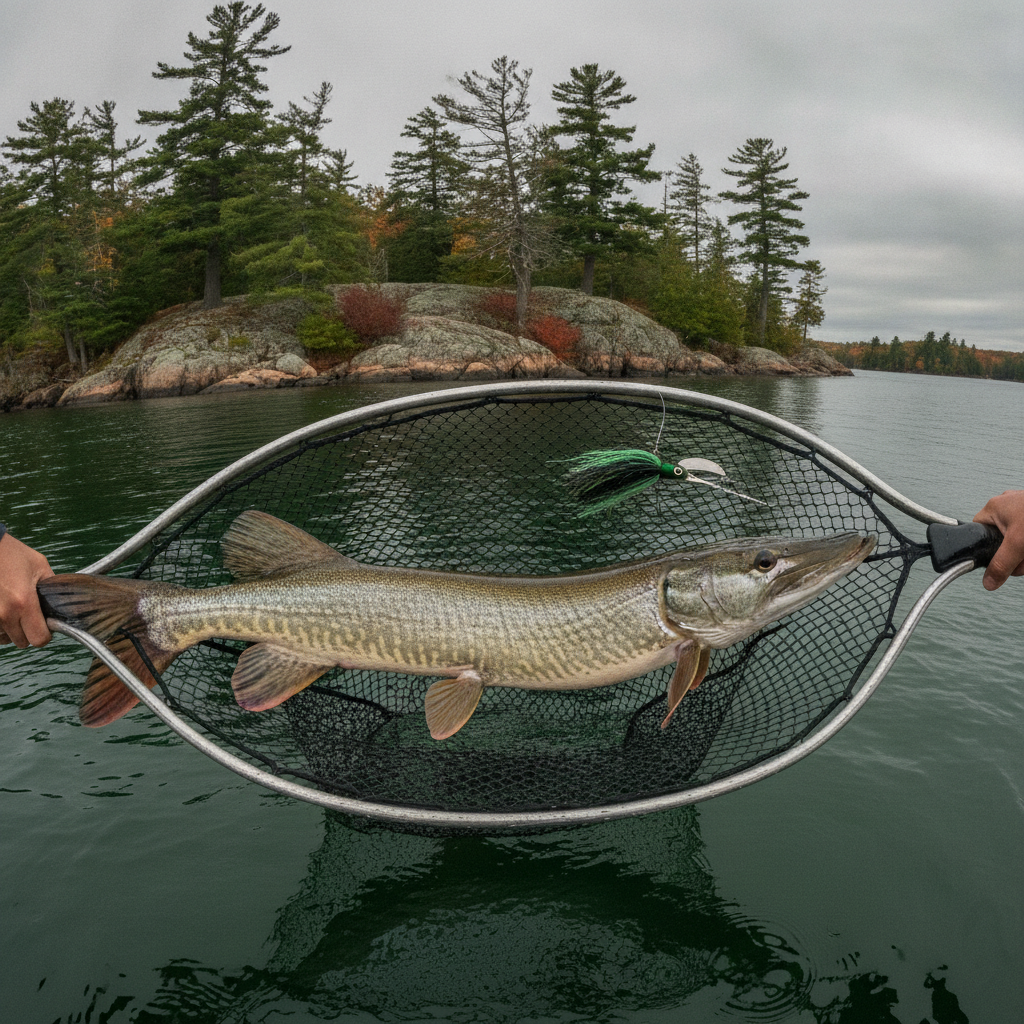
There’s a moment, fishing for muskellunge, that most anglers never get to. You’ve been casting a 12-inch bucktail for four hours. Your shoulder is shot, your back is locked up, and the only thing keeping you going is muscle memory. The lure comes back to the boat for the 600th time. You start the figure-8 at the side of the gunwale — just a habit, you’ve been told to do it but you’ve never had one come up. And on the third pass, in three feet of clear St. Lawrence River water, a fifty-inch muskellunge materializes underneath your lure, follows it through one more pass, opens its mouth, and inhales.
You’re not casting at fish anymore. You’re casting at fish you can SEE.
The Thousand Islands is the best place in the world to have this experience. Northern Wisconsin, Minnesota, the Ottawa River, Mille Lacs — all of them grow muskies, and all of them have their partisans. The Thousand Islands is still in a category of its own. Clear water. Aggressive fish. A density of mature muskies — including 50-inch+ trophies — that you don’t find anywhere else. And the figure-8 game is the heart of why people travel here to fish.
What you’re actually fishing for
Muskellunge — Esox masquinongy — is the largest member of the pike family. In the Thousand Islands and the eastern Great Lakes basin generally, mature fish are 36-50+ inches, with the trophy class starting at 50. The all-tackle record is just over 60 inches. The Thousand Islands produces 50+ inch fish every season, year after year.
These are apex predators. They eat ducklings, perch, walleye, smaller pike, and other muskies. They have an attack pattern based on lateral-line sensing and visual recognition. They hunt by stalking — following bait for long distances before committing — and that hunting pattern is what makes them so brutally frustrating, and what makes the figure-8 work.
The figure-8
I’ll say this plainly: if you do not know how to figure-8, you should not be muskie fishing. Half the trophy fish taken on this river — and most of the biggest ones — come on a figure-8 or one of its variations. The figure-8 isn’t optional. It’s THE technique.
Here’s the move. Cast your lure as you would for any species. Retrieve it normally back toward the boat. As the lure approaches the boat — within about six feet — you lower the rod tip to the water and start moving the lure in a wide oval at the boatside. The lure traces a “figure-8” pattern — wide arcs, smooth direction changes, no jerky motions. Speed of the motion matters too: muskies will commit on speed transitions more than on steady-state speed.
You’re doing this for one reason: muskies frequently follow lures all the way to the boat WITHOUT striking. They sit in the prop wash, watching, deciding. They commit when the lure changes direction — when it acts like prey that’s seen them and is trying to escape. The figure-8 simulates that escape behavior. It’s the closing argument in a sales pitch you’ve been making for four hours.
How long to figure-8: minimum two or three turns. Better is six or seven. The longer you keep the lure moving smoothly at boatside, the more chances you give a following fish to commit. Plenty of good fish commit on the seventh or eighth pass.
What NOT to do during a figure-8: stop. Slow down. Speed up suddenly. Pull the lure out of the water to look for the fish (this is the most common mistake — you see a follow, get excited, lift the rod, and the fish loses interest). KEEP MOVING THE LURE until you’ve made at least a half-dozen smooth passes.
If you see a follow but no commit, sometimes change the lure on the next cast. Sometimes change the depth. Sometimes change the speed of your retrieve. But the figure-8 is the place where you finally close — and if you don’t believe that, you’re going to lose more fish in a single trip than most people lose in a season.
Where to fish in the Thousand Islands
The St. Lawrence River as it flows from Lake Ontario into Canada creates the Thousand Islands archipelago — roughly 1,800 islands across about 50 miles of river. Muskies hunt the structure in this area: rocky points, weed edges, current breaks, deep-water adjacent shallows.
In order of priority, the productive zones:
1. The shoals off Wolfe Island and Howe Island. Rocky humps that rise from 30+ feet to 8-15 feet. Muskies stage on these to ambush bait moving past. Cast across the top, retrieve down-current.
2. The weed edges in shallower bays. Specifically the inner bays of Wellesley Island, Grindstone Island, and the back coves of Clayton. Inside-edge of cabbage weeds. Fish hold IN the weed and ambush prey moving past.
3. The current seams. Where the main river current meets slower water around islands or behind points. Muskies pin bait at the seam edges. Cast across the seam, work back through it.
4. The deep-water transitions. Points where shoal water (10-20 feet) drops abruptly into the deeper river channel (40-60+ feet). Trophy fish hold on these edges, especially in late fall.
The big trophies — the 50+ inch fish — tend to live in three or four “lairs” each, repeatedly. A 52-inch fish caught and released in early September will likely be in the same general area for the rest of the season. Talk to local guides. Some are willing to share areas. Most are not.
When to fish
The Thousand Islands muskie season opens in late June (verify NY DEC dates for the exact opener — it shifts) and closes December 15. The progression:
- Late June through July: Post-spawn fish are recovering. Numbers can be good but trophies are sluggish. Topwater bite is best (Pacemaker, Mojo Mouse, Bert’s Mossback).
- August: Fish active and feeding. Bucktails (Cowgirl, Posseidon) and big swimbaits dominate. This is the most numerically productive month.
- September: Transition month. Fish move shallower as water cools. Variety in tactics.
- October and November: TROPHY MONTHS. Big fish feed up before winter. Bondy Baits, Bull Dawgs, and large soft plastics in cold water. Slower retrieves. Bigger profile. The 50+ inch fish are caught in fall.
- Mid-November through close: Cold, brutal, sometimes empty. Most productive trip can also be most empty.
If you can only go ONCE for a trophy, go the third week of October.
Tackle
This is a heavy-tackle game. Stout rods, big reels, heavy line.
- Rod: 8’6″ or 9′ heavy-action muskie rod, fast taper. St. Croix Mojo Muskie, Shimano Compre Muskie, or G. Loomis IMX Pro. The length is what gives you the figure-8 motion you need at the boat — shorter rods make the figure-8 cramped and uncontrolled.
- Reel: Conventional/baitcasting, with the line capacity for 100+ yards of 80lb braid and a clutch that handles big lures. Shimano Tranx 400, Daiwa Lexa 400, or the various Abu Garcia Revos.
- Line: 80 lb braid (not heavier — heavier costs you casting distance). 130 lb fluorocarbon leader, 3-4 feet, with a high-quality snap on the lure end. Use a leader EVERY time. Muskies have teeth and gill plates that will slice 80 lb braid in one head shake.
- Lures (the essentials):
– Cowgirl bucktail (size 9, the standard) — black or fluorescent orange. The workhorse. – Bondy Bait in white or chartreuse — for cold water, slow presentations. – Bull Dawg (9-inch or 12-inch) — for fall trophies. – Mepps Musky Killer — when the fish are spooky and the lure needs to be smaller.
You will spend $400 on lures the first time you walk into a Thousand Islands tackle shop. Plan on it.
The mindset
This is what separates muskie anglers from people who fish for muskies once.
Muskies are called the “fish of 10,000 casts” not because the cast count is literal, but because the FRUSTRATION is real. You will fish all day and see no fish. You will fish three days and see no fish. You will fish a week and have one follow that doesn’t commit. You will think you’re doing something wrong.
You’re probably not. You’re playing a game where the upside is so high that any reasonable person would walk away after a day. The 50-inch fish you’re after is the apex predator of an entire river system. There are not many of them. They eat infrequently — adult muskies may feed once every three or four days when conditions aren’t perfect. Your job is to be there when one decides to feed, and to put your lure in front of it, and to figure-8 with conviction when it follows.
Most anglers will not catch a 50+ inch muskie on their first trip. Or their second. Or their fifth. The people who catch them consistently are the people who fish methodically, log everything, and slowly build a mental map of where the big fish live in their water.
If you’re going to the Thousand Islands for the first time, hire a guide for at least one day. Not because you can’t figure it out — you can — but because a half-day of being shown WHERE on the river the fish actually live will compress two seasons of learning into eight hours. Most regional guides charge $400-600 a day. It’s the best money you’ll spend on the trip.
What matters most
You can do a lot of things wrong fishing for muskies and still catch fish. You can throw the wrong lure, fish at the wrong time, retrieve wrong. The one thing you cannot do is QUIT MID-DAY. The bite is so unpredictable that the trophy comes out of the water on the cast you almost didn’t make. More than a few forty-inch fish have come on the last cast of a day that had been written off three hours earlier.
Stay on the water. Keep casting. Figure-8 every cast — every single one. And when one comes up, breathe through it: don’t pull the lure out of the water, don’t speed up, just keep the figure-8 going smoothly until the fish either commits or leaves.
It’s a sport that punishes shortcuts. But the reward is a fish that puts your name in your own personal hall of fame.
Dennis Suler is a career outdoors writer and lifelong angler. He spent six years on the editorial staff of The Fisherman magazine as a field editor and managing editor — first editing the New Jersey reports section, then managing editor of the Mid-Atlantic edition. He also served as managing editor of Boater’s Digest magazine. He’s a member of the Outdoor Writers Association of America and writes for fishing.digital — covering 40+ U.S. fishing destinations with weekly reports, location guides, and feature articles.
This article is part of fishing.digital’s Great Lakes & Inland regional coverage. For weekly reports across the Great Lakes, Lake Champlain, the Thousand Islands, and other inland trophy fisheries, visit fishing.digital/newsletter and subscribe to fishing.digital Great Lakes & Inland Weekly.
Planning a trip to Thousand Islands NY?
This report tells you what happened. ReelAI tells you what to do about it — a briefing for your date, your target species and how you're fishing, built from our reports plus live NOAA and USGS data.
Powered by ReelAI — fishing.digital's intelligence layer. Answers are generated from fishing.digital reports and public NOAA, NWS and USGS data, and may be incomplete or out of date. Regulations and marine safety information are summaries only; always confirm with the responsible authority before you fish.