
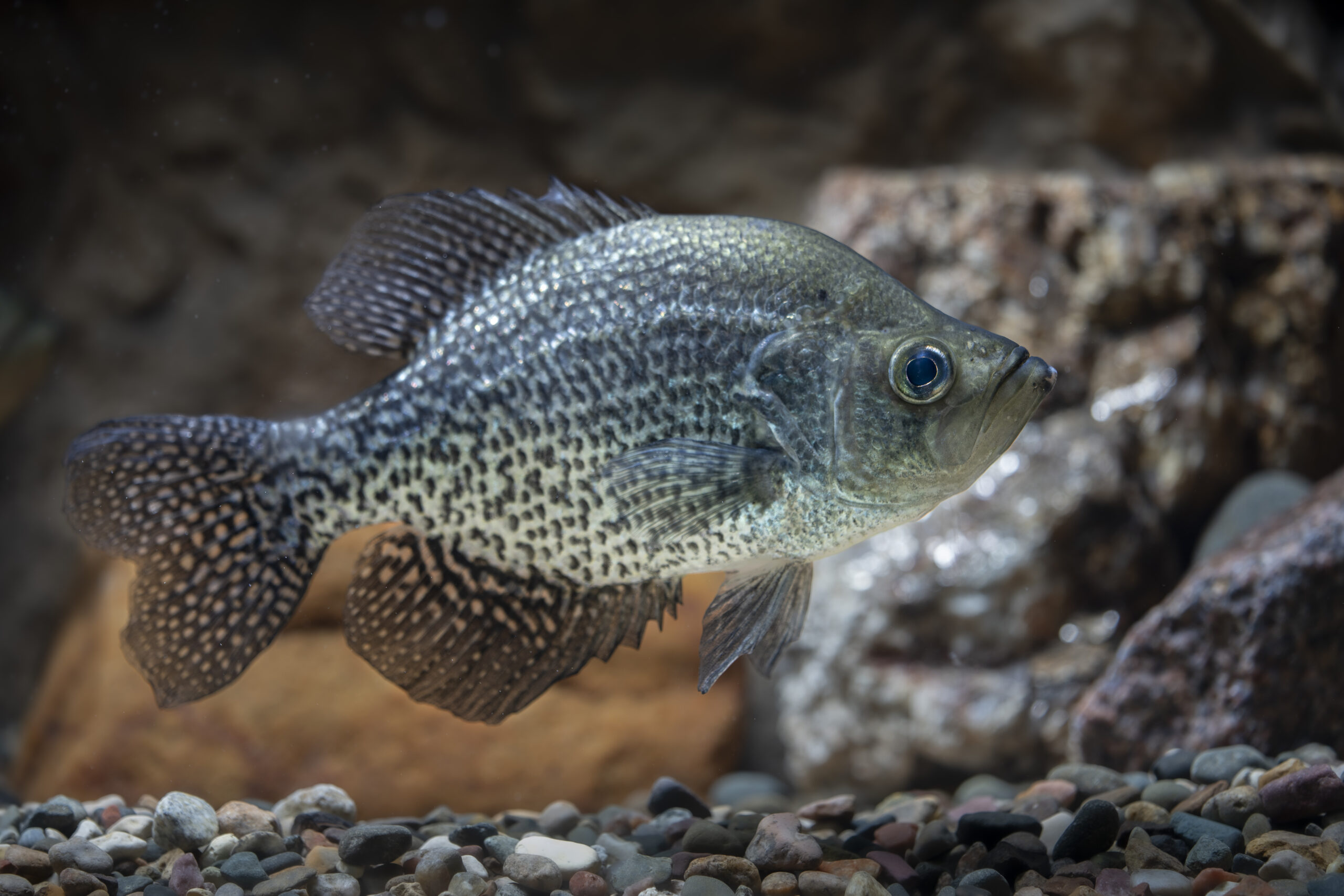
Crappie (Pomoxis spp.) are one of America’s most beloved panfish — accessible, tactically rich, and superb on the table. Black crappie and white crappie inhabit lakes and slow rivers across nearly the entire United States, and they reward anglers willing to read structure, time the spawn, and refine presentation. This guide covers the full crappie playbook from spring-spawn fundamentals through deep-summer trolling and ice fishing.
Black vs. White Crappie
Black crappie (P. nigromaculatus): Mottled black-and-silver pattern, 7-8 dorsal spines, prefers clearer water with weed cover, more common in northern lakes. White crappie (P. annularis): Vertical dark bars on the side, 5-6 dorsal spines, tolerates murkier water, more common in southern reservoirs and rivers. Many lakes hold both species. State records exceed 5 lbs for both; a 2 lb crappie is a legitimate trophy.
Where to Find Crappie: Range & Habitat
Crappie are found in nearly every U.S. state. Strongest fisheries: the TVA reservoirs (Kentucky Lake, Pickwick, Wheeler, Wilson, Guntersville), Reelfoot Lake (TN), Mississippi River backwaters (MN, WI, IA, IL), Truman Reservoir and Lake of the Ozarks (MO), Toledo Bend and Sam Rayburn (TX/LA border), Grenada and Sardis (MS — true trophy waters with multiple 3+ lb fish each spring), Santee Cooper (SC), Lake Fork (TX), Lake Washington (MS), and many farm ponds. Crappie orient to structure year-round — submerged brush, standing timber, bridge pilings, dock pilings, creek channels, and weed edges.
Tackle for Crappie
Spinning
Rod: 6-7′ ultralight to light spinning rod with a soft tip. Reel: 1000-2000 size spinning reel. Line: 4-6 lb monofilament, or 6-10 lb braid with a 4-6 lb fluorocarbon leader. Jigs: 1/32 to 1/16 oz jigheads with 1.5-2″ soft plastic bodies (Bobby Garland Baby Shad, Mr. Crappie Slabalicious, Z-Man Microfinesse).
Spider-Rigging (8+ Rod Specialist Setup)
The dominant tactic on Mississippi and Tennessee reservoirs. Rods: 12-16′ B&M, Wally Marshall, or Lew’s spider rods. 6-12 rods fan-rigged off the bow with rod holders. Reels: Small spinning or push-button. Rigs: Capps & Coleman double-hook rigs or single jig-and-minnow setups with 1/2-1 oz egg sinkers. Slow-drift or troll at 0.3-0.6 mph over deep creek channels and brush piles.
Trolling / Long-Lining
Rods: 8-10′ light trolling rods. Lures: Small crankbaits (Bandit 200, Berkley Flicker Shad #5, Bomber Fat Free Fingerling), trolling jigs with 1/16-1/8 oz heads. Speed: 1.0-2.0 mph; vary until the bite comes together. Lead-core line in increments of 5-15 feet controls depth.
Float Fishing (Slip Bobber)
A live minnow under a slip bobber at 4-8 feet depth, positioned over brush or a dock — the most consistent crappie tactic for less-experienced anglers. Slip floats let depth be adjusted for water clarity and fish position.
Top Techniques
Spring Spawn Pattern
When water temperatures hit 55-60°F, crappie begin staging in 5-12 feet of water adjacent to spawning bays. At 60-65°F, fish move into shallow brush and pads to spawn (males arrive first, build nests, then females push in). Pitch jigs to visible brush and pads, twitch live minnows under slip floats, or longline cast small crankbaits along shoreline edges.
Summer Suspended Schools
Post-spawn crappie suspend in 10-25 feet over deep structure (creek channels, ledges, brush piles). Use electronics to find them; vertical jig with 1/16-1/8 oz jigs tipped with plastic or minnow, or spider-rig with multiple rods across the school.
Fall Schooling
Crappie chase shad in fall — look for surface activity in the backs of creeks. Cast small jigs or shad-pattern crankbaits to the edges of breaking fish. October-November can produce limits in minutes when patterns align.
Night Fishing Under Lights
One of the most underused summer patterns. Crappie are drawn to dock lights and to submerged green lights hung off a boat — the light pulls in plankton, the plankton pulls in shad, and the crappie stack under the whole thing. Fish a small jig or a minnow on the shaded edge of the light circle rather than in the bright center. On a hot reservoir in July, an hour after dark will out-produce the entire day.
Ice Fishing for Crappie
Through-the-ice crappie are one of the most popular winter species in the Upper Midwest. Use a flasher (Vexilar, Marcum) to locate suspended fish at 10-20 feet. Drop a tungsten jig (1/32-1/16 oz) tipped with a single waxworm or a 1″ soft plastic. The bite is subtle — watch for the slightest line tick.
Best Baits & Lures
Live minnows on plain-hook setups or 1/16 oz jigheads are the gold standard nearly everywhere. Soft plastic jigs: Bobby Garland Baby Shad, Slabalicious, Stroll’R; Crappie Magnet (the original tube body); Z-Man MicroTRD. Colors: chartreuse, white, pink/white, “blue ice” — match local water clarity. Hair jigs: Marabou and bucktail jigs in 1/16-1/8 oz produce in stained water year-round. Small spinners: A Beetle Spin retrieved slowly past brush edges is a forgiving option for anglers who struggle to feel a jig bite. Crankbaits for trolling: Bandit 200, Berkley Flicker Shad, Strike King Bitsy Pond Minnow.
Reading Crappie Water
Crappie are tight to structure 95% of the year. Find brush, find fish. Use side-imaging sonar to scan creek channels and ledges for “brush piles” — submerged trees that hold huge schools. Spider-riggers map dozens of brush piles in a lake and rotate through them. Mark every productive pile on GPS — crappie return to the same structure season after season, and a waypoint list built over two years is worth more than any new electronics. In spawn season, fish are visually located in shallow bays — Polaroid sunglasses and a slow, quiet approach.
Best Times to Fish
Pre-spawn (March-April): Best of the year. Big females stack in staging depths. Spawn (April-May): Easy shallow fishing; males defend nests aggressively. Post-spawn (May-June): Transition to summer depths. Summer (June-August): Suspended schools; spider-rigging and longlining shine. Fall (September-November): Schooling on shad; explosive afternoon bites. Winter (December-February): Ice fishing in north; deep vertical jigging in south.
Hot Spots
South: Grenada, Sardis, and Enid lakes (MS) — true trophy waters; Reelfoot Lake (TN); Toledo Bend (TX/LA); Lake Fork (TX); Santee Cooper (SC). Midwest: Truman Reservoir (MO), Lake of the Ozarks (MO), Mississippi River backwaters; Kentucky Lake and Lake Barkley. North: Lake Winnebago (WI), Mille Lacs and Leech Lake (MN), the Great Lakes drainage. Florida: Lake Okeechobee, Rodman Reservoir, Lake Talquin.
Cleaning & Eating
Crappie are among the best-eating freshwater fish in North America. Fillets are white, mild, and flaky. Fillet from behind the gills back, then peel skin and remove rib bones. Excellent fried (cornmeal-and-flour breading is traditional in the South), baked, or in crappie po’ boys. Yield: about 30-35% of whole weight.
Regulations
State-specific. Most states have 9-10″ minimum size and 15-30 fish daily bag. Mississippi trophy lakes (Grenada, Sardis) have 12″ minimums and reduced bag limits to protect trophies. Tennessee TVA reservoirs typically 10″ / 30 per day. Verify current rules with your state agency.
More Resources
Browse all How-To Guides · How to Catch Bluegill · Location Guides
Best Crappie Tackle
Affiliate disclosure: fishing.digital earns a small commission on qualifying purchases at no extra cost to you.
1. Bobby Garland Baby Shad, 2-Inch
The soft plastic most crappie tournaments are won on. Buy two or three colors and let water clarity decide — chartreuse and white in stain, translucent shad patterns in clear water. Check price on Amazon
2. B’n’M 10-Foot Jig Pole
A long, sensitive pole for lowering a jig straight down into a brush pile or under a dock — the tool that makes vertical crappie fishing work. Check price on Amazon
3. 1/16 oz Crappie Jigheads
A spec, not a brand: 1/16 oz round or ball-head jigheads with a light-wire hook. That size covers most of the season; carry 1/32 oz for shallow spawners and 1/8 oz for deep summer fish. Check price on Amazon
4. Live Minnows and a Slip Float
Still the most consistent crappie setup there is. Fathead minnows come from the bait shop, not a shipping box — pair them with a slip float set to run the bait just above the brush and a light-wire size 6 hook.
Planning a trip to Crappie?
This report tells you what happened. ReelAI tells you what to do about it — a briefing for your date, your target species and how you're fishing, built from our reports plus live NOAA and USGS data.
Powered by ReelAI — fishing.digital's intelligence layer. Answers are generated from fishing.digital reports and public NOAA, NWS and USGS data, and may be incomplete or out of date. Regulations and marine safety information are summaries only; always confirm with the responsible authority before you fish.