
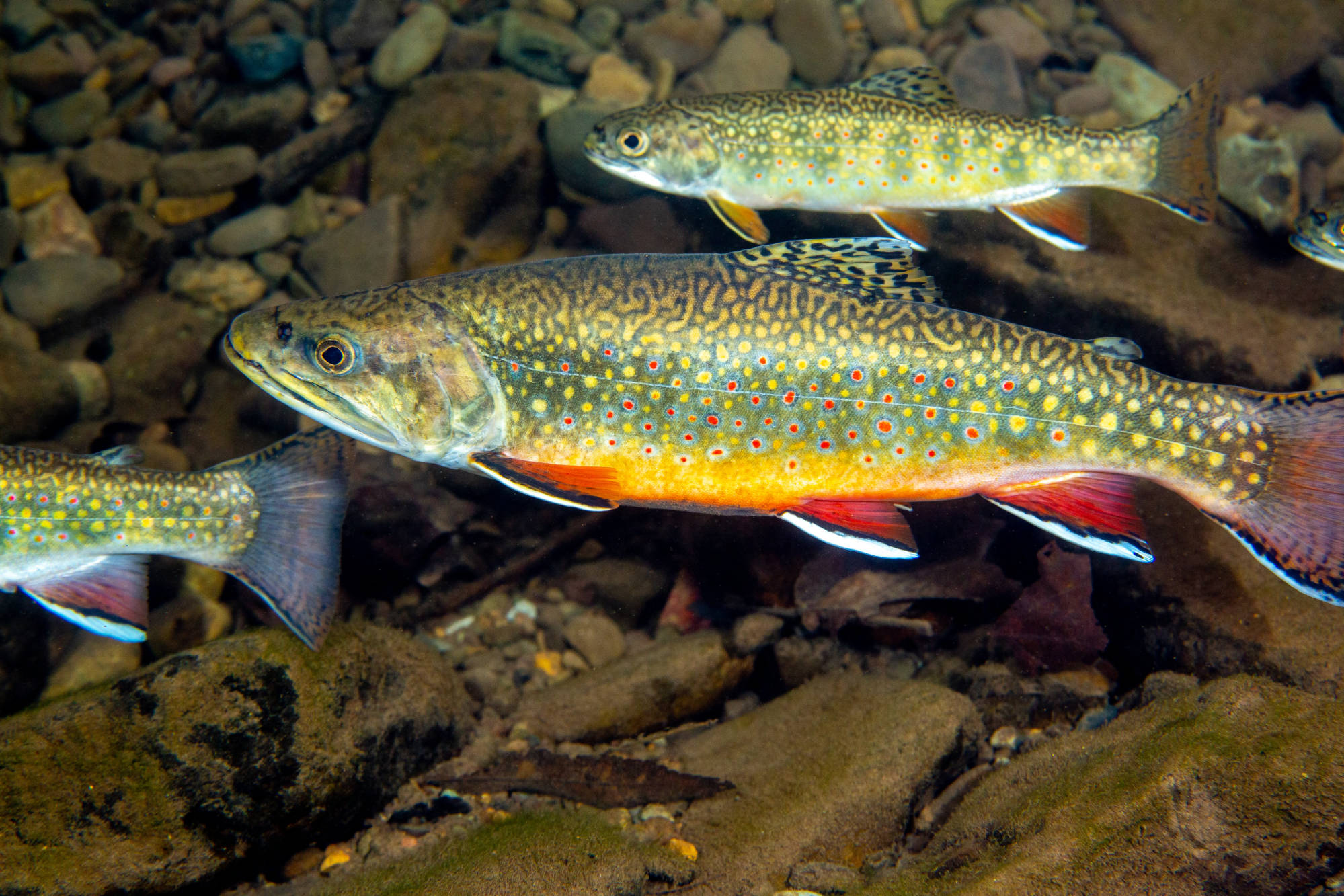
Brook trout (Salvelinus fontinalis) are North America’s native trout — technically a char, not a true trout — and among the most beautiful freshwater fish on the continent: orange bellies, red spots ringed in blue halos, and worm-track vermiculation across the back. Smaller on average than brown or rainbow trout, brookies are beloved for their willingness to strike a fly or a spinner and for the places they live. They are simultaneously the most forgiving trout for a beginning fly fisher and a prestige target for anyone who hikes in after wild fish. Native brook trout in their original range are one of American fishing’s great treasures.
Range & Habitat
Brook trout require the coldest, most pristine water of any North American gamefish — 55–60°F is ideal and they struggle above 68°F. Native to the Appalachians from Georgia north to Labrador, New England, the Great Lakes watershed, and boreal Canada, they hold on today mainly in cold headwater streams, beaver ponds, and high alpine lakes. The Adirondacks, Maine’s remote ponds, Appalachian backcountry streams, and the Canadian Shield are the strongholds. They have also been widely introduced in the Rockies and Pacific Northwest, where they have naturalized in many alpine watersheds.
Best Tackle
Ultralight spinning: 5′–6′6″ ultralight rod, 1000–1500 reel, 2–4 lb monofilament or fluorocarbon. Fly fishing: 7–8′ 2–4 weight — a short, light rod is perfect for the tight casting lanes of a brook trout stream — with a 7–9′ tapered leader to 4–6X tippet. Small water demands small tackle and delicate presentations.
Top Techniques
Small Dry Fly Fishing: The most rewarding brookie experience. In small streams brook trout are rarely selective — any reasonable dry fly (Adams, Elk Hair Caddis, Royal Wulff) presented naturally will draw strikes from willing fish.
Short-Line Nymphing: Short casts and high-stick drifts through plunge pools and pocket water. Pheasant Tail and Hare’s Ear nymphs cover almost everything a brookie eats subsurface.
Small Spinning: Inline spinners (1/32–1/16 oz), small spoons, and tiny Rapalas are extremely effective in streams and small ponds, and they are the easiest way for a new angler to learn to read water.
Natural Bait: Nightcrawler pieces, waxworms, and grasshoppers on ultralight gear produce excellent catches, drifted in the current or hung under a tiny float.
Small Streamer: A Woolly Bugger or small Muddler Minnow worked through pools and runs is how you find the largest brook trout in a given stretch.
Best Baits & Lures
- Royal Coachman / Royal Wulff: The classic brookie dry fly — a bright attractor pattern that works even when nothing is hatching.
- Adams (size 14): The most versatile dry fly on a brook trout stream.
- Beadhead Pheasant Tail or Hare’s Ear Nymph: The most productive subsurface flies for brook trout, particularly in plunge pools.
- Small Inline Spinner (Mepps size 0–2, Panther Martin, Rooster Tail 1/32 oz): Gold blade in tannic stained water. The top brook trout spinning lure.
- Nightcrawler or Waxworm: Natural bait is extremely effective in small streams and under the ice. Use the smallest hook you can get away with.
- Tiny Rapala (1–2″): Floating minnow worked through pools and behind boulders.
- Grasshopper (live or foam imitation): Late-summer terrestrial fishing is exceptional brook trout action.
Seasonal Patterns
Spring (April–June): Excellent as streams drop and clear from snowmelt and runoff and fish feed hard. Summer: Move to the coldest, most shaded sections; early morning and evening are best in accessible water, and remote cold headwaters fish well all day. Fall (September–October): Brook trout spawn in fall, males develop stunning spawning colors, and fish are in superb condition and feeding aggressively. Winter: Active through the cold months in most streams, and brookies in beaver ponds and alpine lakes are outstanding ice fishing targets on waxworms and tiny jigs.
Pro Tips
- Tiny presentations: Brook trout rarely exceed 12 inches in most streams. Scale everything down — size 14–18 flies, 2–4 lb line, small bait pieces. Big presentations put small brookies down.
- Approach quietly: Small-stream brookies spook easily in clear water. Stay low, move slowly, and don’t wade through the water you’re about to fish.
- Search upstream for the best fish: The larger fish hold at the heads of pools and in the fast water above. Work methodically upstream.
- Remote fish are willing fish: The farther you get from the trailhead, the more naive and aggressive the brook trout. The best populations are in headwaters most anglers never reach.
- Handle with cold, wet hands: Brook trout are the most temperature-sensitive and fragile of the trout species. Minimize handling and keep fish in the water.
Regulations
Brook trout regulations vary significantly. Many native brookie streams carry catch-and-release rules, artificial-only restrictions, or very restrictive bag limits to protect wild populations. Always check your state agency’s rules for the specific stream before you fish it.
Best Brook Trout Tackle
Affiliate disclosure: fishing.digital earns a small commission on qualifying purchases at no extra cost to you.
1. Adams Dry Fly, Size 14
The Adams works everywhere for brook trout. The one essential dry fly for small streams. Check price on Amazon
2. Panther Martin Spinner, 1/16 oz Gold
Top brook trout spinner — the in-line blade throws vibration in tannic, turbid headwater flows. Check price on Amazon
3. Beadhead Hare’s Ear Nymph, Size 14
The most versatile brook trout nymph for fast water and plunge pools. Check price on Amazon
4. Ultralight Spinning Rod, 5′6″ Light
Short enough to cast under branches in tight brook trout headwaters. Check price on Amazon
Browse all species guides: How To Catch Fish — Complete Species Guides | Weekly Fishing Reports — updated every Thursday.
Planning a trip to Brook Trout?
This report tells you what happened. ReelAI tells you what to do about it — a briefing for your date, your target species and how you're fishing, built from our reports plus live NOAA and USGS data.
Powered by ReelAI — fishing.digital's intelligence layer. Answers are generated from fishing.digital reports and public NOAA, NWS and USGS data, and may be incomplete or out of date. Regulations and marine safety information are summaries only; always confirm with the responsible authority before you fish.