
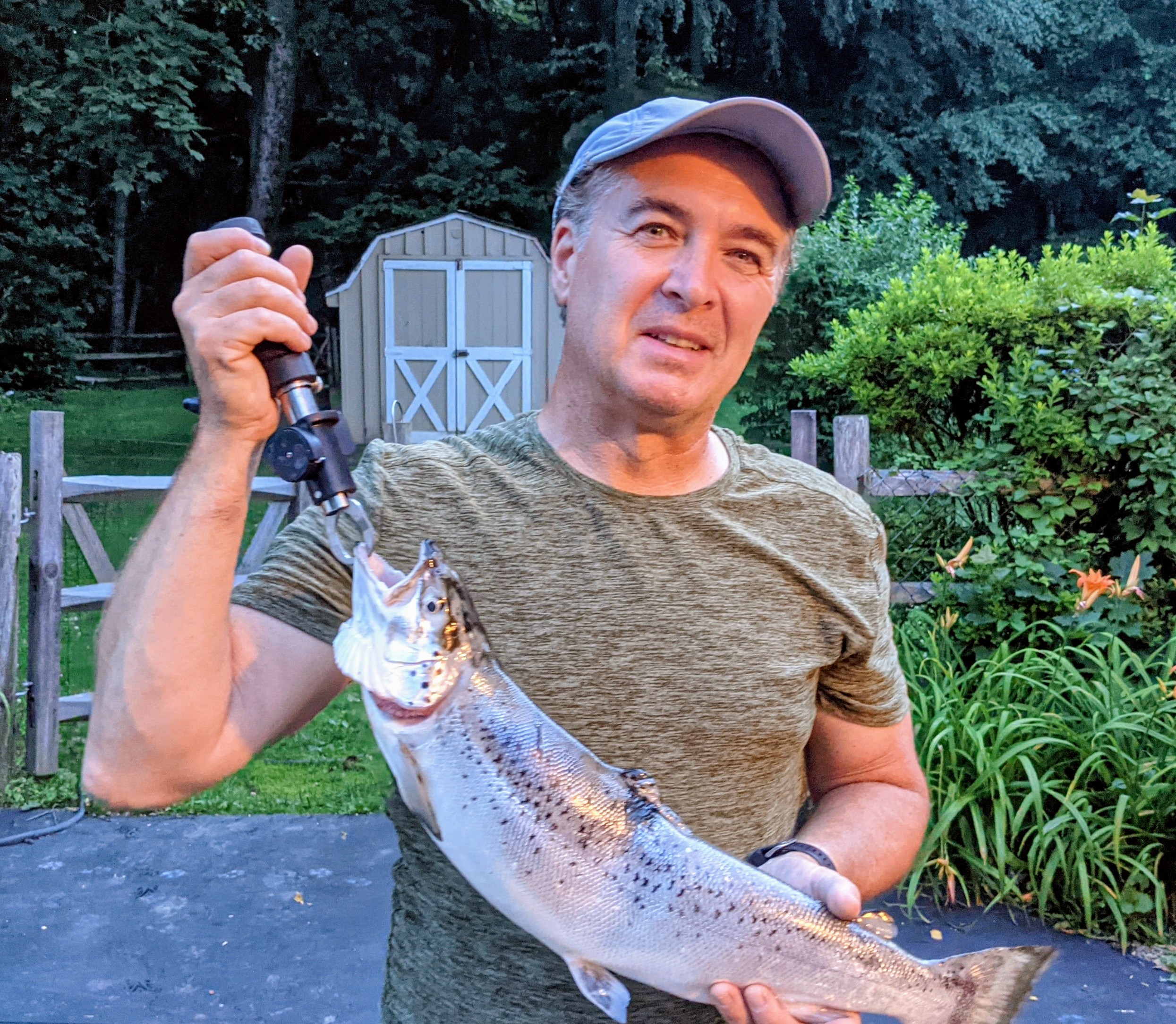
Atlantic salmon (Salmo salar) — the “king of game fish” — is one of the most storied freshwater quarries in North America. After decades of decline, sport fishing for sea-run Atlantic salmon in the United States is now catch-and-release only on Maine’s Penobscot River and is heavily regulated. Landlocked Atlantic salmon, however, thrive in Maine lakes, parts of New York, New Hampshire, and Vermont, providing accessible angling for this iconic species. This guide covers both sea-run and landlocked Atlantic salmon.
Where to Find Atlantic Salmon: Range & Status
Sea-run Atlantic salmon in the U.S. are listed as endangered. Wild populations remain only in a few Maine rivers — primarily the Penobscot, Kennebec, and a handful of Downeast streams. Sport fishing for sea-run fish is strictly catch-and-release and limited to the Penobscot River below the Veazie Dam (verify current Maine DMR/USFWS rules). Landlocked Atlantic salmon are stocked and self-sustaining in numerous waters: Lakes Sebago, Moosehead, and Sebec in Maine; Lake George (NY); Lake Champlain (VT/NY); New Hampshire’s Big Squam, Sunapee, and Newfound; and several smaller waters in Quebec and the Adirondacks.
Sea-Run Atlantic Salmon: Tackle
Rod: 9-10′ single-hand fly rod, 8 or 9 weight for the Penobscot. Two-hand (spey) rods 12-14′ in 7-8 weight for swinging. Reel: A large-arbor reel with at least 150 yards of 20 lb backing. A sealed disc drag is essential — wild Atlantics make blistering runs. Lines: Floating line for low water, sink tips for high water, full sinking lines in deep pools. Leader: 9-12′ tapered to 12-16 lb fluorocarbon.
Landlocked Atlantic Salmon: Tackle
Trolling tackle: 6-8′ medium light-action rods with 8-10 lb line. Streamlined reels (Mooselook, Sutton, DB Smelt) on lead-core line or short downrigger setups. Casting tackle: 7′ light spinning rod with 6-8 lb line for casting small spoons and smelt patterns. Fly tackle: 9′ 6-7 weight rod, floating or intermediate line, tapered leader to 8 lb.
Top Techniques — Sea-Run Salmon
The Swing: Cast across and slightly down, mend upstream, and let the fly swing through the holding water. Classic wet flies (Cosseboom, Black Bear, Green Highlander, Blue Charm) sized #4-#8. Dead-Drifting: In low water, dead-drift small flies (#10-#14) downstream of fish. Patience: Sea-run Atlantics often refuse 50+ presentations before taking. Cover water systematically and don’t skip any seams.
Top Techniques — Landlocked Salmon
Smelt Trolling: The classic technique. Troll live or rigged smelt at 1.5-2.5 knots in the top 30 feet, especially at ice-out (April-May) when smelt spawn near tributary mouths. Streamer Trolling: Mooselook Wobblers, DB Smelts, Gray Ghosts, and Magog Smelt patterns trolled on lead core or downriggers. Surface Fly Fishing: Ice-out and post-spawn fall periods — strip streamers fast across the surface for chase-and-eat action. Jigging: Through the ice with small jigging spoons or small swimbaits over deep structure.
Best Baits & Lures
For sea-run: traditional wet flies are the standard. For landlocked: live smelt is unbeatable; rigged smelt rigs (single-hook or double-hook setups) excel; Sutton spoons (Sutton 38, 44, 38 Hammered Silver), Mooselook Wobblers, DB Smelts, and Toby spoons all produce. Streamer flies — Gray Ghost, Magog Smelt, Black Ghost — are the historic patterns.
Reading Atlantic Salmon Water
Sea-run salmon hold in oxygenated water with slight current — the heads and tails of pools, behind boulders, in deep slots, and along seams. Find the type of holding water that matches the river’s flow conditions: low water concentrates fish in deeper pools; high water spreads them through faster runs. Landlocked salmon orient to smelt schools — find the bait and you’ll find fish. Use sonar to locate smelt schools at 15-40 feet, then troll or jig at that depth.
Best Times to Fish
Sea-run salmon enter the Penobscot from June through October, with peak fishing typically in late summer and early fall as cool nights drop river temperatures. Landlocked salmon: ice-out (April in most lakes) is gold; June into July as fish push deeper; fall (September-October) for surface action again; winter through the ice in many waters.
Conservation & Ethics
Atlantic salmon are catch-and-release for all sea-run fish in the U.S. — handle minimally, keep fish in the water for photos, pinch barbs, and use rubber landing nets. The Atlantic Salmon Federation, Trout Unlimited’s Salmon Initiative, and the U.S. Atlantic Salmon Assessment Committee track recovery efforts. Consider donating or volunteering — wild Atlantic salmon remain in trouble.
Regulations
Maine sea-run Atlantic salmon fishing requires a special permit; only the Penobscot below Veazie is open, and only certain stretches; verify with the Maine DMR and USFWS each year. Landlocked salmon: state-by-state — Maine and New Hampshire have generous slot limits and bag rules; New York and Vermont vary by lake. Always check current state regulations before each trip.
More Resources
Browse all How-To Guides · Location Guides
Planning a trip to Freshwater Fishing?
This report tells you what happened. ReelAI tells you what to do about it — a briefing for your date, your target species and how you're fishing, built from our reports plus live NOAA and USGS data.
Powered by ReelAI — fishing.digital's intelligence layer. Answers are generated from fishing.digital reports and public NOAA, NWS and USGS data, and may be incomplete or out of date. Regulations and marine safety information are summaries only; always confirm with the responsible authority before you fish.