
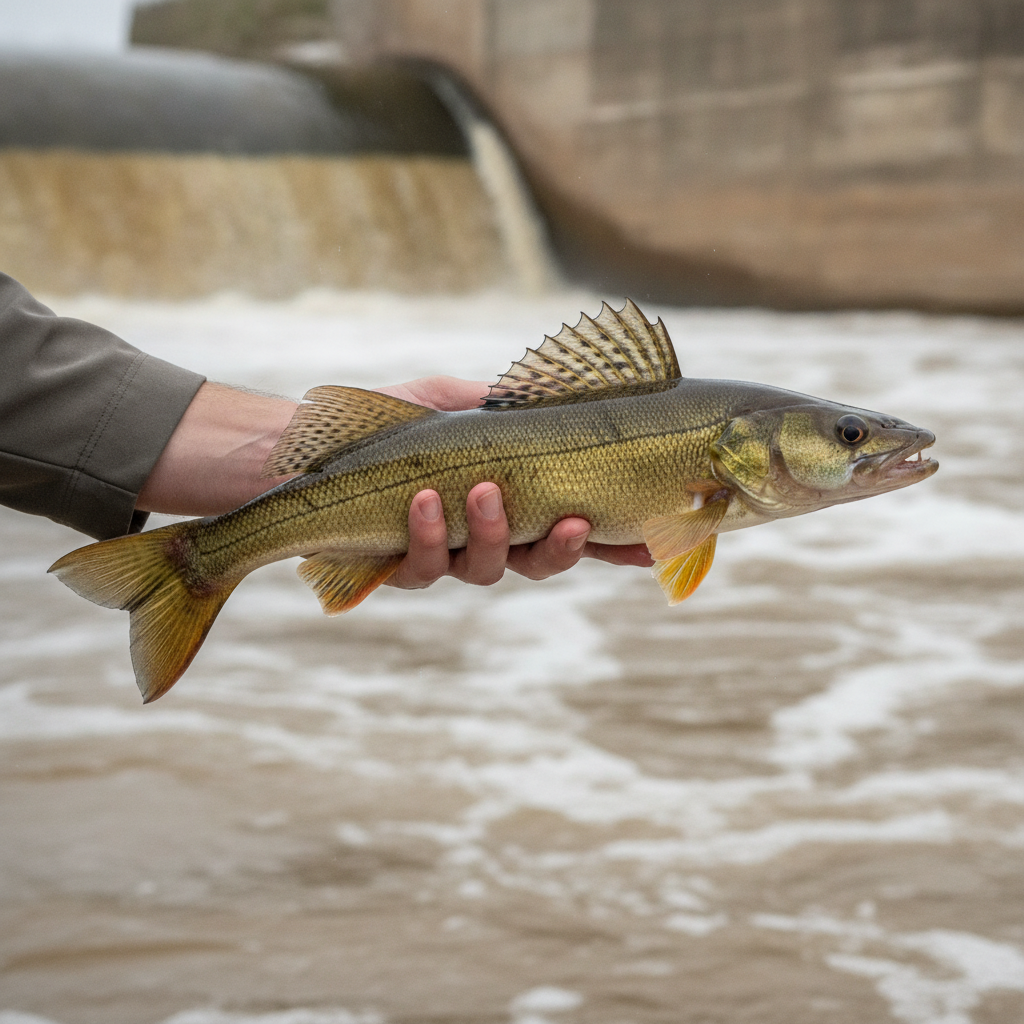
Sauger (Sander canadensis) — the walleye’s smaller, darker, river-living cousin — is one of the most underrated freshwater gamefish in North America. Saugers thrive in big, turbid rivers where walleye struggle, providing some of the most reliable late-fall and winter fishing in the Midwest and South. They strike hard, fight scrappily, and rival walleye on the table.
Where to Find Sauger: Range & Habitat
Saugers are native to large North American river systems — the Missouri, Mississippi, Ohio, Tennessee, and their tributaries. They thrive in turbid, current-laden water where walleye populations are limited. Major sauger fisheries include the Tennessee River below Pickwick, Wilson, and Wheeler dams in Alabama and Tennessee; the Ohio River from Pittsburgh down through Cincinnati to Cairo; the Mississippi from Iowa through Tennessee; the lower Missouri; and the Cumberland River below Cordell Hull and Old Hickory dams. Unlike walleye, saugers tolerate muddy water and stronger current — they’re a tailwater specialist.
Tackle for Sauger
Rod: 6’6″-7′ medium-light action spinning rod, fast tip for detecting subtle bites. Reel: 2500-3000 size spinning reel. Main line: 8-10 lb braid (preferred for current) or 8 lb mono. Leader: Often skipped; if used, 8-12 lb fluorocarbon. Sinkers: Bell sinkers and pencil weights from 1/2 oz to 1 oz depending on current.
Top Techniques
Vertical Jigging: The #1 sauger technique. Position the boat directly over fish or holding water, drop a 1/4 to 3/8 oz jig tipped with a minnow or 3-4″ plastic to the bottom, then pop it 6-12 inches and let it fall. Saugers strike on the fall. Watch your line; bites are often subtle. Three-Way Rigging: Below dams, anchor a three-way rig with a heavy dropper sinker and a 18-24″ leader with a stinger-hooked minnow or twister tail. Position bait just above the bottom in current breaks. Trolling Crankbaits: Pull deep-diving crankbaits (Rapala Shad Rap, Reef Runner, Bomber Long A) at 1.5-2.5 mph through deep pools and river bends.
Best Baits & Lures
Live minnows — fathead minnows or chubs hooked through the lips — are deadly. Soft plastic twister tails in chartreuse, white, and orange on 1/4-3/8 oz jigheads catch fish all winter. Blade baits (Sonar, Silver Buddy) excel in deep cold water. Stickbaits (Husky Jerk, Smithwick Rogue) for jerk-pause retrieves over deep flats. Crankbaits for trolling — chartreuse-and-orange “fire tiger” is a classic sauger color.
Reading Sauger Water
Saugers position in current breaks: behind submerged boulders, in the seams between fast and slow water, on the down-current side of wing dams, and in scour holes below dam tailraces. They favor depths of 15-30 feet in winter and shallower in spring. Use a quality side-imaging or down-imaging sonar to find structure and bait — saugers stack tight on specific features.
Best Times to Fish
Peak Season: November through March — the colder the water, the better the bite. Tailwater fishing below dams is most consistent in December and January. Spring: Pre-spawn saugers stage below dams in late February and March. Summer: Fish push deeper; quality dips. Fall: Fish move shallower and bite increases through November.
Hot Spots
Tennessee River: Pickwick Dam tailrace (border of TN/AL/MS), Wilson Dam tailrace (Florence, AL), Wheeler Dam tailrace. Cumberland River: Below Old Hickory and Cordell Hull dams (TN). Ohio River: Markland Dam (KY/IN), Cannelton Dam, Smithland Dam. Mississippi River: Lock & Dam tailwaters from Iowa to Missouri. Missouri River: Below Gavins Point Dam (SD/NE border) for the famous “Sauger Season.”
Sauger vs. Walleye
Saugers are smaller (typically 1-3 lbs, with a 5 lb fish a true trophy), darker, with distinctive black blotches on the dorsal fin and a slightly more elongated body. They handle current better and tolerate turbidity better than walleye. Hybrid “saugeye” (sauger × walleye) are stocked in many waters and combine the size of walleye with the river-tolerance of sauger.
Cleaning & Eating
Sauger fillets are nearly identical to walleye — firm, white, and mild. Many sauger anglers consider them slightly better on the table than walleye. Standard fillet technique; remove the rib bones with a fillet knife. Excellent fried, baked, or in fish tacos.
Regulations
Varies dramatically by state and water body. Tennessee: typically 15″ minimum, 5 per day combined with walleye and saugeye (verify TWRA rules). Alabama: no minimum, generous limits in tailwaters. Kentucky: 14″ minimum, 6 per day combined with walleye/saugeye. Always verify current state regulations before each trip — sauger rules change.
More Resources
Browse all How-To Guides · Location Guides
Planning a trip to Freshwater Fishing?
This report tells you what happened. ReelAI tells you what to do about it — a briefing for your date, your target species and how you're fishing, built from our reports plus live NOAA and USGS data.
Powered by ReelAI — fishing.digital's intelligence layer. Answers are generated from fishing.digital reports and public NOAA, NWS and USGS data, and may be incomplete or out of date. Regulations and marine safety information are summaries only; always confirm with the responsible authority before you fish.