
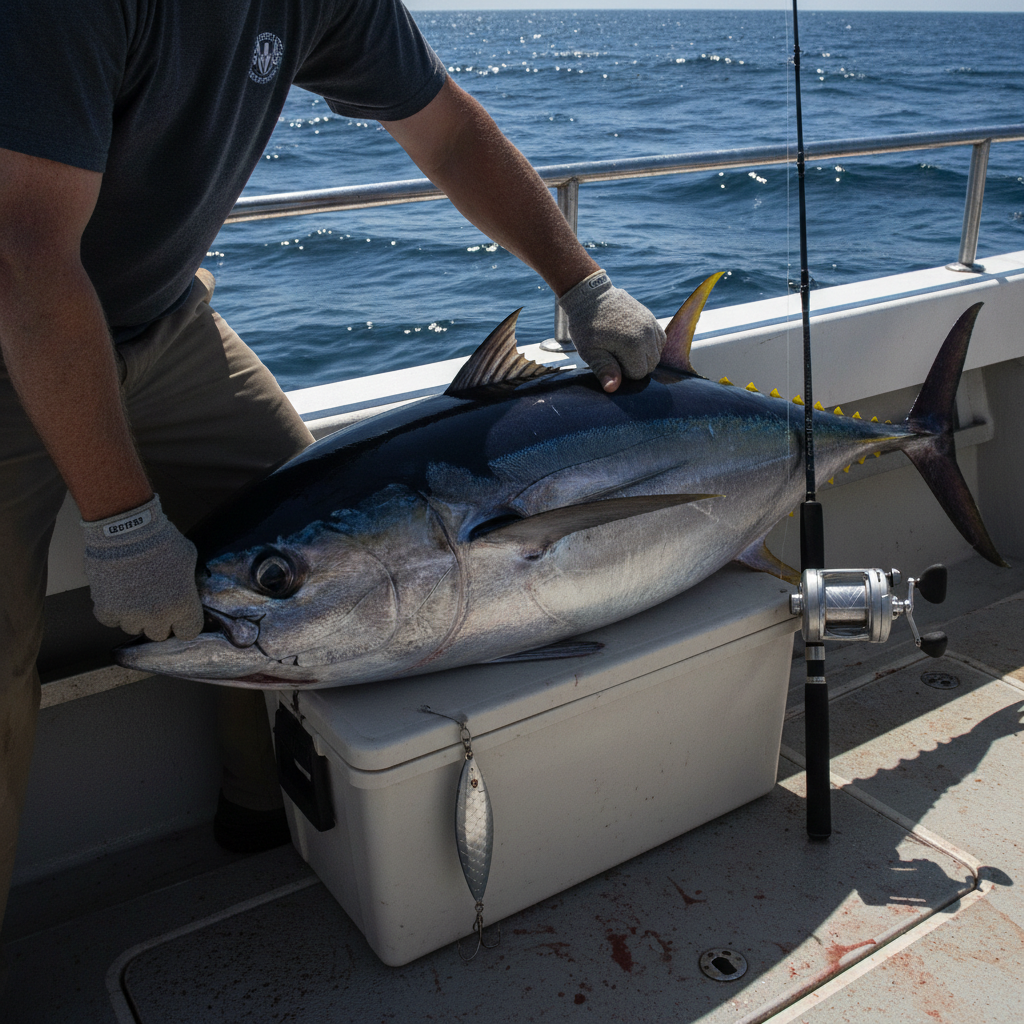
Late August is prime time in Southern California, and the San Diego fleet has had a strong stretch. Bluefin tuna are the headline as always, the kelp paddies are holding dorado and yellowtail, and the inshore kelp beds are giving up calico bass to anglers who never leave sight of land. Conditions have been warm and generally cooperative.
What’s Hitting
Bluefin tuna are the primary offshore target, ranging widely from the outer banks in toward the 43 and the 302. Sizes have been mixed, from footballs to genuinely large fish that will test your gear and your patience.
Yellowtail are at the Coronado Islands and around the offshore paddies and structure. Dorado are on the kelp paddies in the warmer water — find a good paddy holding bait and it can be loaded. Yellowfin tuna are showing in the mix. Inshore, calico bass and sand bass are on the kelp beds and hard structure, halibut are on the sand flats, and there are barracuda and bonito around the bay mouth.
Where to Find Them
The offshore banks and the water south and west of Point Loma have been holding the bluefin — look for meter marks, foamers and working birds, and be prepared to run.
The Coronado Islands are the yellowtail zone; fish the hard structure and the current edges. Kelp paddies anywhere in the warm water can hold dorado and yellowtail — check every one you pass. Inshore, the La Jolla and Point Loma kelp beds hold calicos, and the flats inside San Diego Bay and Mission Bay hold halibut and spotted bay bass.
Tides & Conditions
Offshore water has been in the upper 60s to low 70s with the warmer breaks holding the dorado and yellowfin. Inshore water is cooler.
Morning conditions have been light with afternoon westerlies building. The marine layer has been persistent some mornings, which suppresses the visual signs offshore — meter marks and sonar matter more on those days than birds do. Plan long-range trips around the weather windows and check the current temperature break charts before deciding on a direction.
Tackle & Tactics
For bluefin, heavy spinning or conventional gear with 60- to 100-pound fluorocarbon and a live sardine on a matched circle hook, or a flat-fall jig worked on the meter marks. Fluorocarbon size is often the difference between a bite and a long stare — go lighter than feels comfortable.
Yellowtail take a live mackerel or sardine, or a surface iron worked fast at the islands. Dorado on a paddy will eat almost anything once they are fired up — a live bait on a light outfit, or a small jig. Inshore calicos want a swimbait on a leadhead thrown tight to the kelp stringers, and halibut come to a live smelt or a swimbait dragged on the sand.
Local Intel This Week
Access: the Shelter Island Boat Launch and the Dana Landing ramp in Mission Bay are the two main public ramps, with the Pepper Park ramp in National City on the south bay. The Ocean Beach Pier, Shelter Island Pier and Crystal Pier give shore anglers access, and the sportfishing landings at Point Loma run everything from half-day to multi-day trips.
Fish are concentrating on the offshore temperature breaks and around the kelp paddies, with the islands holding yellowtail. Fishing the Coronado Islands means fishing Mexican waters and requires a valid Mexican fishing license, and bluefin, yellowtail and halibut all carry size and bag limits — check current CDFW and federal HMS regulations before keeping fish.
This Week’s Tip
When you find a kelp paddy, do not pull up on top of it. Stop the boat a long cast up-current, shut down, and throw a few live baits toward it before you commit. A paddy that looks empty will often light up thirty seconds after the first chum bait hits the water — and a boat that idles right up to it will never find out, because the school sounds before anyone gets a bait wet.
Planning a trip to San Diego?
This report tells you what happened. ReelAI tells you what to do about it — a briefing for your date, your target species and how you're fishing, built from our reports plus live NOAA and USGS data.
Powered by ReelAI — fishing.digital's intelligence layer. Answers are generated from fishing.digital reports and public NOAA, NWS and USGS data, and may be incomplete or out of date. Regulations and marine safety information are summaries only; always confirm with the responsible authority before you fish.