
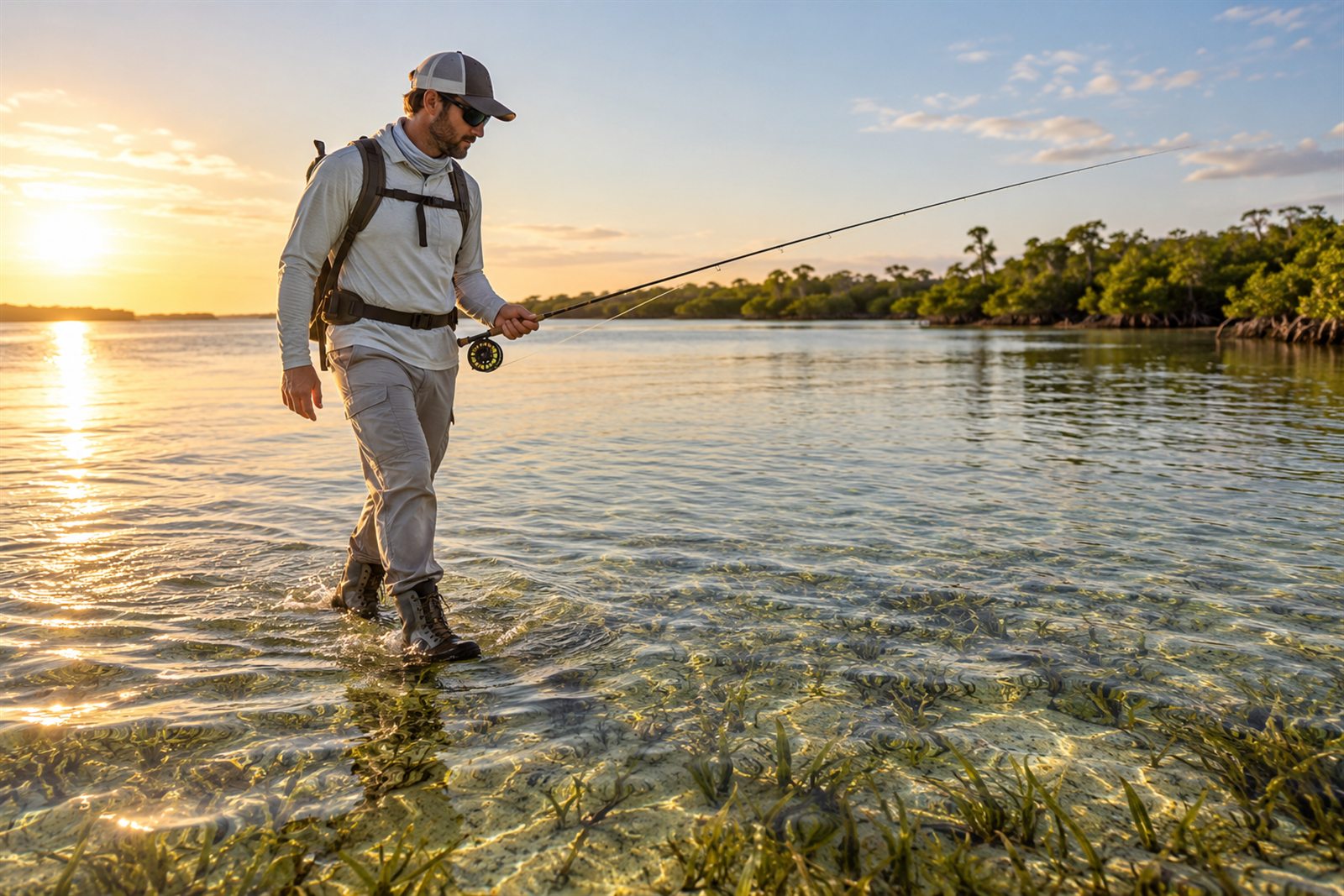
Florida anglers use “waders,” “wading boots,” “flats boots,” and “wet-wading shoes” almost interchangeably in conversation, but the products are not interchangeable. Chest and hip waders keep water off your legs and torso. Wading boots and shoes protect your feet, improve traction, drain water, and make long walks across sand, grass, shell, or mud more manageable.
For warm-water flats fishing, the right footwear is usually a saltwater-specific boot, high-top shoe, or bootie—not an insulated trout boot. The best choice depends less on brand than on the bottom under your feet. Firm sand and turtle grass reward light, flexible footwear. Oyster beds, coral rubble, and riprap demand more protection. Soft mud punishes heavy boots and tightly spaced tread.
Editorial note: This is a research-based buyer’s guide built from current manufacturer specifications, intended uses, construction details, and Florida fishing conditions. We have not personally field-tested every product below. Product availability and prices change, so verify the current model and size before buying.
Disclosure: Fishing.Digital may earn a commission from qualifying purchases made through affiliate links, at no additional cost to you.
Best Saltwater Wading Boots for Florida Flats: Quick Picks
| Pick | Best use | Construction advantage | Main tradeoff |
|---|---|---|---|
| Simms Flats Sneaker | Best overall for Florida sand and grass flats | Saltwater-safe materials, puncture resistance, non-marking gum rubber | Not intended for the most technical rocky shoreline |
| Orvis PRO Approach Hiker–Salt | Best support for long approaches and mixed bottom | Mid-height ankle support, integrated gravel guard, Michelin outsole | Premium price and more boot than a minimalist angler needs |
| Frogg Toggs Aransas 3.0 | Best value for surf, sand, and casual flats use | 5mm neoprene, reinforced toe and heel, full-gusset zipper | Warmer and less breathable than quick-draining mesh footwear |
| Patagonia Salt Wading Booties | Best lightweight flats bootie | Low-bulk design, quick drainage, puncture protection, debris barrier | Less ankle structure than a full boot |
| Patagonia River Salt Wading Boots II | Best protection for shell, coral, and rocky access | High collar, Cordura upper, rubber protection, Vibram Megagrip | Small lugs can load up in sticky mud; fit is oriented to wet wading |
Best Overall: Simms Flats Sneaker
The Simms Flats Sneaker is the most direct match for the classic Florida flats day: warm water, miles of firm sand or turtle grass, repeated transitions between skiff and water, and the possibility of shell or scattered rock. Simms builds it with non-corrosive, saltwater-friendly materials, molded rubber toe and heel protection, a neoprene liner, and a non-marking gum-rubber outsole.
That combination keeps it closer to an athletic high-top than a bulky freshwater wading boot. The reinforced upper gives more puncture and abrasion protection than an ordinary water shoe, while the outsole is appropriate around boat decks and docks. It is the most balanced choice here for anglers who want one pair for redfish, snook, bonefish, permit, and shallow-water exploring.
Choose it for: firm sand, turtle grass, skiff-to-flat use, coral or shell in moderation, and anglers who prioritize mobility.
Skip it when: your normal access involves steep riprap, extremely slick technical rock, or deep sucking mud where tread release and boot weight become the dominant concerns.
Check current Simms Flats Sneaker availability
Best Support: Orvis PRO Approach Hiker–Salt
The Orvis PRO Approach Hiker–Salt is the support-first option. Its mid-height construction, abrasion-resistant exterior, protected toe, EVA midsole, and integrated zippered gravel guard suit anglers who cover real distance or move among docks, mangrove edges, shell, and uneven shoreline before entering the water.
Orvis uses a non-marking Michelin outsole intended to grip wet and dry surfaces without scuffing a boat deck. The built-in guard helps keep sand and debris away from the foot, and the lace-up interior allows a more controlled fit than simple pull-on booties. Orvis says a separate wading sock is not required unless colder water calls for one.
This is a strong choice for anglers who value ankle structure and all-day support. It is less attractive for someone who fishes only ankle-deep firm sand and wants the lightest possible footwear.
Check current Orvis saltwater hiker availability
Best Value: Frogg Toggs Aransas 3.0 Surf & Sand Shoe
The Frogg Toggs Aransas 3.0 is the practical value pick for surf anglers, beach walkers, and occasional flats fishermen. The current model uses a 5mm neoprene shell, a one-piece rubber athletic outsole, reinforced toe and heel caps, an adjustable ankle strap, and a high-density front zipper with a full gusset.
Its neoprene construction offers coverage and comfort for cool mornings, winter surf, and anglers who dislike sand entering low-cut footwear. That same construction is the compromise in hot weather: it will generally feel warmer than a ventilated mesh boot or lightweight flats sneaker.
For someone who fishes both the beach and protected flats—and does not need premium hiking-boot support—the Aransas occupies a useful middle ground. It is also a more fishing-specific solution than wearing old running shoes, which drain poorly and offer limited protection from shell.
Check current Aransas 3.0 pricing
Best Lightweight Bootie: Patagonia Salt Wading Booties
Patagonia’s Salt Wading Booties are built for quick, quiet movement on warm saltwater flats. The low-bulk upper uses perforated Yulex natural and synthetic rubber to drain water while helping block sand and debris. Patagonia also specifies puncture protection, corrosion-resistant hardware, and a non-marking sole.
This is the most minimalist option in the group. It makes sense for a traveling flats angler, a skiff fisherman who wades only when a fish requires it, or anyone who prizes speed and packability over rigid ankle support. The tradeoff is straightforward: a bootie cannot provide the same structure as a mid-height boot when the bottom is broken, unstable, or covered in heavy shell.
Best terrain: firm light-colored sand, clean grass flats, and relatively predictable warm-water bottom.
Use more protection for: oyster bars, aggressive coral rubble, riprap, and unfamiliar bottom where puncture and ankle stability matter more than weight.
Check current Patagonia Salt Wading Booties availability
Best for Hard Bottom: Patagonia River Salt Wading Boots II
The River Salt Wading Boots II provide the most traditional protective boot construction in this group. Patagonia specifies an abrasion-resistant Cordura nylon mesh upper, rubber toe and heel caps, a high collar, an adjustable ankle strap, corrosion-resistant hardware, and a non-marking Vibram Megagrip outsole that accepts studs.
Those features suit shell, coral, rock, and mixed hard-bottom access. The boots are designed for wet wading with a liner or neoprene sock rather than as an oversized cold-water boot over bulky stockingfoot waders. Confirm the sizing guidance carefully.
There is an important Florida caveat: Patagonia’s own published response to customer feedback says the smaller lugs can pack with mud and clay. That makes this a better choice for hard, abrasive bottom than for marsh muck. Anglers who regularly cross soft mud should favor a lighter design with wider-spaced, self-clearing tread and should avoid forcing each step when a boot becomes suctioned.
Check current River Salt II availability
Waders vs. Wading Boots: What Florida Anglers Mean
Waders are waterproof garments extending to the hip, waist, or chest. Stockingfoot waders end in a waterproof neoprene sock and require a separate boot. Bootfoot waders have the boot permanently attached. Florida anglers typically reserve breathable or neoprene waders for winter, cold surf, deep water, or situations where staying dry matters.
Wading boots are protective footwear. Traditional versions are sized to fit over stockingfoot waders. Saltwater flats boots and wet-wading shoes are often designed for bare legs with a thin liner or neoprene sock. Never assume the sizing is interchangeable: a boot designed around a bulky stockingfoot can feel loose when wet wading, while a fitted flats boot may be too tight over waders.
For most warm Florida inshore fishing, the search phrase “saltwater wading boots” better matches the product need. “Fishing waders” becomes the better phrase when the objective is staying dry or warm.
Choose the Boot for the Bottom
Sand and turtle grass
Prioritize low weight, secure heel fit, quick drainage, and a sole that will not mark a boat deck. A flats sneaker or bootie is usually enough if sharp structure is limited.
Oyster shell and broken reef
Move protection ahead of weight. Look for a substantial outsole, rubber toe and heel coverage, abrasion-resistant uppers, and enough height to keep shell fragments away from the ankle.
Soft mud
Heavy boots and closely packed tread become tiring. Choose lighter footwear with tread that releases mud, maintain a deliberate stance, and pull upward slowly rather than twisting the knee against suction.
Jetties and slick rock
Flats footwear is not automatically technical-rock footwear. Use a boot and sole intended for wet rock, and verify local rules before adding studs. Metal studs can damage boat decks and become hazardous on smooth fiberglass.
Florida Flats Safety Matters More Than the Logo
No boot makes an angler stingray-proof. Shuffle rather than taking high, blind steps in ray country, keep the rod and free hand available for balance, and do not step backward automatically after a strike. Polarized eyewear helps with bottom visibility; our fishing sunglasses guide explains lens color and material choices for shallow water.
Enter unfamiliar water slowly. Dark patches may be grass, mud, rock, or depth changes. Tides can cover the return route, and a bottom that supported you on the way out may soften as water rises. The Stuart fishing guide and other location guides are useful starting points, but local conditions always take priority.
Fit, Socks, and Saltwater Care
- Fit for the intended system. Decide whether the boot will be worn with a thin wet-wading sock or over stockingfoot waders before choosing a size.
- Prevent grit movement. Sand inside a boot creates hot spots and can damage neoprene. A secure cuff, gravel guard, or integrated gaiter is valuable.
- Rinse after every saltwater trip. Flush the upper, zipper, laces, eyelets, tread, and interior with fresh water.
- Dry with airflow. Remove insoles when practical and avoid sealing wet footwear in a vehicle or gear bin.
- Inspect the sole bond. Salt, heat, and repeated flexing expose separation early. Check before a long walk, not at the launch.
Our Verdict
For the broadest range of Florida sand and grass flats, the Simms Flats Sneaker is the most balanced starting point. Choose the Orvis PRO Approach Hiker–Salt when ankle support and long approaches matter most, the Frogg Toggs Aransas 3.0 for budget-conscious surf and flats use, the Patagonia Salt Wading Booties for lightweight mobility, and the Patagonia River Salt Wading Boots II for hard, abrasive bottom rather than sticky mud.
The correct answer is terrain-specific. A lighter boot that encourages careful, comfortable movement will outperform an overbuilt boot on clean sand; a protective high-collar boot is worth the weight when oyster shell or coral can end the day. Match the sole, structure, and drainage to the water you actually fish.
Continue planning your setup through the Fishing.Digital tackle guide hub, or pair the right footwear with current tactics in our guides to catching redfish and catching snook.
Planning a trip to Fishing Gear?
This report tells you what happened. ReelAI tells you what to do about it — a briefing for your date, your target species and how you're fishing, built from our reports plus live NOAA and USGS data.
Powered by ReelAI — fishing.digital's intelligence layer. Answers are generated from fishing.digital reports and public NOAA, NWS and USGS data, and may be incomplete or out of date. Regulations and marine safety information are summaries only; always confirm with the responsible authority before you fish.