
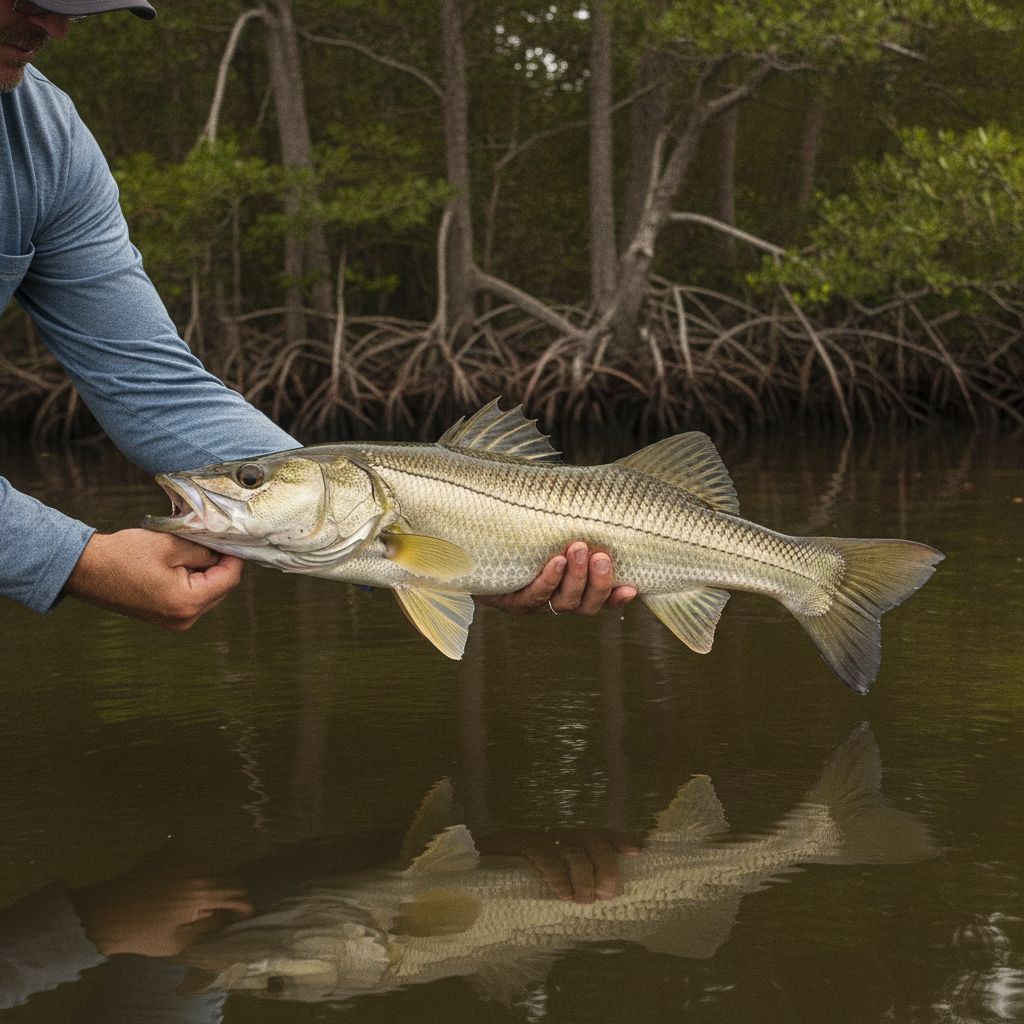
The Caloosahatchee River carves across Southwest Florida from Lake Okeechobee to the Gulf at Fort Myers, a 67-mile freshwater-to-brackish artery that, in its lower stretches, holds one of the most consistent inshore snook fisheries on the Gulf Coast. From the upriver fish in the Olga and Alva backwaters through the residential canals of Cape Coral and Fort Myers, down to the river mouth at Punta Rassa where the Caloosahatchee meets San Carlos Bay, the system produces snook year-round in fishable numbers.
For inshore anglers used to the Atlantic side — the Indian River Lagoon, the Stuart inlet, the Jupiter waters — the Caloosahatchee fishes differently. The water is darker. The salinity shifts with the regulated releases from Lake Okeechobee through the Franklin Lock. The mangrove shoreline is more developed, broken by canals and residential basins. And the fish themselves often hold tighter to specific structure than their Atlantic-side cousins do, making the Caloosahatchee a finesse fishery as much as a power one.
For traveling anglers and Southwest Florida residents alike, the Caloosahatchee snook fishery rewards local knowledge in ways that show up clearly on the water. Here is the framework worth walking in with.
What you’re fishing for
Snook (Centropomus undecimalis) — the headline inshore gamefish of Southwest Florida. The Caloosahatchee holds a year-round resident population plus seasonal influxes from the Gulf. Fish run from 18-inch schoolies to 40+ inch breeding-class females.
The Florida snook regulations are strict and active. As of 2026, the recreational slot in Gulf waters is generally 28-33 inches with a 1-fish daily bag limit and a closed harvest season (typically December 1 – February 28 and May 1 – August 31 in Gulf waters — always verify current FWC regulations as these have been modified multiple times). Most Caloosahatchee snook fishing is catch-and-release regardless.
The Caloosahatchee fishery is built on three primary patterns:
Backwater residents. Fish that hold in canals, residential basins, brackish creek mouths, and shoreline structure year-round. These are the bread-and-butter fish for the system.
Migratory schoolies. Smaller fish (18-26 inches) that push up and down the river with the tide and salinity changes, especially in fall and spring.
Big breeders. Mature females that stage at the river mouth and outer bays from late spring through summer for spawning, then return to the upriver structure.
When to fish
The Caloosahatchee fishery is genuinely year-round, but the patterns shift dramatically by season:
Late winter / early spring (February through April): Snook recovering from the cold-water months. Hold tight to dark-bottom structure that warms in the afternoon sun. Lethargic feeders early; aggressive feeders as temperatures climb into the 70s. Some of the year’s biggest fish come from the spring transition because the river holds the wintering population before the Gulf push.
Late spring (May through June): The pre-spawn push. Big females stage at the river mouth and on the bay-side shorelines. The “tarpon and snook” combination period when both species are catchable in the same trip.
Summer (July through September): Peak Gulf-side snook bite at the mouth. Backwater fish are scattered, often deeper, holding in shaded structure. Catch-and-release season for snook regardless of regulations — fish are spawning, stressed, and warm.
Fall (October through November): The “ringer” months. Migratory schoolies push back into the river from the Gulf. Mullet run kicks off the heaviest backwater bite of the year. Multi-species days (snook + redfish + jacks + ladyfish) are common.
Winter (December through January): Cold-water concentration. When water temperatures drop below 65°F, snook stack at known thermal refuges — power plant outflows, deep canals, dark-bottom basins that absorb solar heat. Fish are catchable but slow.
If you can pick one window for a Caloosahatchee snook trip, the last week of October through the third week of November is the textbook. Mullet run is on, water temperatures are ideal (mid-70s), the fish are aggressive, and the weather is typically cooperative.
Where to fish
The Caloosahatchee divides into three distinct zones, each with its own personality:
Zone 1: Upriver and the Franklin Lock area
The water above and below the Franklin Lock (officially the W.P. Franklin Lock and Dam) is the brackish-freshwater transition. Snook hold in the deep channels, around the lock structure itself, and at the confluences of tributary creeks. This zone is often the most productive for big fish in winter and early spring because it concentrates fish during cold weather.
The Olga and Alva backwaters branch off the main river here. Pine Island Sound and the Caloosahatchee don’t connect directly, but the lock-bypass canals and the Orange River system give snook routes between freshwater and salt.
Zone 2: Mid-river and the residential canals
The stretch from roughly Fort Myers downriver to the I-75 corridor includes the most extensive residential canal system on the Florida west coast — Cape Coral alone has 400+ miles of canals. These canals hold snook year-round. Productive canals share characteristics: depth (8+ feet at the mouth), structure (docks, seawalls, riprap), and connection to the main river that provides bait and current flow.
The mid-river zone also includes the Caloosahatchee proper between Fort Myers and the Edison/Ford estates area, where the river is flanked by mature oak hammocks, deep cuts, and bridge structure (the Edison Bridge, the Caloosahatchee Bridge complex).
Zone 3: The river mouth and Punta Rassa
Where the Caloosahatchee meets San Carlos Bay at Punta Rassa is the most photographed snook water in Southwest Florida. The Sanibel Causeway bridges create current breaks. The Picnic Island and Bunche Beach mangrove shorelines hold fish year-round. The mouth itself fishes like a tarpon hole in summer and a snook concentration in fall.
For first-time visitors, start in the mid-river zone — the residential canals from Cape Coral down to Fort Myers. Plenty of public boat ramps, manageable water, year-round fish, and forgiving for someone learning the system.
The technique
Caloosahatchee snook fishing centers on three core techniques:
1. Live bait — the local standard
The Caloosahatchee operates on live bait more than most Atlantic-side snook fisheries. The productive baits:
- Live shrimp (medium to jumbo) — the all-purpose Caloosahatchee bait. Free-lined, under a popping cork, or on a 1/8 oz jighead. Productive year-round.
- Live pilchards/scaled sardines — the warm-weather power bait. Excellent in summer at the river mouth.
- Live pinfish (small) — for big snook. Free-lined to dock pilings or under structure.
- Live shiners (where available, mostly in upriver brackish zones) — productive in winter when other baits are scarce.
Standard setup: 7′ medium-heavy spinning rod, 3000-4000 size reel, 15-20 lb braid mainline, 25-30 lb fluorocarbon leader 18-24 inches, 1/0-3/0 circle hook (required when bait-fishing for snook under Florida regulations).
2. Artificial baits — the run-and-gun approach
For anglers who prefer working water rather than soaking bait, the productive artificials:
- Soft plastic paddle tails on a 1/4 oz jighead — D.O.A. C.A.L. paddle tails, Z-Man Trout Trick, MirrOlure Lil John. Pearl, white, or natural color. Cast to docks, work back with twitch-pause retrieve.
- Topwater walking baits — Rapala Skitter Walk, Heddon Spook Jr. Dawn and dusk in shallow water. Walk-the-dog cadence.
- Suspending twitchbaits — MirrOdine, X-Rap. The all-around tool for fish that are deeper than topwater and shallower than soft plastics.
- Live-bait-imitator swimbaits — Tsunami Holographic Shad, Storm WildEye Live Mullet. Excellent during the fall mullet run.
3. Dock fishing — the Caloosahatchee specialty
Caloosahatchee snook hold under docks more reliably than almost any other Florida snook water. The technique: pitch a soft plastic, jig, or live shrimp UNDER the dock, let it sink into the shadow line, slow retrieve. Skip-casting (sidearm cast that skips the lure under low dock overhangs) is a high-value skill on this fishery.
Productive docks share characteristics:
- Deep water at the end (8+ feet)
- Light structure underneath (NOT just bare pilings — fish want shadow plus cover)
- On the residential canals especially, docks with active lighting that attracts bait at night
The dock bite is most productive at dawn, dusk, and at night under dock lights. The night dock bite under residential lighting is legitimately one of the best snook fishing experiences in Florida.
What separates productive Caloosahatchee anglers from the rest
Specifics that visiting anglers often miss:
The salinity matters. Water releases from Lake Okeechobee dramatically change Caloosahatchee salinity. After heavy rain or scheduled releases, the upriver zone may run completely fresh; the productive snook water shifts downriver. After dry periods, salt pushes much further up. Productive anglers check salinity (or watch the WDIS gauges online) and shift accordingly.
Tide is less important than on the Atlantic side. Caloosahatchee tide ranges are small (often 1-2 feet) compared to the Atlantic side (3-5 feet). Snook in the river system pay more attention to wind, salinity, water temperature, and bait presence than they do to tide stage. This is a different mental model than what Atlantic-side anglers carry.
Cold fronts are gold. A front pushing through Southwest Florida drops water temperatures, concentrates fish at thermal refuges, and triggers feeding windows in the first 24-48 hours after the front. Locals fish the day-after-front aggressively.
The bridge bite is real. The Edison Bridge, Caloosahatchee Bridge, Cape Coral Bridge, and the Sanibel Causeway all hold snook on the right tide and conditions. Most visiting anglers underfish the bridges.
The canals fish year-round. A common mistake is to fish only the main river. The residential canal systems off the main Caloosahatchee — particularly in Cape Coral and the south side of Fort Myers — hold resident snook populations that are catchable in any season. They’re less crowded than the main river too.
Tackle, in detail
Spinning setup (the all-purpose):
- 7′ to 7’6″ medium-heavy fast-action spinning rod
- 3000-4000 size spinning reel with smooth drag
- 15-20 lb braid mainline
- 25-30 lb fluoro leader, 24 inches
Heavier setup for big-fish bridge fishing:
- 7′ medium-heavy to heavy spinning rod or 6500-class conventional
- 30 lb braid mainline
- 40-50 lb fluoro leader
- For pitching live bait to bridge pilings; big fish around the Edison Bridge in fall can be 36-40+ inches
Light setup for the back canals:
- 7′ medium-action spinning rod
- 2500 size spinning reel
- 10-15 lb braid, 20 lb fluoro leader
- For pitching small soft plastics under docks
Conservation note
Florida snook regulations have been modified repeatedly over the past 20 years as the population has dealt with cold-kills (notably the 2010 freeze that crashed numbers), red tide events, and habitat degradation. The fishery has rebuilt and recrashed multiple times. The catch-and-release ethic among Florida anglers — most snook caught are released regardless of legal harvest status — has been central to the recovery.
What Caloosahatchee anglers can do:
- Follow current FWC slot, season, and bag rules exactly. They change.
- Use circle hooks when bait-fishing. Required for snook in Florida.
- Don’t fish snook to exhaustion in warm summer water — they don’t recover well.
- Pinch barbs on hooks if catch-and-release fishing.
- Handle fish in the water; don’t drag a 30+ inch snook onto a sandbar for photos.
- Be aware of red tide closures. The Caloosahatchee system is particularly affected by Lake Okeechobee releases that interact with Gulf nutrient loads.
- Report tagged fish to FWC if encountered. The agency tags snook regularly for population studies.
Trip logistics
The Caloosahatchee snook fishery is accessible from multiple bases:
Fort Myers / Cape Coral: The most central. Ramps include the Centennial Park ramp, the Cape Coral Yacht Club ramp, and multiple smaller public ramps. Mid-river and lower-river access.
Punta Rassa / Sanibel: River mouth and bay-side access. The Punta Rassa public ramp is the primary launch for river-mouth and Sanibel-area fishing.
Olga and the upriver: The Franklin Lock area and Caloosahatchee Regional Park ramp give access to the brackish-transition water and the upriver backwaters.
Charter rate (2026): $400-700 for a half-day inshore trip, $600-900 full day. The local guide community is deep — Capt. Aaron Robinson, Capt. Mike Holliday’s area, the Salt Strong network all have Caloosahatchee-specialty captains.
For first-timers: hire a charter for one day. The salinity-driven shifts, the canal navigation, and the dock-fishing technique all benefit from on-the-water demonstration. Day two onward can be productive DIY with the framework intact.
Final thought
The Caloosahatchee snook fishery doesn’t get the press that the Indian River Lagoon or the Florida Keys do. That’s part of its appeal. The fishery is consistent, the technique rewards local knowledge, and the access is straightforward for traveling anglers with a willingness to fish residential canals and brackish backwaters rather than postcard flats.
The fish themselves are the same Atlantic-coast snook anglers chase on the east side of the state. The water is different. The tactics are different. The mental model is different. For inshore anglers who have only fished the Atlantic-side snook fisheries, a Caloosahatchee trip in October or November will expand the toolkit considerably.
Worth a trip. Worth multiple trips if Southwest Florida is on the way.
Dennis Suler is a career outdoors writer and lifelong angler. He spent six years on the editorial staff of The Fisherman magazine as a field editor and managing editor — first editing the New Jersey reports section, then managing editor of the Mid-Atlantic edition. He also served as managing editor of Boater’s Digest magazine. He’s a member of the Outdoor Writers Association of America and writes for fishing.digital — covering 40+ U.S. fishing destinations with weekly reports, location guides, and feature articles.
This article is part of fishing.digital’s Florida Gulf & Southwest regional coverage. For weekly reports across the Caloosahatchee, Boca Grande, Sanibel, Naples, and the rest of southwest Florida, visit fishing.digital/newsletter and subscribe to fishing.digital Florida Gulf & Southwest Weekly.
Planning a trip to Fort Myers/Sanibel?
This report tells you what happened. ReelAI tells you what to do about it — a briefing for your date, your target species and how you're fishing, built from our reports plus live NOAA and USGS data.
Powered by ReelAI — fishing.digital's intelligence layer. Answers are generated from fishing.digital reports and public NOAA, NWS and USGS data, and may be incomplete or out of date. Regulations and marine safety information are summaries only; always confirm with the responsible authority before you fish.