
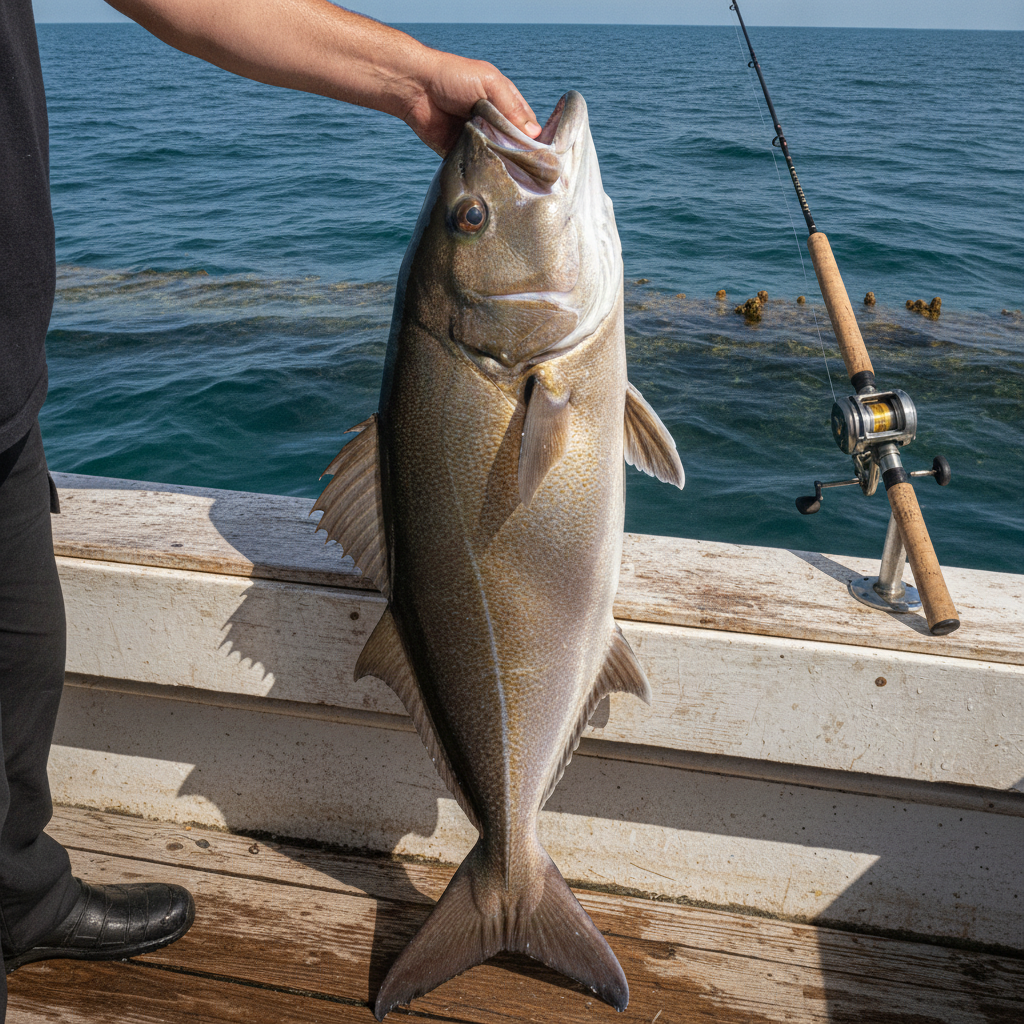
Greater amberjack (Seriola dumerili) — AJ to everyone who fishes for them — are the tackle-busters of the reef world: powerful, relentless brawlers that live on offshore structure and have a well-earned reputation for destroying inadequate gear. Pound for pound one of the strongest fish in saltwater, a big AJ on the end of your line is a full-body workout that tests your equipment and your endurance. Their other nickname — reef donkeys — tells you everything you need to know.
Range & Habitat
Greater amberjack range from New England to Brazil, with peak abundance from the Carolinas through the Gulf of Mexico. They inhabit offshore reefs, wrecks, rock ledges, oil platforms, and buoys, typically in 60–300+ feet of water. They school around any high-relief structure and are usually found in groups — find one AJ and there are more. Smaller relatives (banded rudderfish and lesser amberjack) are common closer to shore. AJs are year-round residents on Gulf structure but make some seasonal movements.
Best Tackle
Heavy conventional required: 6′–7′ heavy to extra-heavy conventional rod (50–80 lb class), a high-capacity 50–80 size lever-drag reel with 400+ yards of 65–100 lb braid, and 4–6 feet of 80–150 lb fluorocarbon leader. Set the drag at 30–40% of line strength — you will need every bit of it. Do not underestimate amberjack: light tackle here means broken rods, stripped reels, and fish lost in the structure.
Top Techniques
Live Bait Fishing: The most effective way to catch a big AJ. Drop a large live blue runner, hardtail, cigar minnow, or pinfish near structure on a knocker rig. Amberjack attack live bait aggressively and will rise well off the bottom to take it.
Vertical Jigging: High-speed jigging with large butterfly or speed jigs (4–10 oz) is deadly. Work the jig fast from the bottom up through mid-column — AJs follow and strike on the upswing, and the hits are brutal. This is arguably the most exciting way to target them.
Live Bait on the Surface: When AJs show near the surface around a buoy or wreck, pitching a big live bait to them produces explosive surface strikes.
Trolling: Large skirted lures pulled past structure will raise amberjack up from depth and show you where the school is holding.
Best Baits & Lures
- Live Blue Runner (Hardtail): The #1 amberjack bait. Large, hardy, handles heavy tackle, and irresistible to big AJ.
- Live Cigar Minnow: The standard Gulf amberjack bait and widely available. Drop to mid-column, not all the way to the bottom.
- Large Butterfly and Speed Jigs (4–10 oz): Pink, white, and blue/white. Work them fast from bottom to mid-column.
- Slow-Pitch Jigs: A slower, fluttering presentation for fish holding tight and deep in the structure.
- Pitch Bait (live pinfish or grunt): Free-lined near structure for fish sitting close to the reef.
- Large Swimbaits (6–8″): Paddle tails rigged heavy and dropped near structure produce well.
- Popper: When AJs are feeding on the surface near buoys, a large popper produces explosive strikes and an extraordinary fight on heavy tackle.
Seasonal Patterns
Spring and Fall: The peak seasons, when fish are most active and feeding aggressively. Summer: Present on structure but feeding windows can be short in the peak heat, and the Gulf recreational season is generally closed (approximately June 1–July 31) to protect spawning aggregations — verify current NOAA dates. Winter: Still catchable; fish may sit slightly deeper. Year-round: AJs are available on offshore structure throughout their range all year — only the harvest windows move.
Pro Tips
- Max drag from the start: The first run of an amberjack goes straight at the reef. Set the drag at 30–40% of line strength and apply maximum pressure the instant you hook up. If they reach the wreck, you lose — there is no negotiating with a big AJ near structure.
- Crank hard and don’t stop: AJ fights are won in the first 30 seconds. Maintain relentless upward pressure.
- Fish mid-column for the big ones: The largest amberjack don’t sit on the bottom — they suspend and move up to eat. Drop to the structure, then reel up 20–30 feet and hold there.
- High-speed jigging: Work the jig as fast as you can reel. AJs key on fast-moving prey and a slow retrieve simply doesn’t produce the same results.
- Sabiki your own bait: Catch blue runners on a sabiki over nearshore structure on the way out. Fresh, lively hardtails dramatically outfish anything bought at a bait shop.
- Vent or descend releases: Amberjack pulled from depth suffer barotrauma. Use a descending device on any fish you’re letting go.
- Ciguatera risk: In some tropical reef areas large amberjack can carry ciguatera toxin. Know your local fishery — this is far more of a concern in the tropics than on the US mainland.
Regulations
Greater amberjack: Gulf minimum 34 inches fork length, 1 fish per person per day, with a closed season running approximately June 1–July 31. South Atlantic minimum 28 inches fork length, 1 fish per person per day, with its own closed period. Seasons and limits are adjusted frequently — verify current rules with NOAA, the SAFMC, or the GMFMC before your trip.
Best Amberjack Tackle
Affiliate disclosure: fishing.digital earns a small commission on qualifying purchases at no extra cost to you.
1. Heavy Speed Jig, 6 oz Pink/White
Vertical speed jig — work it aggressively from bottom to mid-column for savage strikes. Check price on Amazon
2. 150 lb Fluorocarbon Leader
Heavy leader for AJ around reef structure — they test every component in your system. Check price on Amazon
3. Penn Squall Lever Drag Two-Speed (30 Size)
The low gear lets you fight hard and then winch the fish up out of the structure. Check price on Amazon
4. 8/0 Live-Bait Hook
The right hook for a big live blue runner or cigar minnow dropped to mid-column near structure. Buy the bait locally — pick the liveliest, largest runner in the well. Check price on Amazon
Browse all species guides: How To Catch Fish — Complete Species Guides | Weekly Fishing Reports — updated every Thursday.
Planning a trip to Amberjack?
This report tells you what happened. ReelAI tells you what to do about it — a briefing for your date, your target species and how you're fishing, built from our reports plus live NOAA and USGS data.
Powered by ReelAI — fishing.digital's intelligence layer. Answers are generated from fishing.digital reports and public NOAA, NWS and USGS data, and may be incomplete or out of date. Regulations and marine safety information are summaries only; always confirm with the responsible authority before you fish.