
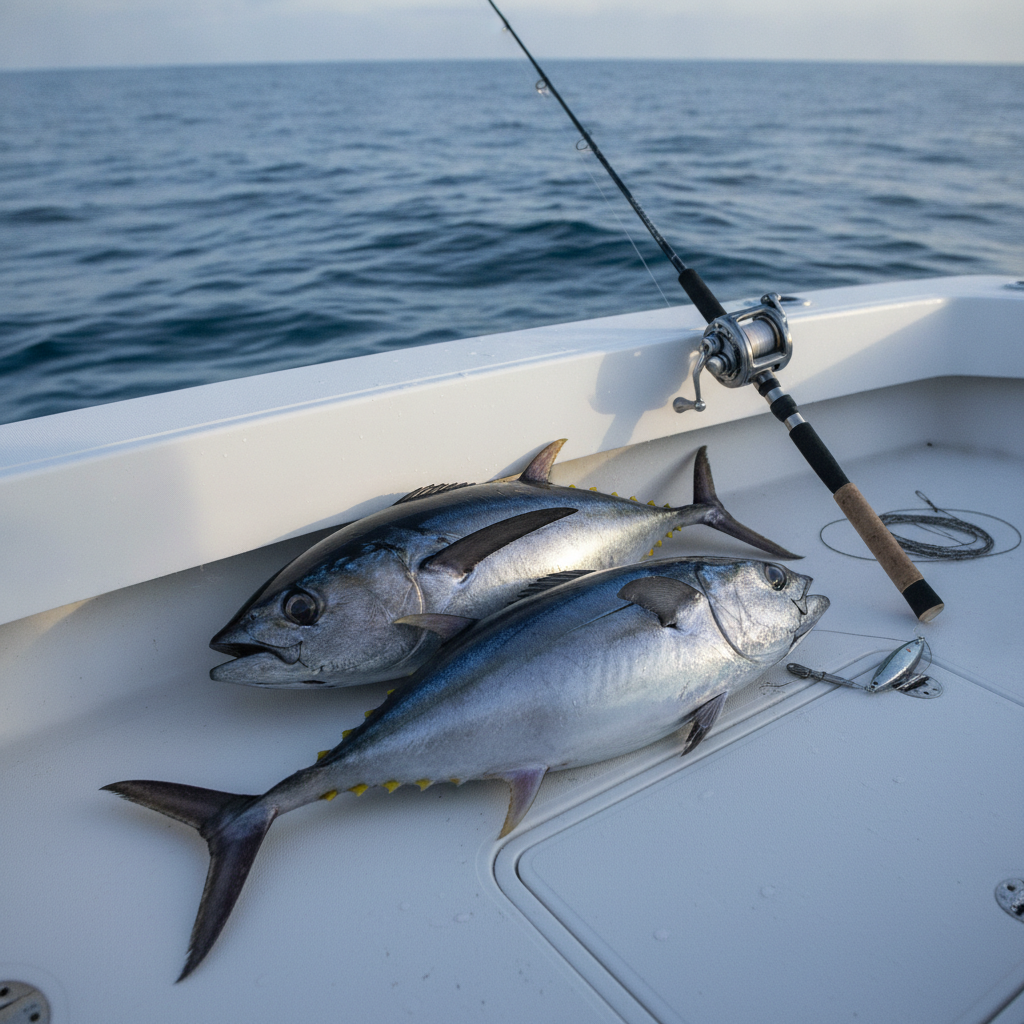
Blackfin tuna (Thunnus atlanticus) are the smallest Atlantic tuna — typically 5–30 lbs and rarely exceeding 45 — but on light tackle they are among the most exciting offshore fish available to Southeast and Gulf Coast anglers. Found year-round off South Florida, the Keys, and throughout the Gulf, blackfin are accessible without the long canyon runs that yellowfin demand, and their willingness to bite makes them the ideal introduction to tuna fishing.
Range & Habitat
Blackfin tuna are found throughout the western Atlantic from Massachusetts to Brazil, with the heaviest year-round populations in South Florida, the Florida Keys, the Bahamas, and the Gulf of Mexico. They hold in 80–600 feet of water, associating with offshore ledges, wrecks, seamounts, current edges, color changes, the Gulf Stream edge, and any concentration of bait. Pushbutton Hill off Stuart, the offshore humps out of Islamorada, and the Gulf’s nearshore platforms all hold blackfin year-round. They frequently school with skipjack and are sometimes mixed in with yellowfin.
Best Tackle
Light to medium: Blackfin on light tackle is exceptional sport. Rod: 7′ medium to medium-heavy spinning. Reel: 3000–6000 size with 200+ yards of 20–40 lb braid. Leader: 4–6 feet of 30–60 lb fluorocarbon — blackfin can be genuinely line-shy in clear water, so start light and go heavier only if you’re getting cut off.
Top Techniques
Chunking: Drift with the current chunking butterfish, pilchards, squid, or ballyhoo pieces, and present a whole bait or small squid on a circle hook in the slick. The same approach used for yellowfin, scaled down.
Live Bait on Structure: Drift live pilchards, threadfins, small goggle eyes, or cigar minnows near offshore ledges and seamounts, or free-line them in the chum slick.
Trolling: Small cedar plugs, feathers, rigged ballyhoo, and small skirted lures at 7–9 knots locate fish efficiently. Blackfin are the most common tuna raised on most South Florida trolling spreads.
Casting and Jigging: When fish are on the surface, small poppers (1–2 oz), butterfly jigs (1.5–3 oz), and metal spoons on light tackle produce spectacular action.
Best Baits & Lures
- Live Pilchards: The top blackfin bait in South Florida. Free-line them near structure or in the slick.
- Butterfish or Pilchard Chunks: The standard chunking bait offshore.
- Small Squid (whole): Excellent blackfin bait in the chum slick.
- Cedar Plug: A classic trolling lure — the small 4–5″ versions are perfect for blackfin.
- Small Skirted Trolling Lures and Rigged Ballyhoo: Blue/white and pink/white are the standards.
- Feathers: Trolled feathers in blue/white or green/yellow are reliable blackfin producers.
- Metal and Butterfly Jigs (1–3 oz): Cast into breaking fish or jigged vertically. Diamond jigs and Kastmasters are classics, and light jigging is outstanding sport on these fish.
- Small Poppers: Exciting surface action when the fish are busting on top.
Seasonal Patterns
Year-round (South Florida and the Keys): The most consistent year-round tuna fishery available to Southeast anglers, with the best action at Pushbutton Hill off Stuart and the offshore humps out of Islamorada. Fall–Winter: Peak season off Stuart and the Treasure Coast, when fish stack up on the hill and water temperatures and bait concentrations are at their best. Spring: Excellent as bait moves through. Summer: Present offshore throughout the Southeast and Gulf.
Pro Tips
- Accessible offshore fish: Blackfin are often caught within 15–30 miles of port — one of the easiest tuna species to reach in a center console.
- Go light for maximum sport: On 20 lb class spinning tackle, even a 20 lb blackfin is a genuinely exciting fight.
- Light fluorocarbon in clear water: Blackfin get finicky. Drop to 40 lb — or lighter — when the bites slow down.
- Keep the slick going: Consistent chunking is essential. Don’t let the slick die while you’re rigging.
- Match the bait size: Blackfin feeding on tiny baitfish will not eat a big chunk. Look at what’s in the water and match it.
- Excellent table fare: Blackfin make exceptional sashimi. Bleed and ice the fish immediately for the best quality.
Regulations
Blackfin tuna currently have no federal recreational bag limit, though some states set their own limits — Florida, for example, has a per-person and per-vessel limit. Verify current NOAA and state regulations before you fish.
Best Blackfin Tuna Tackle
Affiliate disclosure: fishing.digital earns a small commission on qualifying purchases at no extra cost to you.
1. 5000-Size Saltwater Spinning Reel
A sealed 5000-size spinning reel with 200+ yards of 30 lb braid and a smooth 15–20 lb drag is the right class for blackfin. Look for a fully sealed saltwater body — the initial run is short, fast, and hard on a reel.
2. 40 lb Fluorocarbon Leader
Blackfin are leader-shy. 40 lb is the sweet spot between strength and visibility in clear offshore water. Check price on Amazon
3. Small Skirted Trolling Lure
A small skirted trolling lure, rigged in front of a ballyhoo or fished bare, is the standard for raising blackfin on offshore color changes. Check price on Amazon
4. Metal Jig, 2 oz Chrome
Cast into breaking schools and retrieve as fast as you can — or drop it and jig it vertically over the hill. Check price on Amazon
Browse all species guides: How To Catch Fish — Complete Species Guides | Weekly Fishing Reports — updated every Thursday.
Planning a trip to Blackfin Tuna?
This report tells you what happened. ReelAI tells you what to do about it — a briefing for your date, your target species and how you're fishing, built from our reports plus live NOAA and USGS data.
Powered by ReelAI — fishing.digital's intelligence layer. Answers are generated from fishing.digital reports and public NOAA, NWS and USGS data, and may be incomplete or out of date. Regulations and marine safety information are summaries only; always confirm with the responsible authority before you fish.