
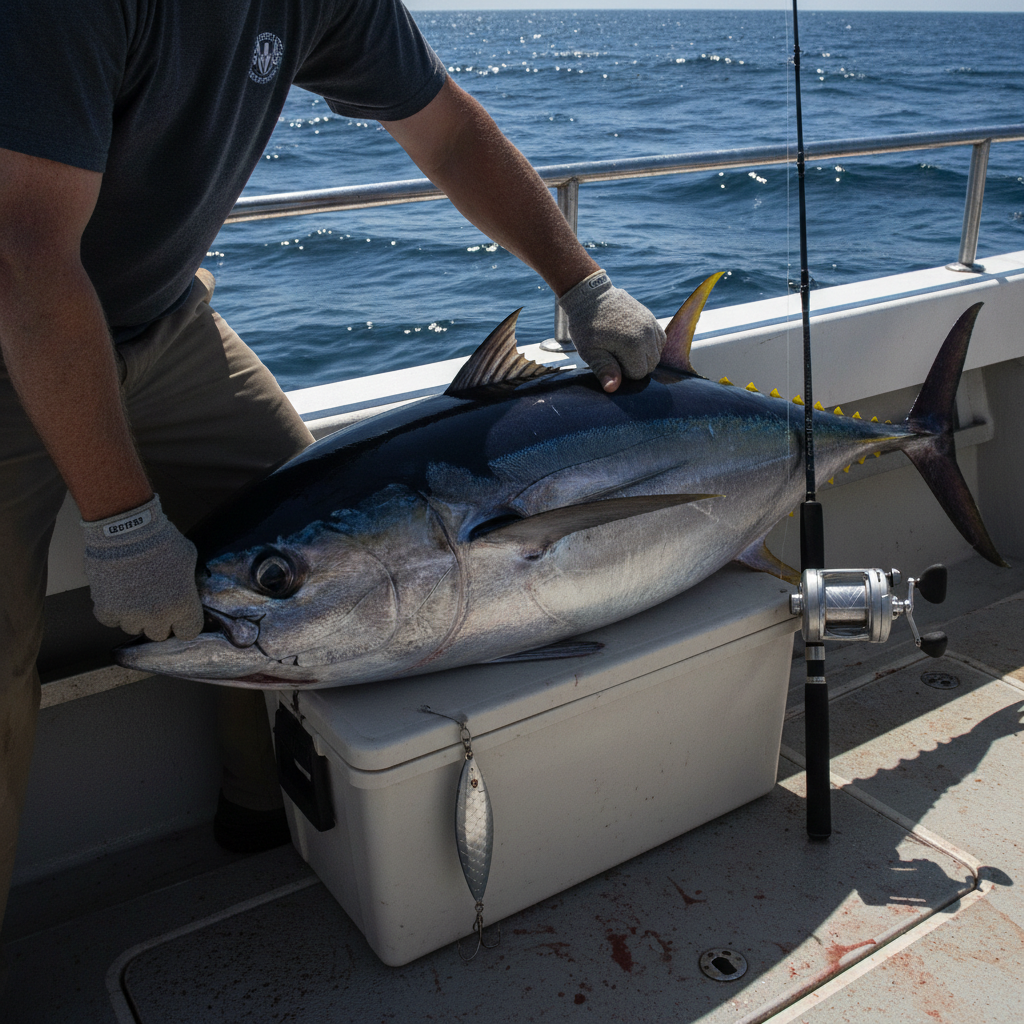
Atlantic bluefin tuna (Thunnus thynnus) are the giants of the tuna world — the largest bony fish in the Atlantic, capable of exceeding 1,500 lbs, reaching speeds over 43 mph, and living for 40+ years. Bluefin are the apex offshore gamefish of the Northeast, drawing serious anglers to Cape Cod, Gloucester, Montauk, and the Outer Banks every year for a shot at fish that can genuinely change the scale reading on any reel.
Range & Habitat
Atlantic bluefin tuna are migratory throughout the North Atlantic. In the western Atlantic they’re found from the Bahamas in winter to as far north as Newfoundland in summer. Key US fishing areas include the Gulf of Mexico (spawning grounds), Cape Hatteras (winter/spring), Outer Banks, Chesapeake Bay approach, Montauk, Cape Cod Bay, Gloucester/Stellwagen Bank, and the Gulf of Maine. Giant bluefin (over 73 inches) are increasingly found nearshore in fall, sometimes within sight of the beach.
Best Tackle
Giant bluefin (80+ lb): 130 lb class conventional, lever-drag reel with 800+ yards of 130 lb mono, 200 lb monofilament or fluorocarbon leader, 12/0–16/0 circle hook. Stand-up harness and fighting chair essential. School bluefin (under 73 inches): 50–80 lb class conventional or heavy spinning. Light tackle (school fish): Heavy 8-weight spinning with 50 lb braid is exhilarating for school fish under 60 lbs.
Top Techniques
Chunking: The standard Northeast technique. Drift over known bluefin grounds (Stellwagen Bank, Race Point, Jeffreys Ledge) chunking butterfish and menhaden while presenting baits on circle hooks in the slick. Trolling: Large skirted lures, swimming plugs, and rigged mackerel at 7–9 knots to locate fish. Jigging: Large butterfly jigs worked quickly near the surface or at mid-water on school fish — spectacular sport. Casting: When giants are finning on the surface, a perfectly placed whole butterfish or mackerel can be irresistible. Spreader bars and daisy chains: Pulled in the trolling spread, they read as a bait school and cover far more water than a drift — the standard way to find fish before settling in to chunk.
Best Baits & Lures
- Whole Butterfish: The top giant bluefin chunk bait in New England. Present on a 10/0–12/0 circle hook with no weight.
- Fresh Menhaden (whole or chunk): Excellent bluefin bait throughout the range. Very oily — creates a strong slick.
- Large Skirted Lures (Moldcraft, Black Bart): 12″+ skirted trolling lures that raise and catch giants.
- Large Butterfly Jigs (6–12 oz): Shimano Butterfly, Mustad Fastach — exceptional for school bluefin.
- Live Herring, Mackerel, or Whiting: The premier giant bait where you can catch or buy it. Hook through the nose or the back and free-line it in the slick.
- Rigged Mackerel/Herring: Trolling whole rigged Atlantic mackerel or herring produces excellent results on large bluefin.
Seasonal Patterns
Spring (April–June): Giants appear off Cape Hatteras and the Outer Banks. Summer (June–August): Fish spread to New England — Cape Cod Bay, Stellwagen Bank, and Gloucester produce excellent school fish and occasional giants. Fall (September-November): Peak season for giants, particularly from Gloucester to the Outer Banks. Fish fatten up before moving south. The nearshore Race Point fishery off Provincetown is the best-known of these — giants within sight of the beach. Winter (December-March): Giants concentrate off Hatteras, North Carolina, in what is the most accessible giant bluefin fishery on the coast for anglers without a New England boat.
Pro Tips
- This is the most regulated recreational fishery in the Atlantic: Bluefin tuna permits, tags, and strict bag limits (typically 1 giant per vessel per day, school fish limits vary) are strictly enforced by NOAA. Carry your HMS permit at all times.
- Circle hooks are required: For recreational bluefin fishing, NOAA now requires circle hooks when bait fishing. Comply — they also improve catch-and-release survival.
- Watch the birds and the whales: Feeding bluefin are announced from a mile away by diving gannets and by humpbacks working the same bait ball. Get ahead of the action rather than driving into it.
- Drag has to match the fish: A 600-pound bluefin needs 40-50 lb of drag. Under-dragging does not protect the tackle — it produces a two-hour fight and a fish that will not survive release.
- Fight time matters for release: Short fight times (under 20 minutes where possible) dramatically improve survival rates for released fish. Use heavy enough tackle to end the fight quickly.
Regulations
Bluefin tuna: HMS Angling Permit required. Atlantic: 1 giant (73″+) per vessel per day. School fish (27–73″) limited separately — see current NOAA Highly Migratory Species regulations at fisheries.noaa.gov. Regulations change frequently.
Want current bluefin tuna conditions? Browse our weekly fishing reports — updated every Thursday.
Best Bluefin Tuna Tackle
Affiliate disclosure: fishing.digital earns a small commission on qualifying purchases at no extra cost to you.
1. Shimano Talica 25 II Two-Speed
A two-speed lever-drag in the 25 size covers school and small-medium bluefin. The low gear is what lets an ordinary angler lift a fish that has sounded. Check price on Amazon
2. 80 lb Class Stand-Up Rod
A short, heavy 80-130 lb class stand-up rod. Pair it with a bucket harness — a giant is fought with your legs, not your arms. Check price on Amazon
3. 200 lb Fluorocarbon Leader
The spec for giants: 130-200 lb fluorocarbon. Heavy enough for a long fight against structure-free open water, clear enough that a wary fish still eats. Check price on Amazon
4. 5 oz Casting Popper
For school fish busting on sand eels. A 4-6 oz through-wired popper with upgraded hooks and split rings — stock hardware fails on bluefin. Check price on Amazon
Planning a trip to Bluefin Tuna?
This report tells you what happened. ReelAI tells you what to do about it — a briefing for your date, your target species and how you're fishing, built from our reports plus live NOAA and USGS data.
Powered by ReelAI — fishing.digital's intelligence layer. Answers are generated from fishing.digital reports and public NOAA, NWS and USGS data, and may be incomplete or out of date. Regulations and marine safety information are summaries only; always confirm with the responsible authority before you fish.