
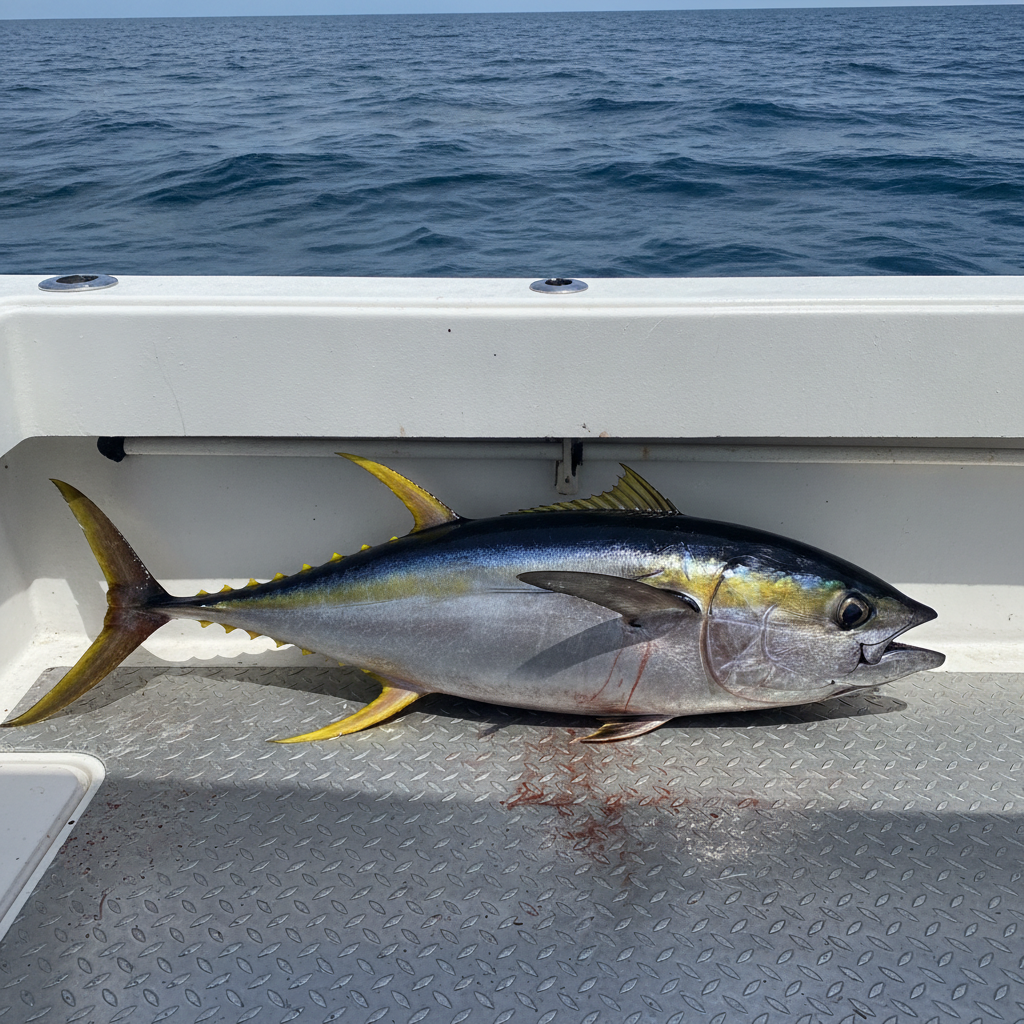
Yellowfin tuna (Thunnus albacares) are the offshore prize of the East Coast and Gulf — large, powerful, and prized as some of the finest sashimi-grade fish available. Reaching over 400 lbs (though 50–150 lbs is typical for sport catches), yellowfin are found along the Gulf Stream edge, offshore canyon edges, and wherever the blue water holds baitfish. Catching a large yellowfin is one of offshore fishing’s defining experiences.
Range & Habitat
Yellowfin tuna inhabit tropical and subtropical waters worldwide. On the US East Coast they’re concentrated along the Gulf Stream and the offshore canyon edges from New England to Florida, most abundantly from the Outer Banks to New England in summer and fall. In the Gulf of Mexico they’re present year-round in deeper offshore waters. They associate with temperature breaks, current edges, and baitfish concentrations. Areas of upwelling where cold and warm water meet are the most reliable concentrators of all — a hard temperature break holding bait on the canyon edge is worth running to even if it means an extra hour each way.
Best Tackle
Heavy spinning or conventional: 7–8″ heavy spinning (5000–8000 reel, 50–65 lb braid) or 50–80 lb class conventional outfit. 60–100 lb fluorocarbon leader 4–8 feet. Stand-up harness and rod belt recommended for fish over 80 lbs. Quality gear is essential — yellowfin do not give up.
Top Techniques
Chunking: Drifting over known yellowfin grounds while ladling cut baitfish (butterfish, mackerel, squid) overboard to create a scent slick. Present a chunk or whole squid on a circle hook drifting naturally in the chum slick. The most reliable East Coast method. Trolling: High-speed trolling of cedar plugs, Moldcraft lures, and rigged ballyhoo at 8–10 knots to locate and raise fish. Popper/Jig: When fish are on the surface, casting large poppers or pitching butterfly jigs produces spectacular strikes.
Best Baits & Lures
- Butterfish: The top chunking bait on the mid-Atlantic and New England canyons. Cut into thirds and chum generously.
- Fresh Squid (whole): The top hook bait in the chum slick. A fresh whole squid on a 7/0–9/0 circle hook drifted naturally is extremely effective.
- Cedar Plug: The classic trolling lure for yellowfin. Simple but lethal — troll at 8–10 knots on the long rigger.
- Moldcraft Hooker/Wide Range: Large skirted trolling lures that raise and catch big yellowfin.
- Live Mackerel or Herring: The best live bait when you can get it. Free-line it back into the slick with no weight at all.
- Spreader Bar (squid): A rigged bar of small squids trolled in the spread reads as a bait school and pulls fish up from depth. Standard equipment on Northeast canyon boats.
- Butterfly Jigs (4-8 oz): When fish are active, vertical or cast jigs produce explosive results.
Seasonal Patterns
Summer–Fall (June–November): Peak season on the East Coast as warm water pushes north along the Gulf Stream. The canyons (Baltimore, Washington, Norfolk, Wilmington) are at their most productive July–October. Gulf: Year-round with peak summer and fall action in the deeper offshore waters.
Pro Tips
- Fresh bait is everything: In the chum slick, fresh butterfish and squid dramatically outperform frozen baits. Buy at the dock the afternoon before the trip if you can — the difference between fresh and freezer-burned butterfish is the difference between a slick that works and one that does not.
- Match the chum: Hook bait must match your chum — if you’re chunking butterfish, fish a butterfish chunk, not a squid. The fish are keyed on what they’re eating.
- No weight in the slick: Keep your hook bait unweighted and drifting naturally in the slick. A lead weight immediately stands out as unnatural to large, wary yellowfin.
- Fish the night: Some of the best canyon yellowfin action happens after dark. Run the underwater lights and fish the edge of the lit water, not the middle of it.
- They are leader-shy: In clear canyon water, 80 lb fluorocarbon is the working compromise — heavy enough to land the fish, light enough to get bit. Going to 130 lb because it feels safer usually costs you the bite.
- Bleed and ice immediately: Yellowfin tuna are outstanding sashimi — but only if handled properly. Spike, bleed, and ice immediately upon boating for the best possible table quality.
Regulations
Yellowfin tuna: no size minimum, no federal bag limit for recreational anglers in the Atlantic. Gulf: no minimum, no bag limit. Always comply with current ICCAT-based regulations.
Want current yellowfin tuna conditions? Browse our weekly fishing reports — updated every Thursday.
Best Yellowfin Tuna Tackle
Affiliate disclosure: fishing.digital earns a small commission on qualifying purchases at no extra cost to you.
1. Shimano Saragosa SW (10000 Size)
The standard heavy spinning reel for popping and jigging tuna. The listing covers several sizes — select the 10000 for yellowfin work and load it with 400+ yards of 50-65 lb braid. Check price on Amazon
2. Seaguar Blue Label 80 lb Fluorocarbon Leader
The leader most canyon boats run. Strong enough for a 100-pound fish, clear enough to get bites in blue water. Check price on Amazon
3. Squid Spreader Bar
A spec-level pick: a 36-inch bar rigged with soft squids, trolled to imitate a bait school. Any well-built bar in that size does the job — this is one widely available example. Check price on Amazon
4. 6 oz Knife Jig
A 4-8 oz center-weighted knife jig for fish marked below the surface. Blue/white and silver are the colors that stay in the box the least. Check price on Amazon
Planning a trip to Yellowfin Tuna?
This report tells you what happened. ReelAI tells you what to do about it — a briefing for your date, your target species and how you're fishing, built from our reports plus live NOAA and USGS data.
Powered by ReelAI — fishing.digital's intelligence layer. Answers are generated from fishing.digital reports and public NOAA, NWS and USGS data, and may be incomplete or out of date. Regulations and marine safety information are summaries only; always confirm with the responsible authority before you fish.