
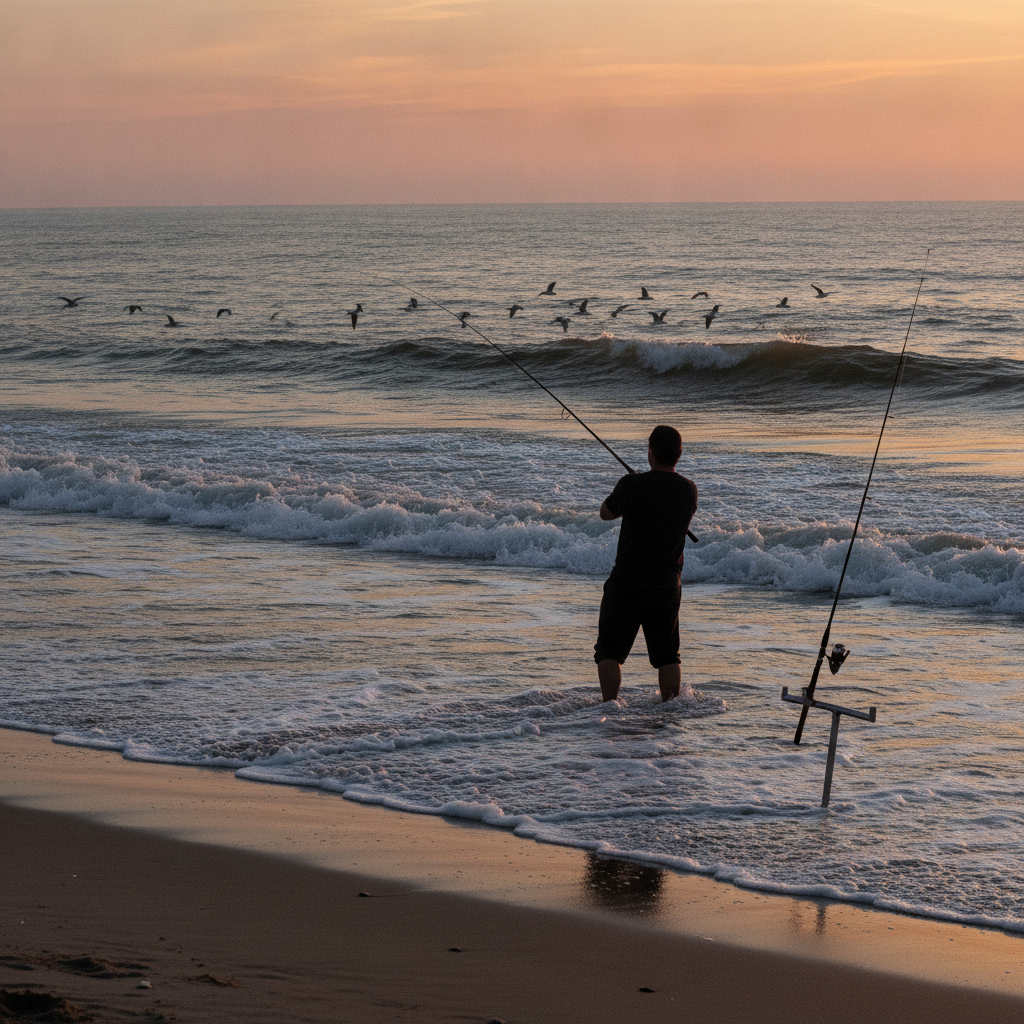
Surf fishing requires nothing more than a rod, a reel, a rig, and access to the shoreline — yet it produces some of the most thrilling fishing available anywhere in the United States. Striped bass blitzing bunker in the New Jersey surf at dawn. Red drum crashing through the Cape Hatteras outer beach breakers. Pompano feeding in the Gulf Coast wash. Pacific halibut from an Oregon beach. The surf is an endlessly productive environment and a great equalizer — some of the best surf anglers in the country fish from a single fixed spot they’ve learned intimately over decades.
Affiliate disclosure: fishing.digital earns a small commission on qualifying Amazon purchases at no extra cost to you.
Surf Fishing Gear: What You Actually Need
Rod
A surf rod needs length (for casting distance and keeping line above breaking waves) and power (for handling large fish in rough water). The standard is a 9–11 ft medium-heavy to heavy rod rated for 2–6 oz sinkers. For most East and Gulf Coast surf fishing, a 10 ft medium-heavy covers 90% of situations — long enough to clear the breakers, powerful enough to handle striped bass and red drum. The Penn Prevail II 10ft and St. Croix Mojo Surf 10ft are the two most recommended rods in this category.
For lighter species (pompano, surf perch, flounder) a 7–9 ft medium rod with lighter sinker ratings gives better feel and more sport on smaller fish.
Reel
A large spinning reel in the 6000–8000 size range spooled with 20–30 lb braided line is the standard surf fishing setup. The Penn Spinfisher VI 6500 and Penn Battle III 6000 are the most widely used surf spinning reels — both are fully sealed against saltwater intrusion, handle the heavy loads of long-distance casting, and are priced accessibly. Spool with 20–30 lb braid (PowerPro or Sufix 832) and attach a 30–40 lb monofilament shock leader (15–20 feet) using an Albright or PR knot. The mono leader absorbs the casting shock and improves presentation on clear water.
Shop Penn Spinfisher surf reels on Amazon →
Terminal Tackle
Most surf fishing uses one of three basic rig configurations:
- Fish Finder Rig: A sliding egg sinker above a swivel and 18–36 inch fluorocarbon leader. Best for live bait and cut bait where you want the fish to run with the bait without feeling resistance. Use with 3/0–7/0 circle hooks. The most versatile surf rig — works for stripers, redfish, sharks, and drum.
- Fishfinder with Pyramid Sinker: Pyramid sinkers dig into sand and hold position in strong current and surf. Essential for fishing a fixed spot in the Cape Hatteras outer beach or Gulf Coast surf.
- Two-Hook Dropper Rig (High-Low Rig): Two hooks on dropper loops above the sinker. Best for smaller species — pompano, croakers, surf perch, whiting. Bait with fresh shrimp, sand crabs, or bloodworms.
Sinkers
Match sinker weight to surf conditions. 1–2 oz for calm inlets and light surf. 3–4 oz for moderate beach conditions. 5–8 oz for heavy surf and strong longshore current. Pyramid sinkers hold; bank/egg sinkers roll. Always carry heavier sinkers than you think you’ll need — nothing is more frustrating than watching your bait get swept out of the strike zone by a longshore current your sinker can’t hold against.
Reading the Surf
Understanding surf topography is the single biggest differentiator between anglers who catch fish consistently and those who don’t. Fish concentrate where structure creates feeding opportunities — not randomly along the beach.
Key Surf Features to Find
- Cuts and troughs: Deeper channels running parallel to the beach (troughs) or cutting through sandbars perpendicular to the beach (cuts). These are fish highways — stripers, reds, and bluefish move through cuts on every tide change. Wade to the edge of a trough at low tide to identify them; set up on the cut edge at high tide.
- Sandbars: Parallel ridges of sand that create multiple wave break lines. Fish hold in the deeper water between the inner bar and the beach, and on the seaward edge of the outer bar where baitfish congregate in the calmer water behind breaking waves.
- Points and jetties: Rock jetties concentrate current, create eddies, and aggregate bait. The tip and the first 50 yards of any jetty on a moving tide are prime fish territory. Fish the downcurrent side — fish face into current and feed on what the flow brings to them.
- Inlets: Tidal inlets concentrate enormous volumes of fish during tidal movement. The outgoing tide flushes bait from estuary systems into the surf where waiting predators stack up. The incoming tide pushes warm, bait-laden water inward and triggers feeding throughout the inlet mouth.
Best Tide for Surf Fishing
The two most productive surf fishing windows are the 2 hours before and after the high tide and the 2 hours around the low tide at dawn or dusk. The high tide brings fish closest to the beach and activates feeding. The low tide exposes structure (bars and cuts) that helps you plan your high-tide strategy. On many beaches, the incoming tide at dusk or dawn is the single most reliable surf fishing window of any given week.
Best Baits for Surf Fishing
| Bait | Target Species | When to Use |
|---|---|---|
| Fresh bunker (menhaden) | Striped bass, bluefish, sharks | Fall striper run; any time bunker are present nearshore |
| Fresh clam (surf clam) | Striped bass, sea bass, drum, whiting | Year-round; especially productive after storms when clams wash up |
| Sand crabs (mole crabs) | Pompano, redfish, drum, surf perch | Spring–fall on most beaches; dig from the swash zone at low tide |
| Fresh shrimp | Redfish, pompano, flounder, whiting, croaker | Gulf Coast primarily; year-round effective bait |
| Bloodworms | Striped bass, sea bass, flounder, croaker | Spring in the Northeast; universal bait for smaller surf species |
| Cut mullet | Redfish, sharks, jack crevalle, drum | Gulf and Southeast Atlantic coasts; mullet run in fall |
| Live eels | Striped bass (large) | Night fishing in the Northeast; summer through fall striper run |
Lure Fishing in the Surf
When fish are actively feeding on baitfish near the surface, lures outperform bait — you can cover more water, feel every bite, and experience the most exciting fishing the surf has to offer.
- Metal jigs (Ava Jig, Hopkins, Kastmaster): The standard surf metal. Cast maximum distance, allow to sink briefly, retrieve with a moderate swimming action. Devastating on bluefish and false albacore; produces stripers in the fall run. 1–4 oz depending on surf conditions.
- Soft plastic swimmers: Large paddle-tail swimbaits (5–9 inch) on 1–2 oz jig heads produce trophy stripers in the surf after dark and during dawn feeding sessions. Bone white, chartreuse, and natural mullet patterns work best.
- Topwater plugs: When predators are busting bait on the surface, a Heddon Super Spook or Yo-Zuri Mag Darter walked through the feeding zone produces explosive surface strikes. Most effective from the Gulf Coast through the Northeast during fall bait migrations.
- Bucktail jigs: A 1–3 oz white bucktail, plain or tipped with a plastic trailer, is one of the most versatile surf lures ever made. Cast across the current, let it swing, and retrieve with hops along the bottom edge of a bar.
Surf Fishing Safety
The surf is a powerful, unpredictable environment. Every year surf anglers are injured or killed by rogue waves, rip currents, and slippery rocks.
- Never turn your back to the ocean. Sneaker waves arrive without warning and are far more powerful than they appear from shore.
- Wear cleated waders or surf booties on wet rocks and jetties — bare feet and smooth-soled shoes are dangerous.
- Know your exit. When wading, always be aware of where you can exit if conditions change. Water that was knee-deep can become waist-deep quickly on a rising tide.
- Rip currents: If caught in a rip current, swim parallel to shore until you’re out of the current, then swim back to the beach at an angle. Never fight a rip current by swimming directly to shore.
- File a float plan. Tell someone where you’re fishing and when you expect to return.
See our regional surf fishing guides for species-specific tactics, seasonal timing, and the best beaches by coast. Explore all fishing guides →
Planning a trip to Saltwater Fishing?
This report tells you what happened. ReelAI tells you what to do about it — a briefing for your date, your target species and how you're fishing, built from our reports plus live NOAA and USGS data.
Powered by ReelAI — fishing.digital's intelligence layer. Answers are generated from fishing.digital reports and public NOAA, NWS and USGS data, and may be incomplete or out of date. Regulations and marine safety information are summaries only; always confirm with the responsible authority before you fish.