
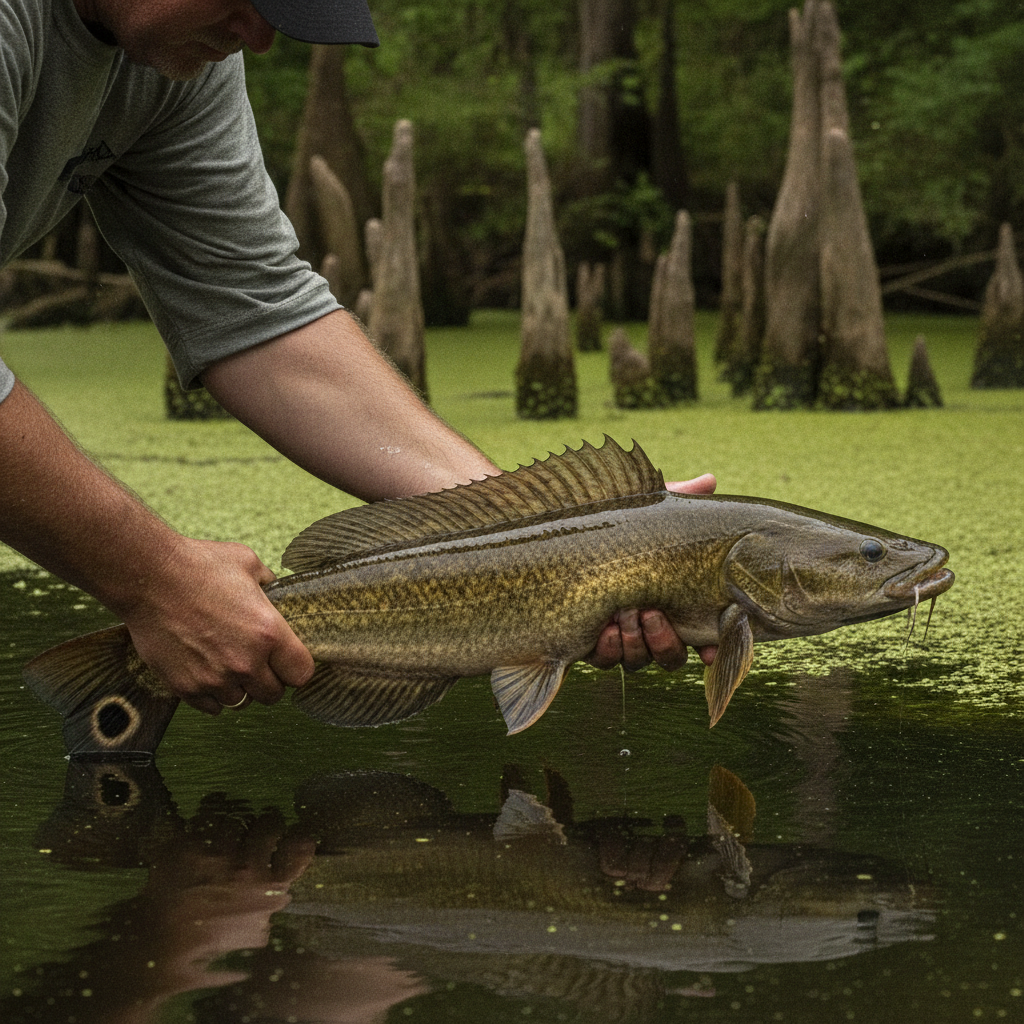
Bowfin (Amia calva) and gar (Lepisosteidae) are North America’s living fossils — primitive fish that survived the dinosaurs and still inhabit warm-water rivers, swamps, and lakes across the eastern and southern United States. Once dismissed as “trash fish,” both species are now appreciated as hard-fighting, accessible gamefish that take a fly, a lure, or live bait with shocking violence.
Bowfin vs. Gar: Two Different Quarries
Despite often being mentioned together, bowfin and gar are different fish with different habits. Bowfin (dogfish, mudfish, grinnel) are heavy-bodied, eel-like fish with a long dorsal fin running most of the back. They’re ambush predators in weedy backwaters. Gar — longnose, shortnose, spotted, alligator — are elongated, armor-scaled predators with bony jaws full of teeth. Alligator gar (Atractosteus spatula) reach 8 feet and 300+ pounds — North America’s second-largest freshwater fish.
Where to Find Bowfin: Range & Habitat
Bowfin inhabit slow-moving rivers, oxbow lakes, swamps, and weedy backwaters from Minnesota and Ontario south to Florida and Texas, with strongest populations in the Southeast and Mississippi River basin. Look for them in dense vegetation, cypress swamps, woody cover, and the deeper holes of weedy lakes. They’re tolerant of low-oxygen water — bowfin can gulp air, allowing them to survive in places where bass and pike can’t. Lake Champlain, the St. Lawrence, the Atchafalaya Basin, and the Florida Everglades all hold quality bowfin.
Where to Find Gar: Range & Habitat
Longnose gar: Eastern half of the U.S. — abundant in mid-South rivers and lakes. Shortnose gar: Mississippi River drainage. Spotted gar: Southeastern U.S. and Gulf Coast. Alligator gar: Lower Mississippi River, Trinity River (TX), Mobile Basin (AL/MS), and select Louisiana waters. Gar prefer warm, slow rivers with vegetated backwaters and deep holes. The biggest alligator gar live in the lower Trinity River (TX) and the Atchafalaya Basin (LA).
Tackle for Bowfin
Rod: 7′ medium-heavy bass spinning or casting rod. Reel: 3000-4000 size spinning or a 200-class baitcaster. Main line: 30-50 lb braid (bowfin live in heavy cover and have abrasive mouths). Leader: 30-50 lb fluorocarbon or 30 lb mono. Steel leader optional for repeated bowfin punishment. Hooks: 2/0-4/0 circle or J-hook for bait; standard worm or jig hooks for lures.
Tackle for Gar
Rod: 7-8′ medium-heavy to heavy rod — surf rods work well for big alligator gar. Reel: 4000-6000 spinning, or conventional levelwind for bigger fish. Alligator gar: 6500+ class reel with 65-80 lb braid. Main line: 50-65 lb braid for longnose/shortnose; 80-100 lb for alligator gar. Leader: Wire (40-60 lb single-strand or 7-strand) is essential — gar teeth slice mono and fluoro instantly. 12-18″ leader. Hooks: Treble hooks (4/0-6/0) for traditional bait fishing; circle hooks (8/0-12/0) for alligator gar.
Top Techniques for Bowfin
Cut Bait on the Bottom: Bowfin love stinky cut bait — fresh cut shad, bluegill, or sucker on a Carolina rig or bottom rig. Live Bait: Live shiners, suckers, or bluegill (where legal) fished under a slip bobber over weed edges. Lures: Bowfin crush soft plastic swimbaits, spinnerbaits, and even topwater frogs over heavy cover. Slow-roll a paddletail near bottom in coffee-stained water. Fly: Big streamers — Game Changers, large Clousers, articulated bunny patterns — stripped slowly through weed pockets.
Top Techniques for Gar
Rope Lures: The classic gar trick — a 4-6″ hank of nylon rope, frayed at one end, with NO hook attached. The gar’s teeth tangle in the fibers, hooking themselves. Strange but legal and deadly effective. Cut Bait or Live Bait: Cut carp, shad, or bluegill on a treble or circle hook under a large float. Let the gar take it and run before setting. Bowfishing: The most popular gar method — high-test bow and arrow, shoot fish at the surface or in clear shallows. Major sport in Texas and Louisiana. Topwater: Large jerkbaits, prop baits, and even surface flies provoke explosive strikes from gar; hookups are tricky due to bony mouths.
Reading Bowfin & Gar Water
Both species favor warm, oxygen-poor water other gamefish avoid. Look for: dense lily pad fields, cypress swamps, oxbow lakes, slow river backwaters, weed-edge transitions, and warm shallow flats early and late in the day. Both species gulp air at the surface — visible “rolls” are a giveaway. Alligator gar specifically inhabit deep pools (10-25 feet) of lower river systems, often with current breaks and woody cover.
Hook-Setting & Fighting
Bowfin: Set hard and immediately — bowfin have bony mouths and shake violently. Expect head-thrashing fights and dirty tactics into cover. Gar: Wait 5-15 seconds before setting on bait — gar often hold and crush prey before swallowing. With rope lures, the tangle does the work; just steady pressure. Big alligator gar can pull a small boat for hundreds of yards — buckle in for fights of 30+ minutes.
Best Times to Fish
Bowfin: May through September; warm water triggers feeding. Gar (longnose/shortnose/spotted): Summer through early fall — warm water, slow current. Alligator Gar: June through August in Texas; year-round in Louisiana. Spawning aggregations (May-June) concentrate fish in shallow flooded backwaters.
Hot Spots
Bowfin: Lake Champlain backwaters, Mississippi River backwaters, Florida Everglades, Atchafalaya Basin, Reelfoot Lake (TN), Santee-Cooper (SC). Longnose Gar: Ohio River, Tennessee River, Cumberland River, Mississippi River tributaries. Alligator Gar: Trinity River (TX) — the world’s best alligator gar fishery; Choke Canyon (TX), Falcon Lake (TX/MX); Atchafalaya Basin (LA); Mobile Delta (AL).
Eating
Bowfin: not great. The flesh is soft, gray, and most anglers release them. Some folks smoke bowfin successfully. Gar: Surprisingly good when properly cleaned — strong, firm white flesh similar to other gamefish. Removing the bony scales requires tin snips or a Sawzall. Gar eggs are TOXIC — do NOT eat the roe.
Regulations
Bowfin: generally unregulated or minimal bag limits — verify state rules. Alligator gar: heavily regulated — Texas: one fish per day (size and tag restrictions on Trinity River), licensed waters only. Louisiana: 1 per day, license required. Other gar species: generally unregulated. Always verify current state regulations.
More Resources
Browse all How-To Guides · Location Guides
Planning a trip to Freshwater Fishing?
This report tells you what happened. ReelAI tells you what to do about it — a briefing for your date, your target species and how you're fishing, built from our reports plus live NOAA and USGS data.
Powered by ReelAI — fishing.digital's intelligence layer. Answers are generated from fishing.digital reports and public NOAA, NWS and USGS data, and may be incomplete or out of date. Regulations and marine safety information are summaries only; always confirm with the responsible authority before you fish.