
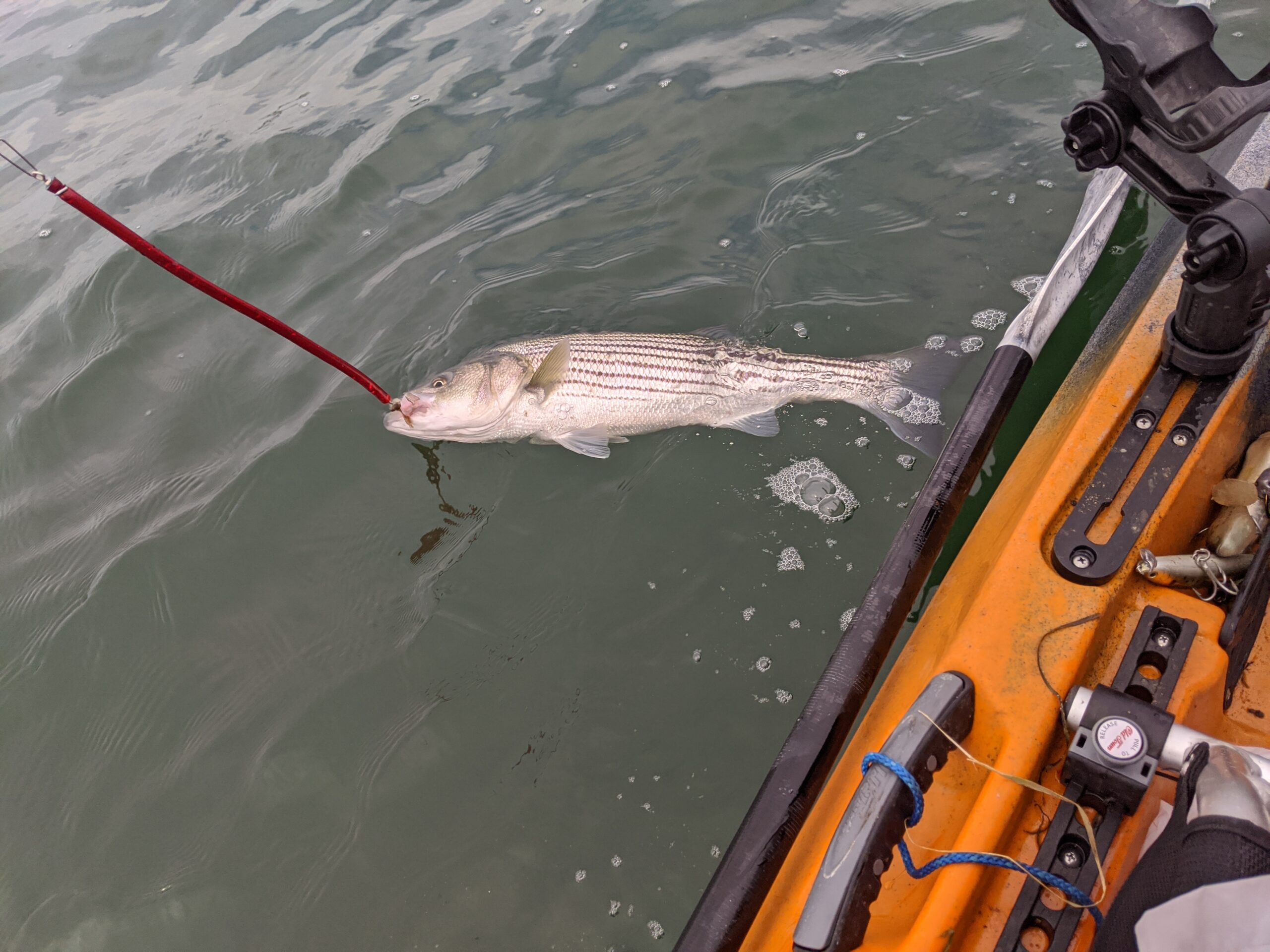
Landlocked striped bass — also called stripers, rockfish, or linesides — are found in reservoirs throughout the South and East, stocked as a trophy freshwater gamefish in major impoundments from Virginia to California. They behave identically to their saltwater cousins but grow large in freshwater, with fish over 30 lbs relatively common in premier reservoirs. Schooling stripers crashing shad on the surface is one of freshwater fishing’s most exciting sights.
Range & Habitat
Freshwater striped bass are found in large reservoirs throughout the South and East — Lake Texoma (Texas/Oklahoma), Clarks Hill (Georgia/SC), Kerr Reservoir (VA/NC), Truman Lake (MO), and Lake Hartwell (SC/GA) are among the best. They prefer large, deep reservoirs with abundant shad forage. They’re migratory within the reservoir, following shad schools and relating to thermoclines in summer.
Best Tackle
Medium-heavy to heavy: 7–8″ medium-heavy rod, 4000–6000 reel, 20–40 lb braid, 30–50 lb fluorocarbon or monofilament leader. Stripers fight hard and make long runs — quality gear is essential.
Top Techniques
Live Bait Fishing: A large live gizzard shad or threadfin shad free-lined or fished under a large float is the most effective freshwater striper method. Topwater (Morning): When stripers are blitzing shad on the surface, casting large topwater lures (Super Spook, Pencil Popper) into the melee. Jigging: Large bucktail jigs and blade baits jigged vertically over marked fish at thermocline depth. Trolling: Deep-diving crankbaits and umbrella rigs trolled along ledges and points.
Best Baits & Lures
- Live Gizzard Shad: The premier freshwater striper bait. Large gizzard shad free-lined near the surface or fished on a downrigger at depth.
- Bucktail Jig (1–3 oz): White or chartreuse jigged vertically at the depth where fish are marked on the sounder.
- Super Spook (topwater): Walk-the-dog lure for surface-feeding stripers at dawn.
- Umbrella Rig: Multiple swimbaits on a multi-arm rig trolled at 4–5 mph along ledges. Highly effective.
- Blade Bait (Swedish Pimple): Vertical jigging for deep summer stripers.
Seasonal Patterns
Spring (March–May): Stripers move shallow and feed aggressively. Often found in creek arms and below dam tailraces. Summer: Fish relate to thermocline — typically 20–40 feet. Early morning topwater blitzes and deep jigging dominate. Fall: Excellent topwater action as stripers chase shad to the surface. Winter: Fish relate to deep structure near dam faces and deep ledges.
Pro Tips
- Follow the shad: Freshwater stripers go where the shad go. Find shad schools on your sounder and the stripers won’t be far away.
- Early morning topwater is the most exciting window: The dawn blitz, when stripers pen shad to the surface and the water erupts, is the highlight of freshwater striper fishing.
- Fish the thermocline in summer: Use your sounder’s temperature gauge to find the thermocline depth — stripers stack just above it in summer.
Regulations
Freshwater striped bass regulations vary by reservoir and state. Many trophy reservoirs have minimum sizes of 18–20 inches and bag limits of 2–5 fish. Always check current state and specific reservoir regulations.
Browse our weekly fishing reports — updated every Thursday.
Planning a trip to Striped Bass (freshwater)?
This report tells you what happened. ReelAI tells you what to do about it — a briefing for your date, your target species and how you're fishing, built from our reports plus live NOAA and USGS data.
Powered by ReelAI — fishing.digital's intelligence layer. Answers are generated from fishing.digital reports and public NOAA, NWS and USGS data, and may be incomplete or out of date. Regulations and marine safety information are summaries only; always confirm with the responsible authority before you fish.