
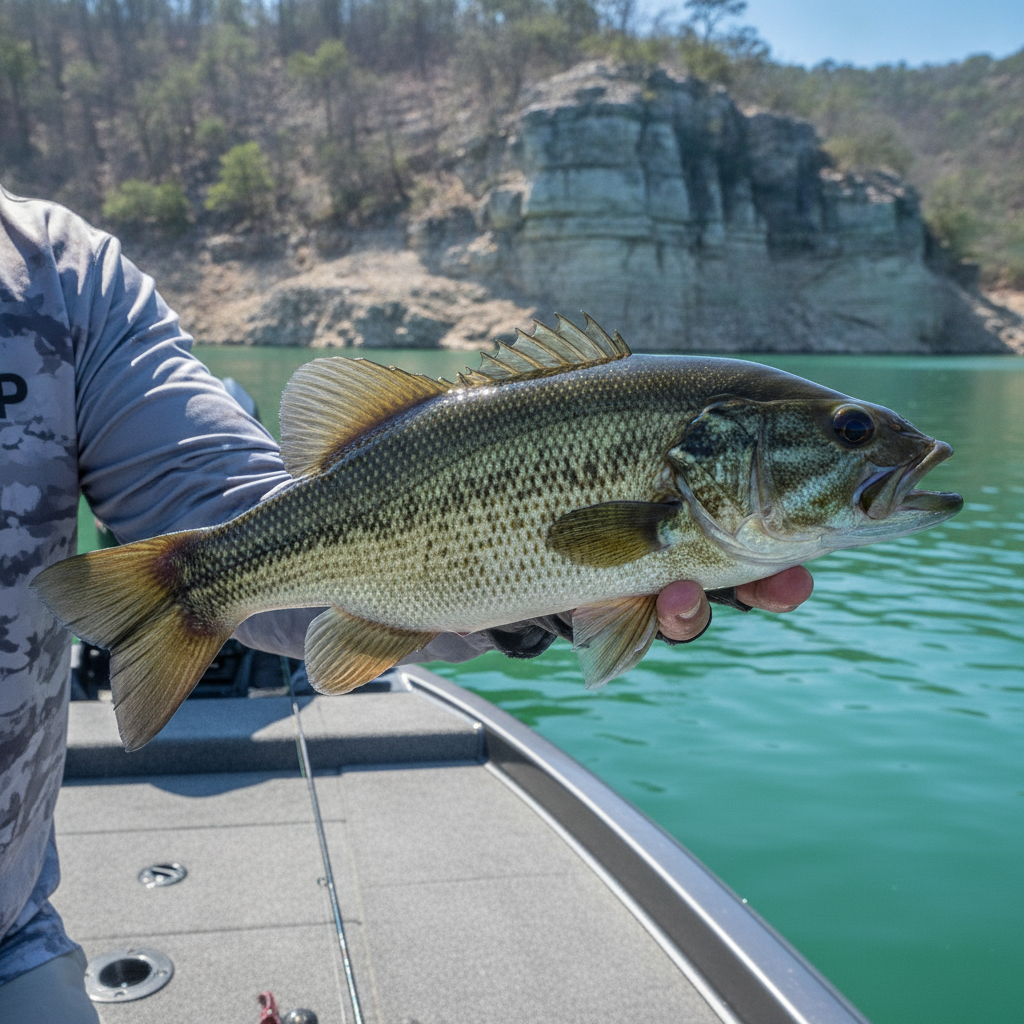
Spotted bass (Micropterus punctulatus) — spots, or Kentucky bass — are the third member of the black bass trio, occupying the niche between largemouth and smallmouth. They are smaller than largemouth, more aggressive than smallmouth, and found throughout the Southeast and increasingly in reservoirs nationwide. In quality impoundments like Lake Lanier in Georgia and Smith Lake in Alabama they grow to impressive sizes, and in California’s clear mountain reservoirs spots have reached trophy proportions that rival Florida-strain largemouth. They fight hard, they’re excellent sport on light tackle, and they’re often the most accessible bass in rocky highland rivers.
Range & Habitat
Spotted bass are native to the Ohio River drainage, the Mississippi basin, and the Gulf Coast and southeastern drainages from Kansas east to Virginia and the Carolinas. They have been stocked in many western reservoirs, where in the absence of competition they have grown to extraordinary sizes — the world record came out of California. They prefer clear, rocky, moderately swift streams and clear highland reservoirs: harder, faster, deeper water than largemouth like. In reservoirs, look for main-lake points, rocky ledges, channel swings, and bluff drops. They are the dominant bass in many Georgia and Alabama highland impoundments.
Best Tackle
Medium spinning or light baitcaster: 6′10″–7′ medium rod, 2500–3000 spinning reel or a compact baitcaster, 10–15 lb fluorocarbon or braid with a 10–12 lb fluorocarbon leader. Spotted bass live in clear water, and light fluorocarbon matters more here than it does for largemouth.
Top Techniques
Drop Shot: The most effective spotted bass technique in clear-water reservoirs — a finesse worm suspended precisely above rocky bottom, or over suspended fish in open water.
Ned Rig: A mushroom-head jig with a buoyant plastic. Extremely effective on the rocky bottom spots prefer, and it keeps producing when nothing else does.
Tube Bait: A classic spotted bass lure on rocky river bottom and clear reservoir structure, on a 3/16–1/4 oz jighead.
Jig Fishing: Small football jigs dragged along rocky points and ledges with a crawfish trailer.
Deep Crankbaits and Swimbaits: Reservoir spots concentrate on deep rocky ledges at 20–40 feet — deep-diving crankbaits cover that band efficiently, and swimbaits take open-water fish feeding on shad.
River Drifting: In rivers, drifting soft plastics naturally through current seams produces excellent results.
Best Baits & Lures
- Straight-Tail Finesse Worm (4.5″) on a Drop Shot: The go-to spotted bass finesse bait in California and clear-water reservoirs. Natural colors — morning dawn, aaron’s magic, and green pumpkin — do the most damage.
- Ned Rig (Z-Man Finesse TRD): Highly effective on spots in clear reservoirs and rocky rivers.
- 3–4″ Tube Bait: The classic spotted bass river and lake lure on a light jighead.
- Football Jig (3/8–3/4 oz): For deep rocky structure. Drag it slowly along the bottom with a crawfish trailer.
- Deep-Diving Crankbait (Strike King 6XD and similar): The ledge-fishing standard — covers depth efficiently on deep rock.
- Swimbaits: For open-water fish chasing shad in impoundments.
- Topwater: Spotted bass are excellent topwater targets on summer mornings.
Seasonal Patterns
Spring: Pre-spawn is the peak — aggressive fish in rocky shallows on points and secondary structure. Summer: Fish move to deep rocky ledges and points, and highland reservoir spots often suspend over deep water at 30–50 feet in July and August, requiring finesse mid-column presentations. Deep crankbaits and drop shot produce. Fall: Excellent shallow action as fish follow baitfish into the creeks. Winter: Slow, deep finesse presentations. In California and the deep South, spots stay active year-round.
Pro Tips
- Look for rocky bottom: Spots love hard substrate exactly the way smallmouth do. Rock, gravel, bluff walls, and chunk-rock banks are the first places to look.
- Go deep in summer: Reservoir spots follow baitfish to thermocline depth and suspend over open water. Your electronics are essential — fish will be 30–50 feet down over 60+ feet of water.
- Go lighter in clear water: In ultra-clear reservoirs, 6–10 lb fluorocarbon significantly outperforms 15–17 lb. Spots are leader-shy.
- They fight dirty: Spotted bass run hard toward structure and bottom. Keep steady pressure on and steer them off the rocks.
Regulations
Regulations vary by state. Alabama and Georgia set 12–14″ minimums on most lakes, while several states have removed size limits or encouraged harvest of spotted bass where they compete with native smallmouth or largemouth. Check your state agency’s current rules for the specific water.
Best Spotted Bass Tackle
Affiliate disclosure: fishing.digital earns a small commission on qualifying purchases at no extra cost to you.
1. 4.5-Inch Straight-Tail Finesse Worm
The drop-shot standard for clear-water spots. Buy the 4.5-inch straight-tail size — that’s the length the finesse worms in this category are actually made in — and stick to natural colors.
2. Z-Man Finesse TRD Ned Worm, 2.75 inch
The Ned rig on rocky bottom is extremely effective for spotted bass in reservoirs. Check price on Amazon
3. Yamamoto Tube, 3 inch
A smaller tube than you’d throw at smallmouth — 3 inch is the right profile for spots on structure. Check price on Amazon
4. Spinning Rod, 7′ Medium-Light Finesse
A light spinning rod for drop shot and Ned rig work in clear highland reservoirs. Check price on Amazon
Browse all species guides: How To Catch Fish — Complete Species Guides | Weekly Fishing Reports — updated every Thursday.
Planning a trip to Spotted Bass?
This report tells you what happened. ReelAI tells you what to do about it — a briefing for your date, your target species and how you're fishing, built from our reports plus live NOAA and USGS data.
Powered by ReelAI — fishing.digital's intelligence layer. Answers are generated from fishing.digital reports and public NOAA, NWS and USGS data, and may be incomplete or out of date. Regulations and marine safety information are summaries only; always confirm with the responsible authority before you fish.