
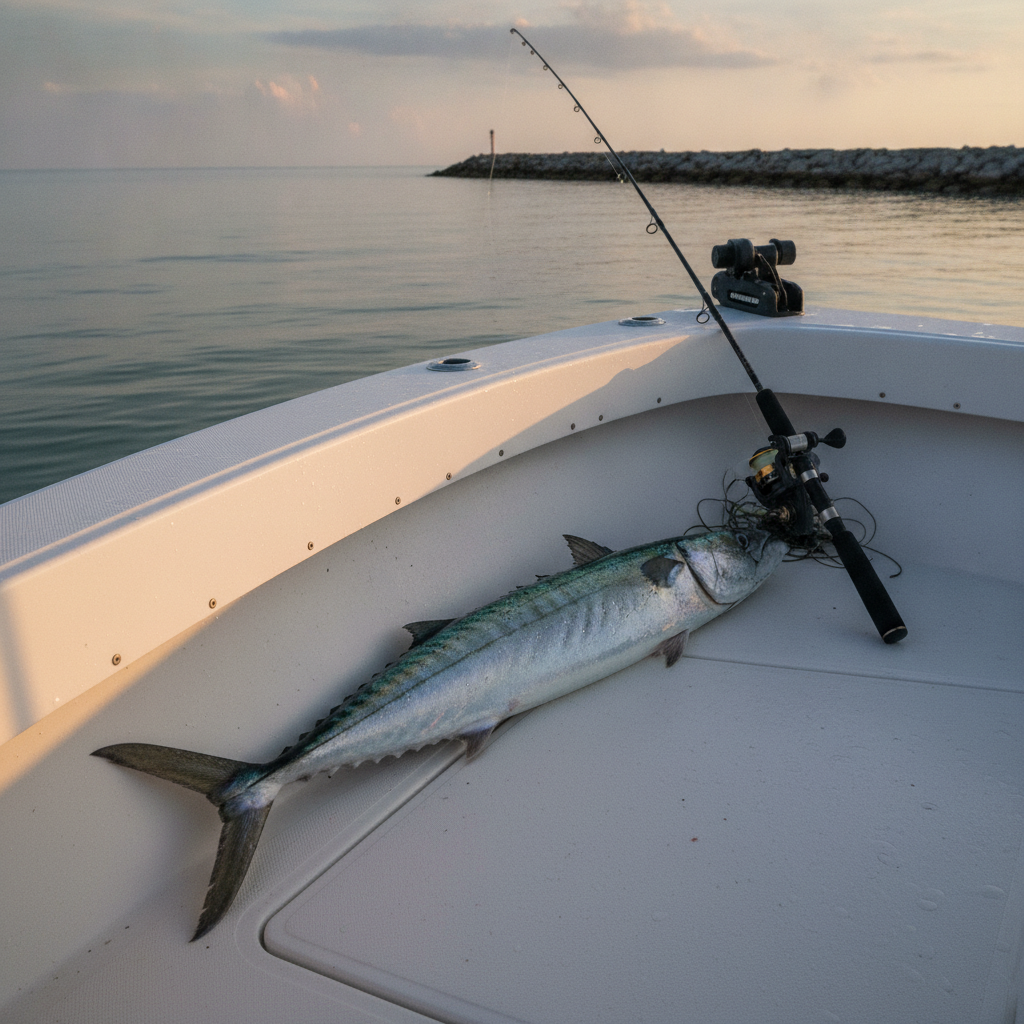
King mackerel (Scomberomorus cavalla) — also called kingfish or kings — are one of the most popular nearshore and offshore gamefish on the US East Coast and Gulf of Mexico. Fast, hard-fighting, and widely distributed, kings are accessible to anglers from small boats in 30 feet of water to large sportfishers working 200-foot depths. Their blazing initial run and ability to completely strip line from a reel make them memorable adversaries.
Where to Find King Mackerel: Range & Habitat
King mackerel range from Massachusetts to Brazil, with peak abundance from the Carolinas through Florida and across the Gulf Coast. They’re highly migratory, following bait schools along the coast seasonally. On the Atlantic coast, fish move north in spring and south in fall. The Gulf has two separate stocks — a migratory Atlantic-side stock and a Gulf stock. Kings are found from the nearshore reefs in 40 feet out to 200+ feet offshore, wherever bait concentrations exist. Nearshore reefs, wrecks, buoys, and current edges all hold fish; the mouth of the Chesapeake, the water off Cape Hatteras, and the Gulf platforms are among the most productive king grounds on the coast.
Best Tackle for King Mackerel
Live Bait/Slow Troll: 20–30 lb class spinning or conventional rod, 4000–6000 reel, 30 lb mono or braid main line, 40–60 lb fluorocarbon or single-strand wire leader 3–5 feet.
Trolling: 30–50 lb class conventional, spooled with 40–65 lb mono or braid.
Wire is often necessary: Kings have razor-sharp teeth. Use single-strand wire (No. 3–5) or heavy fluorocarbon (60–80 lb) depending on water clarity.
Top Techniques for Catching King Mackerel
Slow Trolling Live Baits: The most effective king mackerel technique. Troll live blue runners, cigar minnows, or menhaden at 2–4 knots around nearshore structure, reef edges, and color changes. Use a stinger rig — a main hook through the nose and a trailing treble hook near the tail — to convert short strikes.
Dead Bait Trolling: Trolling rigged cigar minnows, mullet, or ballyhoo at 4–6 knots around buoys, reef edges, and visible bait schools is a reliable secondary method.
Casting and Retrieving: When kings are surface-feeding on bait schools, fast retrieves with large spoons, Got-Cha plugs, or swimbaits produce explosive strikes.
Anchored Live Bait Fishing: Anchor upcurrent of a known reef or buoy and free-line live baits downtide. Effective during tournament season.
Best Baits & Lures for King Mackerel
- Live Blue Runner: The top king mackerel live bait. Hardy, lively, and irresistible to large fish.
- Live Cigar Minnow (Round Scad): Widely available and highly effective. The standard king mackerel live bait on most party and charter boats.
- Live Menhaden (Pogies): Excellent king bait along the Southeast and Gulf coasts where they’re abundant.
- Clarkspoon (trolling): Trolled behind a planer at 5-8 knots. The most iconic king mackerel lure. Clarkspoons are sized 00 through 3, not in ounces — sizes 0 and 1 cover most king work.
- Drone spoon: A larger, heavier trolling spoon fished on wire line or behind a planer. The traditional big-king spoon where the Clarkspoon is the numbers spoon.
- Trolling plugs: A Rapala X-Rap or Yo-Zuri Crystal Minnow pulled at moderate speed near the surface produces when kings are shallow and on small bait.
- Rigged dead ballyhoo: Pulled whole on a wire leader with a stinger. A dependable fallback when the live well is empty.
- Got-Cha Plug: The top casting lure for surface-feeding kings. Fast, erratic retrieve.
- Stinger Rig: When rigging any live bait for kings, always add a stinger treble at the tail — kings are notorious short-strikers that bite the tail of the bait.
Seasonal Patterns
Spring (March–May): Kings move north along the coast. Excellent action from the Carolinas through Florida as fish follow bait northward.
Summer (June–August): Kings spread throughout their range. Tournament season peaks — the King Mackerel Series and Mack Attack events draw thousands of competitors.
Fall (September–November): Fish move south. Excellent action as large concentrations funnel through the Carolinas and Florida inlets.
Winter: Kings overwinter in South Florida and the Gulf. South Florida sees excellent winter king fishing.
Pro Tips
- Always use a stinger rig: Kings consistently bite the tail of baits. A trailing treble at the tail of every live bait dramatically increases hookup percentage.
- Find the bait: Kings follow menhaden, cigar minnows, and other schooling baitfish. Find the bait — on the sounder, by watching birds, or by marking color changes — and you’ll find the kings.
- Wire or heavy fluoro near structure: Around buoy cables, anchor chains, and reef structure, kings will wrap your leader and cut off. Use wire in these situations.
- Set the drag before you leave the dock: Around 25-30% of your line’s rated strength is the working number for kings. Too loose and the first run empties the spool; too tight and a 20-pound fish pulls the hook straight out of a soft-mouthed bait.
- Strike on the initial run: Set the hook hard and early on a king strike. A delayed hookset lets the fish feel resistance and drop the bait.
Regulations
King mackerel are federally managed on both coasts, and the Atlantic and Gulf stocks are regulated separately. Both have generally carried a 24-inch fork-length minimum and a three-fish daily bag in recent years, but bag limits, seasons, and state-water rules change regularly. Verify current NOAA, SAFMC, or GMFMC regulations — and your state’s rules — before keeping fish.
Want current king mackerel conditions near you? Browse our weekly fishing reports — updated every Thursday.
Best King Mackerel Tackle
Affiliate disclosure: fishing.digital earns a small commission on qualifying purchases at no extra cost to you.
1. Stinger Rig Kit
A pre-built stinger — a nose hook with a trailing treble on a short wire link. Kings bite the back half of a bait; this is what converts those cut baits into hookups. Check price on Amazon
2. Single-Strand Wire Leader
No. 3 to No. 5 coffee-colored single-strand wire. A king will shear 60 lb fluorocarbon on the take, and around structure wire is the only reliable answer. Check price on Amazon
3. 4/0 Live-Bait Hook
A short-shank 4/0 live-bait hook through the nose keeps a cigar minnow or blue runner swimming naturally. The baits themselves come from the bait dock, not a shipping box. Check price on Amazon
Planning a trip to King Mackerel?
This report tells you what happened. ReelAI tells you what to do about it — a briefing for your date, your target species and how you're fishing, built from our reports plus live NOAA and USGS data.
Powered by ReelAI — fishing.digital's intelligence layer. Answers are generated from fishing.digital reports and public NOAA, NWS and USGS data, and may be incomplete or out of date. Regulations and marine safety information are summaries only; always confirm with the responsible authority before you fish.