
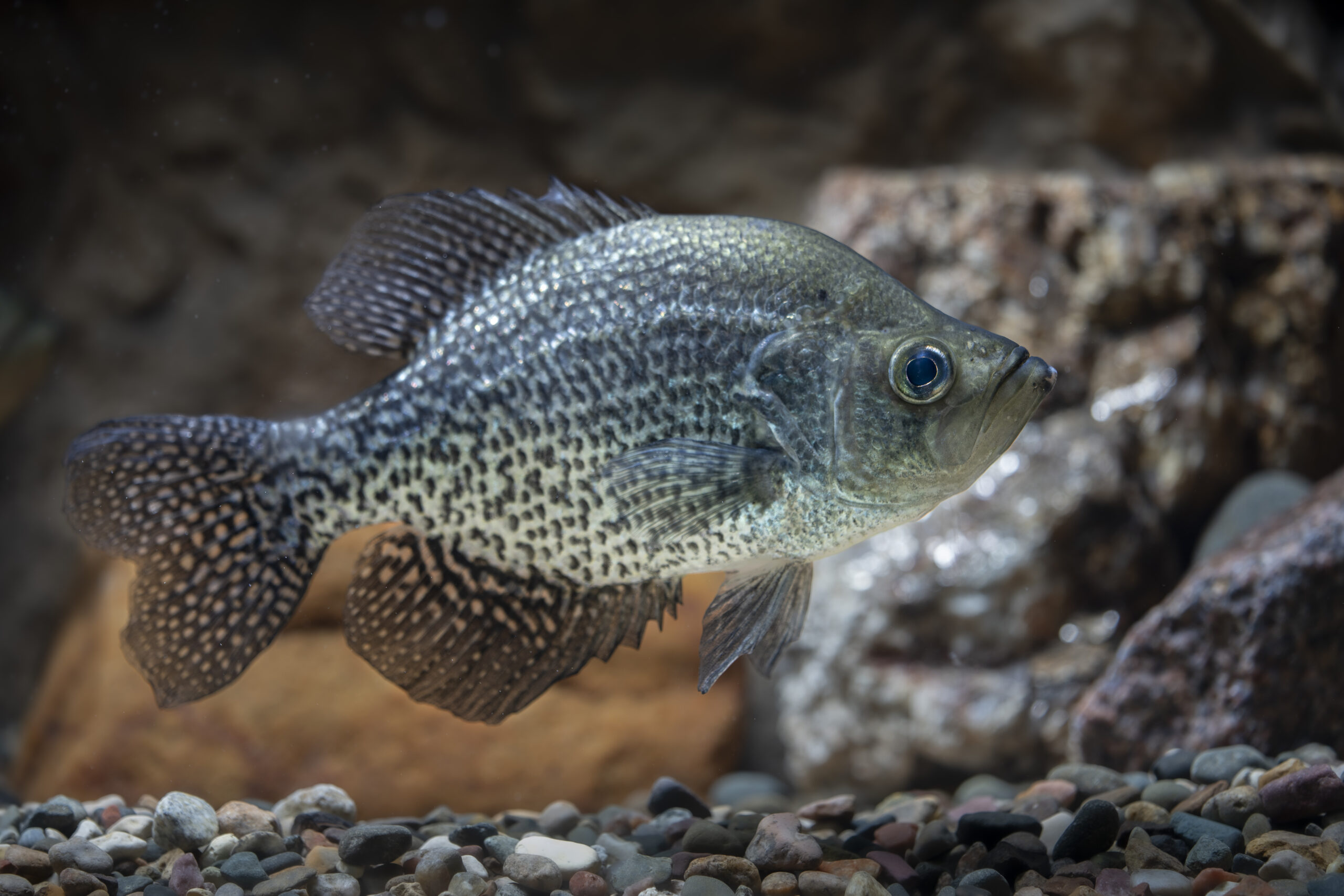
Crappie are one of winter’s most reliable panfish. They school tightly, they feed all winter, and a full bucket of slabs makes for some of the best eating on the ice. They are also finicky, with a light bite and a habit of suspending at one precise depth. This guide shows how to find them, what to put in front of them and how to keep the bite going once you locate a school.
Where Crappie Go in Winter
As water cools, crappie move away from shoreline brush and weeds toward deeper structure. Early ice often finds them near the same cover they used in fall, such as brush piles, standing timber, docks and the edges of weed beds. As winter deepens they tend to gather over deeper basins, creek channels and holes near the main body of the lake, often suspended well off the bottom. Use a lake map, or the previous season’s notes, to mark spots where deeper water meets cover.
Finding Suspended Fish
Sonar makes the difference. Drill a hole, drop the transducer or flasher, and look for marks sitting off the bottom, often in the 8 to 25 foot range depending on the lake. When you see marks, note the exact depth, because crappie commonly stay within a foot or two of one level. If there are no marks, move. Drill a line of holes across a basin or along a channel edge and keep traveling until the screen lights up. Crappie schools move, so the bite you had yesterday may be 100 yards away today.
When They Feed
Low light is prime time. The hour around dawn and dusk is often the most productive, and many anglers also catch fish after dark under lights. Midday can be slow, but not always, and cloudy days often fish better than bright ones. Pay attention to changes in weather: a stable stretch of cold weather tends to keep fish feeding, while a sharp pressure drop or a warm spike can slow them down.
Best Baits and Presentations
Small Jigs
Tiny jigs in the 1/64 to 1/16 ounce range are the standard. Tungsten jigs sink fast and are easy to feel in deeper water. Common colors include chartreuse, white, pink and glow patterns; try different colors until fish show a preference.
Plastics and Minnows
Small soft plastics such as tiny tubes and curly tails add movement. Many anglers tip jigs with a waxworm or a small minnow head. A small live minnow on a plain hook, or on a light jig head, under a tiny float or on a dropper rig, is a classic. Check your state’s rules on live bait use before you go.
Spoons and Blade Baits
Small jigging spoons draw fish from further away, especially when schools are scattered. Use them to call fish in, then switch down to a light jig if they hesitate.
Rods, Reels and Line
A light or ultralight rod of 24 to 32 inches, with a sensitive tip, helps you see subtle bites. Pair it with a small spinning reel or spring-bobber and 2 to 4 pound line, either monofilament or fluorocarbon. Many anglers use a spring bobber, a thin wire that sits on the end of the rod and shows tiny taps. Keep the line fresh, because ice and cold water make old line brittle.
How to Fish the Jig
- Drop the jig to the bottom, then reel up a few turns to the depth of the marks on your sonar.
- Lift the rod slowly and let the jig fall back, in a very gentle motion.
- Hold the jig still. Crappie often hit while it is stationary, and the bite can be as subtle as the rod tip dipping or the spring bobber rising.
- Set the hook with a soft lift, not a hard snap. Crappie have thin mouths, and they tear off easily.
- Keep your fish below the ice as you play it, to avoid cuts.
Staying Mobile
A common approach is to drill several holes in a pattern, then rotate between them with a sonar. If you catch a few fish and the bite stops, move on. A portable shelter or a simple sled makes this easy. Cover water early in the day, and slow down when you find fish.
Safety and Regulations
Always confirm that the ice is safe before you travel, as detailed in our ice thickness and safety guide. Check your state’s regulations, including limits and size requirements for crappie, before keeping any fish.
More Reading
For open-water tactics, read How to Catch Crappie, and for the basics of gear and technique, see the Complete Ice Fishing Guide. Perch anglers will also find useful overlap in our ice perch guide.
Dennis Suler is a career outdoors writer and lifelong angler. He spent six years on the editorial staff of The Fisherman magazine as a field editor and managing editor — first editing the New Jersey reports section, then managing editor of the Mid-Atlantic edition. He also served as managing editor of Boater’s Digest magazine. He’s a member of the Outdoor Writers Association of America and writes for fishing.digital — covering 40+ U.S. fishing destinations with weekly reports, location guides, and feature articles.
Planning a trip to Freshwater Fishing?
This report tells you what happened. ReelAI tells you what to do about it — a briefing for your date, your target species and how you're fishing, built from our reports plus live NOAA and USGS data.
Powered by ReelAI — fishing.digital's intelligence layer. Answers are generated from fishing.digital reports and public NOAA, NWS and USGS data, and may be incomplete or out of date. Regulations and marine safety information are summaries only; always confirm with the responsible authority before you fish.