
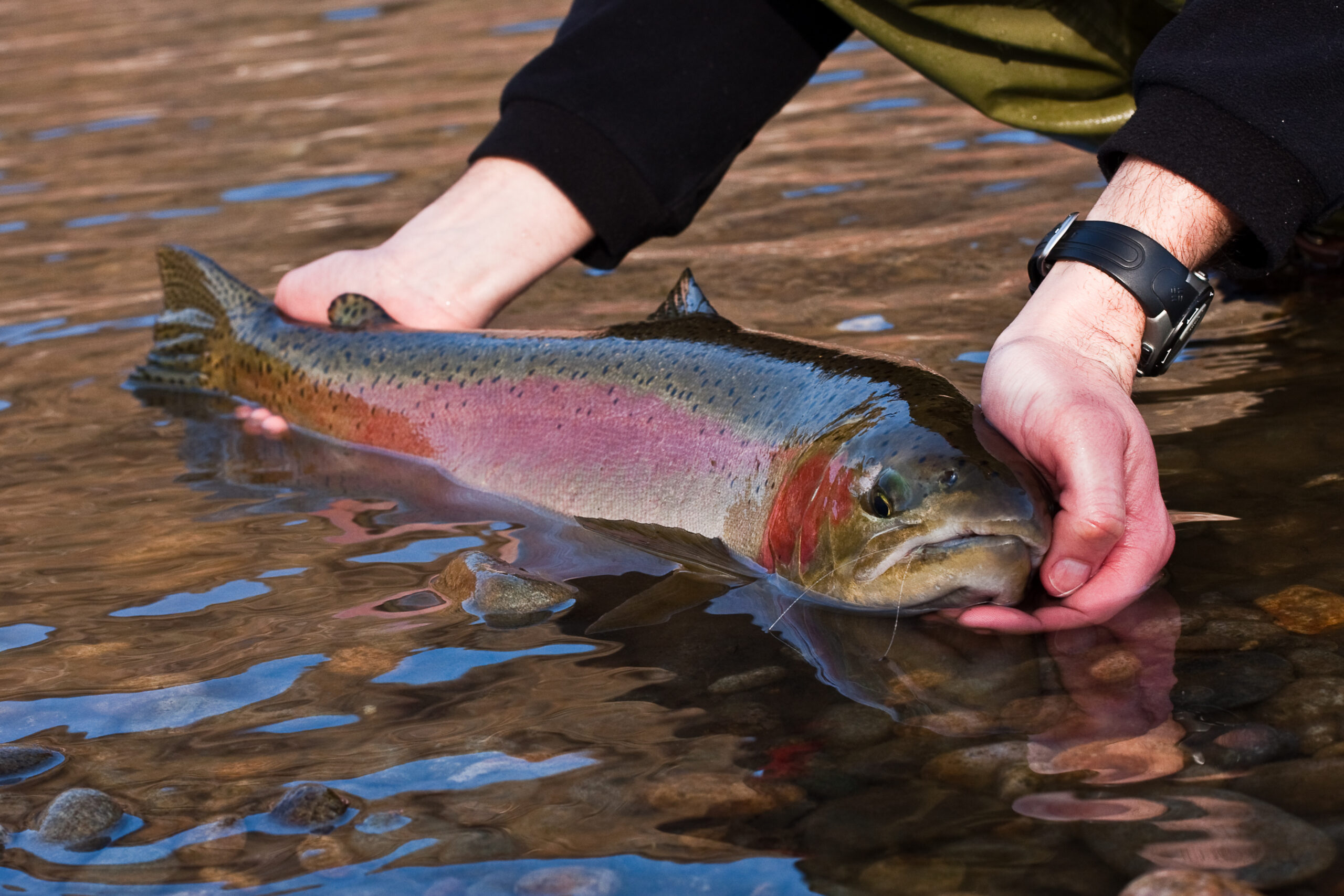
Steelhead — sea-run rainbow trout — are the most sought-after and challenging river fish in North America. They combine the acrobatic fury of a rainbow trout with a body conditioned by months in saltwater, resulting in a fish that routinely jumps 4–6 feet in the air and runs 100 yards of backing in seconds. A single steelhead encounter justifies dozens of cold, fishless hours on the river. This is fishing at its most demanding and most rewarding.
Affiliate disclosure: fishing.digital earns a small commission on qualifying Amazon purchases — at no extra cost to you.
Winter vs. Summer Steelhead
Steelhead return to rivers in two distinct runs that demand different tactics and conditions.
| Run | Timing | Characteristics | Best Rivers |
|---|---|---|---|
| Winter run | November–April | Enter river in peak condition; hold in slow, deep pools | Deschutes, North Umpqua, Sandy (OR); Skagit, Hoh (WA); Most Great Lakes |
| Summer run | May–October | Enter river months before spawning; more aggressive, hold in faster water | Deschutes, Grand Ronde, Clearwater (ID); Dean (BC) |
Where Steelhead Are Found
Pacific Northwest: The Deschutes River (Oregon) is America’s most celebrated summer steelhead river. The Skagit and Sauk Rivers (Washington) hold wild winter steelhead of legendary size. The Clearwater River (Idaho) and its tributaries produce summer runs that draw anglers from around the world.
Great Lakes: All five Great Lakes tributaries receive steelhead runs. The Muskegon, Pere Marquette, and Betsie Rivers in Michigan are consistently ranked among the best. Salmon River in New York, Cattaraugus Creek, and the tributaries of Lake Erie in Ohio and Pennsylvania all produce excellent fall and spring steelhead fishing.
Best Techniques for Steelhead
Drift Fishing with Float and Jig
The most accessible and productive steelhead technique. Rig a 1/4–3/8 oz jig (marabou jigs in pink, white, or chartreuse) below a pencil float set at the depth of the run (typically 6–12 feet). Cast upstream, mend the line to achieve a drag-free drift, and watch the float for any hesitation or sideways movement — set the hook immediately. Drifting cured roe under a float produces equally well in higher, off-color water conditions.
Swinging Flies on a Spey Rod
The classic steelhead technique. A 13–15 foot two-handed Spey rod with a Skagit or Scandi head and appropriate tip (T-11 to T-17 for winter; floating to T-8 for summer) delivers large wet flies across and downstream on a tight swing. As the fly swings through the bucket — the transition from fast current to slow — the strike comes as a hard pull. Intruders, Hoh Bo Spey, Purple Peril, and large Marabou patterns are proven winter patterns; smaller soft-hackles and wets work better in summer on lower, clearer water.
Nymphing (Euro/Indicator)
In clear-water, technical rivers, Euro nymphing with egg patterns (size 8–12), stonefly nymphs, and beadhead worms on light tippet produces steelhead that won’t respond to swung flies. This technique dominates on Great Lakes tributaries in fall and spring when fish are heavily pressured.
Best Tackle for Steelhead
- Drift/float rod: 9–10 ft medium-heavy spinning, 10–17 lb monofilament or light braid, 10–12 lb fluorocarbon leader
- Spey rod: 12.5–14 ft two-handed, 500–600 grain Skagit head, T-14 tip for winter
- Single-hand fly: 7–8 weight, sink-tip line for larger rivers
Browse steelhead rods on Amazon →
Top Steelhead Rivers in the US
The Deschutes River below Maupin, Oregon is the quintessential summer steelhead destination — it’s accessible, beautiful, and holds strong runs of wild B-run fish. The Skagit River system in Washington hosts some of the last healthy wild winter steelhead populations in the lower 48. The Muskegon River in Michigan is the premier Great Lakes steelhead fishery, with runs beginning in October and fish available through April.
Planning a trip to Saltwater Fishing?
This report tells you what happened. ReelAI tells you what to do about it — a briefing for your date, your target species and how you're fishing, built from our reports plus live NOAA and USGS data.
Powered by ReelAI — fishing.digital's intelligence layer. Answers are generated from fishing.digital reports and public NOAA, NWS and USGS data, and may be incomplete or out of date. Regulations and marine safety information are summaries only; always confirm with the responsible authority before you fish.